Friday, March 11, 2011

Baseball Starts to Bloom

Major League Baseball has crawled out of its winter hibernation and its participants have begun stretching, yawning and wiping the crust out their eyes. Spring Training baseball has begun in Florida and Arizona, new players are meeting their teammates and donning new threads, pitchers are loosening up their arms and getting injured already, hitters are getting back in the swing of things and, of course, the always anticipated annual rite of spring has begun: the publishing of new baseball books.

I picked up the annual Baseball Prospectus book a couple weeks ago and I'll have plenty to say about it soon. Also, a writer who began with the BP conglomerate, Jonah Keri, has released his first book on his own and its getting great reviews already. The book is titled The Extra 2%: How Wall Street Strategies Took a Major League Baseball Team from Worst to First detailing the extraordinary turnaround of the Tampa Bay Rays from pathetic embarrassment to pennant-winning AL East powerhouse regularly competing with the league's most powerful and resource-rich organizations. I've only read the opening pages thus far but the writing is great; Keri has a reputation for being a wonderful writer, and the book is a bit like the Moneyball story which means I'll probably become a Rays fan after reading it. Admittedly, for me the prominence of Wall Street tactics and ex-Goldman Sachs honchos within the story is a bit discomforting because of my violent feelings toward that sector of society these days but it is a baseball story above all and Keri has denied that the Rays people had any past involvement in the shady tactics that murdered the economy. Besides that, Jonah is a cool guy, I've had lunch with him once before.

About 5 or 6 years ago when I was getting college credit as an intern with Baseball Prospectus (thanks to my pal Jay Jaffe), my brother John and I attended a book-signing and discussion upon the release of the big annual book and we got to go out for lunch with the crew of writers afterward. It was a highly interesting, baseball-chatter filled afternoon, and it just so happened that John and I sat at the end of the table next to both Jonah Keri and Nate Silver. Jonah was an extremely nice, humble guy; a Canadian with a deep and sometimes humorous affection for the Expos (which John and I could sympathize with since we'd recently drove to Montreal for a weekend to take in a couple games), he was also highly knowledgeable about college basketball and that often snuck into the discussion since it was March. We also talked about the new hardcover book BP had recently written, Baseball Between the Numbers, which Jonah edited.

Nate was also a very cool dude. The whiz kid who had developed BP's statistical projection system PECOTA, he is probably the smartest individual I've ever met. He would later go on to leave BP for a pretty famous career as a statistician analyzing political polls. (He accurately predicted the results for 49 of the 50 states in the last presidential election and was even named one of Time Magazine's 100 Most Influential People in 2009---with Bill James himself writing the article.) I remember Nate having the physical quirks and awkwardness of a genius; he would sit in a strange twist with his legs crossed and arms leaning forward. For such a gifted mind, he was a humble and soft-spoken individual. A few years later, big bro John and I went to another signing and Nate, who I hadn't spoken to since that lunch, remembered me. In retrospect, it should come as no surprise because his digital computerbrain probably remembered what hat I wore that day (Padres, actually) and what I had for lunch.

You can read more about Jonah's new book here and here, and if you're interested in what Nate Silver's up to these days he's got a blog on the New York Times site. Mostly about politics, sadly. He doesn't touch on baseball too much anymore though he does write about basketball (college and pro) every now and then.

Thursday, March 10, 2011

Thirst for Knowledge Thursdays: Wu Tablets

With the release of Raekwon's brand new album Shaolin vs. Wu-Tang this past Tuesday and the Wu essence glowing brightly in the public eye once again (nearly twenty years after their debut), now would be a good time to become familiar with the history of the Wu-Tang Clan and its deep mythological elements.

The man who started it all and produced their first dozen or so albums, The Rza (known as The Abbott of the Wu-Tang Clan), published The Wu-Tang Manual in 2005. The book has the look and feel of a mystical manual and contains a full introduction to the mythological universe of the Wu with chapters on the genesis of the nine-member group, their infatuation with chess, kung-fu movies, spirituality, organized crime, comic books, and much more. One of my favorite parts is a section of the book in which Rza explains the lyrics to some of their greatest songs.

For me, this book was one of the first bricks in the foundation of knowledge I've been building for years now. It introduced me and encouraged me to study the major wisdom books in the world like the Tao Te Ching, Bhagavad Gita but also The Bible and Holy Qur'an. From the beginning I wanted to emulate The Rza whose breadth of knowledge spans both the spiritual and scientific realms (he often talks about physics in his work) and that really led to the voracious reading/study habit I've had that has led me to the works of people like Joseph Campbell and James Joyce. I didn't learn any of this stuff in school, not even in college, but my mind is consumed by it and I've reached the point where I will not be happy in a career that doesn't involve intellectual expansion and expression. I am not exaggerating when I say that this book was the springboard that flung me into this new universe.

Rza released a second book, The Tao of Wu, last year and I even drove three hours from San Diego to Los Angeles for a book-singing but I've yet to get deeply into that book with all the Joyce studies I've become immersed in this past year and a half. Once I do get to feast on it, I will definitely share my thoughts here.

*   *   *

Rae's album was not the only piece of pure hip hop music to be released on Tuesday. The new EP from Kevlaar 7 entitled Who Got the Camera? became available on CD and, as much as I'm enjoying the Raekwon album, this is really my favorite record of the year thus far and truly one of the most powerful albums I've heard in a long time. If you'd like to see what I'm talking about, check out this analysis I wrote for one of the tracks entitled "I Have a Dream" which parallels and re-examines the world through Martin Luther King's famous speech.

Also, in the same vein, I have to mention a brand new EP from another underground emcee from New York City by the name of Zagnif Nori (who appears on the opening track for Who Got the Camera?). His new EP is a dense mixture of hard drums and smokey samples with sharp, thought-provoking lyrics. It is entitled "Insignia" and it is available to download for free at this link.

Tuesday, March 8, 2011

Potent Quotables: Dali Dinner Reflections

In the late 1920s, a young Salvador Dali left Spain with his lady Gala and moved to Paris to enter into the famous art scene there. At this point, Dali was unrefined, shy, and thrust into an unfamiliar bourgeois atmosphere. His reflections on this period contain funny anecdotes (written in a perfectly weird style) like this one.  
"One evening I was having dinner at the Vicomte de Noailles'. Their house intimidated me, and I was extremely flattered to see my painting The Lugubrious Game hung between a Cranach and a Watteau. At this dinner there were artists and society people, and I immediately realized that I was the chief object of attraction. I believe that the Noialles were deeply touched by my timidity. Each time the wine-butler came and whispered the name and year of the wine into my ear with an air of great secretiveness, I thought it was something very serious that he had come discreetly to tell me---Gala run over by a taxi, or a furious surrealist who was coming to beat me up---and I would turn livid, leap up and prepare to leave the table. Then, in a louder voice so as to reassure me, and looking with the utmost dignified intentness at the bottle lying prone in the little basket, the butler would repeat "Romanée 1923." At one gulp I would drink down this wine that had just so terrified me and thanks to which I recovered my hope of overcoming my timidity and of being able to talk.

I have always admired---and I did so particularly at this time---the person who, without having anything really sensational or important to say, manages throughout a whole dinner of twenty people to steer the conversation in whatever direction he chooses, to make himself heard in the midst of a general silence at the right moments without having to stop eating---in fact, eating more than the next fellow---and still has time for an occasional slyly calculated pause during which he gracefully and self-confidently stops the flow of conversation just long enough to brush aside the danger of anyone's taking advantage of his absorption to kindle fresh hearths of conversation, or---in the extreme case in which this should occur---is able to extinguish them at the desired moment without seeming to make the slightest effort, and at the same time give the recalcitrant ones the impression, when he interrupts their incipient conversation against their will, that it is they who are interrupting by asking him in a voice that verges on the impolite to repeat his last remarks so that they can follow the course of his argument in which they have not the slightest interest."

from The Secret Life of Salvador Dali pg. 258

Monday, March 7, 2011

Holding a Golden Mac

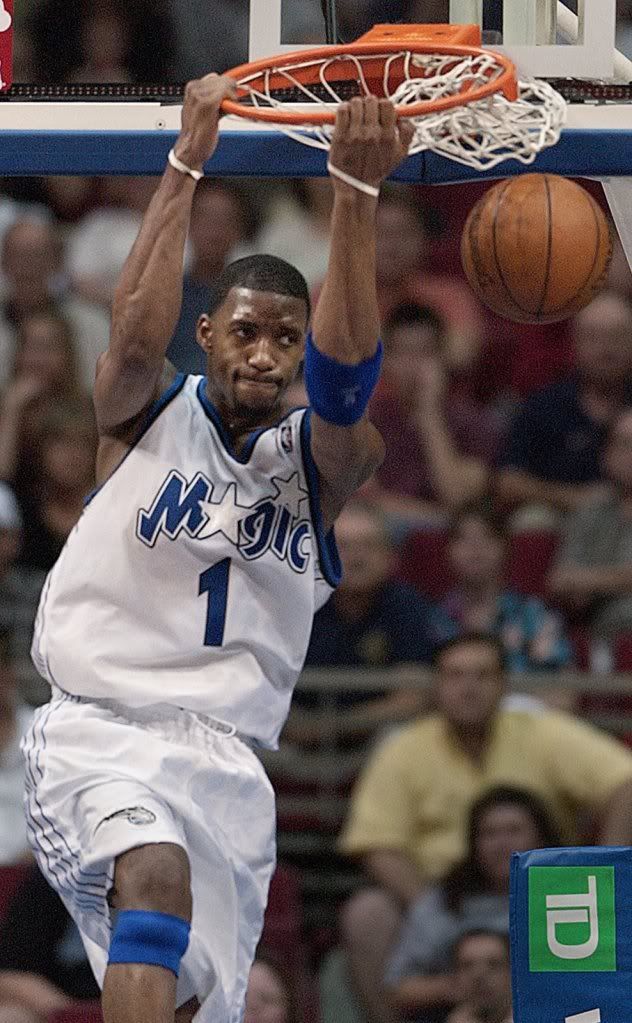
It's getting late. I'm tired and my eyes feel like they're half shut. What better time to write a little post about one of my favorite basketball players ever, one who is known in some circles as The Big Sleep: Tracy McGrady.

At the annual Sloan Sports Analytics Conference this weekend, McGrady was held up as an example of wasted talent; greatness squandered through laziness. His former coach, Jeff Van Gundy, cracked some jokes about poor practice habits and a whole auditorium laughed and listened to a few gentleman on a stage talk about how great T-Mac should have been, if only he gave a shit. If only he worked harder or practiced more.

Back in 2000, I read a Sports Illustrated piece about McGrady and his new role as Grant Hill's sidekick on the remade Orlando Magic. Interested in checking out what this McGrady guy had to offer, I started checking for any games on television featuring the Magic and watching him closely. It was right around this time that my NBA fanhood was reborn after a brief hiatus. McGrady was a spectacle to watch, a visual feast for basketball fans. A long, lanky athlete, he frequently looked like a pro who'd stepped onto a street ball court to have some fun. With his size and athleticism, he was basically the perfect basketball player. His jumpshot was a thing of beauty, a sudden rise and quick release that always seemed to create a perfect crisp snap of the net; he was one of the league's most exciting finishers at the rim; he possessed amazing court vision and passing skills that somehow forced his crappy teammates to make baskets (the superstar Hill was always in street clothes with severe ankle problems); his long-limbed, blanketing defense brought comparisons to Scottie Pippen---and he was only 21 years old.

With his droopy eyes and smooth lanky motions, the guy often looked like he was doing it all in his sleep. Writers and TV commentators often mentioned the humorous fact that one of his listed hobbies was sleeping. It didn't take long for the 6-foot-8 McGrady to acquire the nickname The Big Sleep.

During that time the Magic's games became must-see TV for me. I started tape-recording (with VHS tapes...on a VCR) their games any time they were on national TV or going up against the Knicks or Nets on a local channel. My favorite team, the Knicks, was clearly his favorite team to play against and he would frequently bring new moves to the table against them, embarrassing my team in such a way that I didn't care that they were getting their asses whooped. It was fun to watch! Even his headfakes were cool. Instead of just lifting up his chin for an apparent jumpshot, he lifted the ball high above his head like a yo-yo and then zoomed past the befuddled defender for a dunk or lay-up. On defense, he would frustrate and embarrass my favorite Knick, Allan Houston, with his long arms providing the perfect stopgap to Houston's only real weapon, a standstill jumper.

Over the next few years T-Mac became a superstar, his arrival punctuated by a self-pass-off-the-backboard dunk in the All Star Game. With Grant Hill sitting out on a bad ankle, McGrady established himself as a one-man show, carrying the Magic to three straight playoff appearances. His team fell short in the first round each time although McGrady averaged over 30 points in every series. A prolific scorer, passer, and defender---he still couldn't win by himself.


In 2004, the Houston Rockets acquired McGrady to team up with Yao Ming for a perfect match against the West Coast powerhouses but Yao soon succumbed to a series of injuries and left T-Mac to carry the team once again. There were many great moments with the Rockets, especially the epic 13-points-in-35-seconds to defeat the Spurs, one of those events which I'll always remember where I was when I saw it (standing enraptured right in front of my bedroom TV with my arms folded). But, once again, McGrady failed to lead his team past the first round of the playoffs and was harshly criticized for it.

Before turning 30, he was hit with a number of injuries that helped to erode his skills and over the last few seasons he's languished as an oft-injured part-timer for a couple of crappy teams (Knicks and Pistons). Because of an apparently poor work ethic, his career narrative is becoming imbued with a sense of failure and missed opportunity. Van Gundy and the Analytics Conference folks weren't the first to point it out. (Heck, I even mentioned it in my very first post on this blog.)

In opposition to this somber view, a few NBA bloggers have stepped up recently to defend the T-Mac legacy, reminding us of the heights he reached when he was healthy and the Hall of Fame career he had despite our best efforts to label him a failure. I particularly liked this piece from Dan Devine (a fellow Staten Island native, I've just realized) over at the Yahoo blog Ball Don't Lie and Zach Lowe of Sports Illustrated assertively set the record straight as well. Via Outside the NBA's Twitter page, here is another great post in defense of McGrady's excellence entitled Have Respect: He Was Legend which, among other things, calls to our attention that we once had to debate who was better: T-Mac or Kobe. Because of his defense and point guard-like passing skills, I still say T-Mac was better at that point in time but, of course, Kobe has gone on to win two more rings since then and continues to lead the Lakers to one of the best records in the West.

While farting around on Basketball-Reference.com a bit, I came across an interesting comparison between McGrady and Hall of Fame forward Billy Cunningham, a highly regarded player from the 60s and 70s. His career was also derailed by injuries yet Bill Simmons listed him as the 49th greatest player of all time (with McGrady at #77). The all-encompassing Win Shares statistic is by no means perfect but one of its best uses is for comparing players across different eras. Looking at their careers: McGrady had four seasons that were better than Cunningham's best year. T-Mac was also a more accurate shooter, better passer, and better defender. Cunningham was done as a player by the time he was 33 and, as he's currently playing out the string for shitty teams at age 31, we might soon see the last of The Big Sleep.

Let us hope the hoops community can open their eyes to his greatness instead of whining over our own shattered dreams for him.

Thursday, March 3, 2011

Catching up with the NBA fireworks

The NBA has certainly had a lively last few weeks. This new billboard by FreeDarko's Jacob Weinstein seems to embody it all pretty well.

The Dunk Contest and All-Star Game were as good as they've been in years. Blake Griffin (the dude on the billboard) put the ultimate exclamation point on everything with a jaw-dropping dunk, jumping over a car with a choir singing "I Believe I Can Fly." Outlandish? Yup. And one of the Dunk Contest's best participants, the gifted Toronto Raptor with the euphonious appellation of DeMar DeRozan, has made a stink about all the extra bells and cannons. He says he's done competing in the Dunk Contest if they continue to bring in so many props and gimmicks (JaVale McGee brought in a second hoop and dunked on both at the same time---cool, yes, but it's a dunk contest not a circus).

It's a shame because DeRozan is one of the more naturally gifted high-flyers in the league as evidenced by this (organic) dunk he did that night. Witness the grace and sheer athleticism in this video. (And I love the look on Darryl Dawkins' face as he watches proudly.)


I missed the entirety of the All-Star Game itself (still didn't have internet or TV hooked up) and have had to settle for highlights but it seems to have had a great ending, with Kobe Bryant kicking ass and taking home the MVP in his home arena.

Not long after all those fireworks, the NBA trade winds came blowing through town like a tornado, picking up pieces and tossing them to and fro. There were about a bajillion trades and you can read a nice analysis of all the deadline deals here and here.

The biggest trades involved my own hometown favorite New York Knicks and New Jersey Nets. After six months of public haggling, the Denver Nuggets and the Knicks agreed on a deal that sent forward Carmelo Anthony, point guard Chauncey Billups (a favorite player of mine), and a few other small pieces to the Knicks in exchange for about 60% of the Knicks' roster as well as a bunch of other assets. The Knicks absolutely gave up a shitload to get Anthony, a great player but one who is definitely a notch below the game's biggest stars because he's a bit one-dimensional.

The former baseball stats genius and now famous election poll analyst Nate Silver actually chimed in on the value that Anthony provides to a team. First, he had an interesting piece about how Carmelo tends to make his teammates better by being such a good shooter (an article that Basketball Prospectus' Kevin Pelton responded to with a numbers-heavy piece of his own) then he wrote a huge article analyzing the State of the Knicks after giving up so much to get just a couple of players. The verdict: the immediate future for the Knicks is good. Not great because they'll have a top-heavy stars-and-scrubs lineup for a while, but good. For all the hoopla, I'm not sure that's a big success. But Pyrrhus would be proud.

I've tried to watch all the Knicks games since the trade and I can say that I'm definitely glad Chauncey Billups was in the deal. I love watching that guy play. Other than that, they look good...not great.

Across the river in New Jersey, the Nets made a pretty daring trade, one-upping their rivals by acquiring a better player in point guard Deron Williams from the Utah Jazz (whose fans are ready to bum rush the front office now). Williams is an all-around superstar and arguably the best point guard in the NBA. The problem for the Nets is that his contract is about to expire and they've got no guarantee that he'll stay with them. If he does, the Nets have themselves a great piece to build around. If not, they're shit outta luck.

Thirst for Knowledge Thursdays: Hope and Cheaters

"Thirst for Knowledge Thursdays" is a new weekly digest in which I will select a book (or two) off my shelf, say a few things about it, and suggest that you read it. Boom.

The first book I've selected is an important one for properly comprehending the current global climate and cutting through the bullshit our news media spreads. Killing Hope: U.S. Military and C.I.A. Interventions Since World War II is both a highly readable history book and an important guide to understanding the way our insidious intelligence agencies work. The book is written by William Blum, a former government operative who left the State Department in the late 60s because he was disillusioned by the Vietnam War.

In the book, he thoroughly outlines and tells the story of over 50 different invasions, staged coups, tortures, drug trafficking, disinformation, assassinations, mass murders, and other heinous acts orchestrated or directly perpetrated by the U.S. military and C.I.A. The facts are all backed up by over 50 pages of footnotes. What's most shocking, especially when you read the stuff from the last 30 years or so, is how often the intelligence agencies openly admit to carrying out campaigns of misinformation, planting and spreading fake stories all throughout the American news to sway people's opinions in one way or another. For instance, in the chapter on Ronald Reagan's battles with Libya in the 80s, Blum notes that Newsweek uncovered and exposed (thoroughly) the C.I.A.'s plan to remove Muamar Qaddafi in an August 1981 issue.
The plan called for a "disinformation" program designed to embarrass Qaddafi and his government ; the creation of a "counter government" to challenge his claim to national leadership; and an escalating paramilitary campaign of small-scale guerilla operations.
Immediately afterward, the U.S. began flying fighter jets over Libyan airspace to provoke retaliation. They shot down two Libyan planes and then the Reagan crew sparked a whole bullshit terrorist story using the idea that "they [the Libyans] fired first!" There were reports of Libyan plans to assassinate Reagan, Libyan terrorist cells in the United States, and all the same exact stuff we've been fed about Iraq/Osama bin Laden/Al Qaeda for years now. Reagan flexed his muscles and his Hollywood pipes and suddenly the whole country was rallied behind kicking Qaddafi's ass. Somehow, he survived, but I'll let you read the book for the rest of the story.

Of course, the situation in Libya has now recently descended into chaos. But, I advise you to read between the lines. You can read more about Mr. Blum and his excellent book here at his site which also includes a bunch of free chapters to preview.

*   *   *

On a lighter note, I finally picked up a baseball book which I've been meaning to read for a while. The Cheater's Guide to Baseball is written by Derek Zumsteg, formerly of the great crew at Baseball Prospectus, and a highly entertaining writer. The book covers baseball's rich history of cheaters, cheating methods, and other hi-jinks including sign-stealing, corked bats, spit balls, gambling, and even a chapter on heckling and fan participation.

I've only just recently acquired the book and read just a couple of chapters but it looks great (photos, diagrams, drawings) and Zumsteg's writing has always been excellent. It's on my list of books to read as baseball starts coming out of its winter slumber and I recommend it to anybody else who's in the process of preparing for the upcoming season.

Monday, February 28, 2011

Waking up to the genius of Marshall McLuhan

"that patternmind, that paradigmatic ear, receptoretentive as his of Dionysius"
- Finnegans Wake p. 70

I don't think I had ever heard the name Marshall McLuhan before last year. It was in January or February. I had heard of a Finnegans Wake group that meets each month up in Venice, California and decided to drive two hours up there one night to check it out. It was an extraordinarily enlightening evening, hearing the Wake read aloud and a whole array of minds discussing the various meanings and interpretations of James Joyce's abundantly rich masterpiece, but I was also introduced to the genius of Marshall McLuhan. Turns out, the group is actually a Finnegans Wake-slash-Marshall McLuhan reading group and we spent the first half hour discussing current events from the standpoint of McLuhan's Tetrad of Media Effects.

I went to another one of their meetings, coincidentally, almost exactly a year later but I showed up late and missed the McLuhan part. It's been only recently that I've taken the time to familiarize myself with the life and work of this 20th century megamind named McLuhan (pronounced "Mick-Loo-In"). It's because he's actually been in the news a lot lately with a great new book about him by Douglas Coupland.

McLuhan was a Canadian-born, Cambridge-educated scholar who could best be described as a media mystic or media metaphysician. A popular intellectual figure in the 1960s, he wrote a number of paradigmatic books on the rapid advancement of media technology---essentially, he philosophized (in an entertaining manner) on the way we perceive the world. It's amazing to read some of his theories and writings and realize that he explicitly predicted and discussed things like the explosion of the internet 40-50 years before it happened.

Here's an example, from the opening of Coupland's new book entitled Marshall McLuhan: You Know Nothing of My Work!
The next medium, whatever it is---it may be the extension of consciousness---will include television as its content, not as its environment, and will transform television into an art form. A computer as research and communication instrument could enhance retrieval, obsolesce mass library organization, retrieve the individual's encylopedic function and flip it into a private line to speedily tailored data of a saleable kind. - M.M. 1962
An extremely erudite, educated man, he was a devout Joycean and constantly praised Finnegans Wake, holding it up as a reference manual for the future. The conductor of the McLuhan/Wake book club in Venice, Gerry Fialka, gives a workshop called Dream Awake that analyzes the Wake and Joyce's genius through these McLuhan goggles. I haven't had a chance to hear it yet but I know he will be delivering it at the June Joyce conference in Los Angeles and the highly fascinating program notes can be read here. Here's an example of McLuhan's praise for Joyce's work, a quote taken from those program notes:
The world of discontinuity came in most vividly with the telegraph and the newspaper. The stories in the newspaper are completely discontinuous because they are simultaneous. They're all under one dateline, but there's no story line to connect them. TV is like that. It's an X-ray, mosaic screen with the light charging through the screen at the viewer. Joyce called it, "the charge of the light barricade." In fact, FW is the greatest guide to the media ever devised on this planet, and is a tremendous study of the action of all media upon the human psyche and sensorium. It's difficult to read, but it's worth it. -MM.
You should also check out this EXTREMELY informative interview which explains McLuhan's interpretation of the ten thunderclaps (each a one-hundred-letter word) heard throughout Finnegans Wake.

Also, friend of A Building Roam Seana recently pointed to an article on the trio of Joyce, Giordano Bruno (a frequently referenced figure in FW), and McLuhan. I've been avoiding reading the whole thing so I don't get sidetracked from the essay I'm writing right now on a different trio of minds, but here's an excerpt on McLuhan's FW obsession:
The Wake was McLuhan's vade mecum. In later years he kept one copy unbound, with each page pasted onto a sleeve of 3-ring paper. The stack stood in an accessible spot just outside the door of his office. McLuhan was forever plucking fresh pages like a gambler toying with oversized cards. He liked to snap the pages into new configurations, up, down, across, and read the phrases in a kaleidoscopic collage, much as Joyce himself had written them. Bruno, who flits through dozens of the pages, must have become a pleasantly familiar ghost.
The new McLuhan book by Coupland is a great read, the language very straightforward and concise, the content interesting and entertaining. The story of McLuhan's upbringing and education is a very unique one and Coupland presents it all knowledgeably and with a wit and quirk reminiscent of McLuhan himself. The book has gotten great press lately including an interview with Coupland in the prestigious Paris Review and a New York Times Book Review cover story.

Finally, here is a great YouTube clip I found of an interview with McLuhan. He was an expert (though enigmatic) debater and talker as you'll see.


Interviewer asks: Have you ever taken LSD?

McLuhan: No. I've thought about it. And I've talked with many people who have taken it. And I have read Finnegans Wake aloud at a time when takers of LSD said "That is JUST LIKE LSD." So I begun to feel that LSD may just be the lazy man's form of Finnegans Wake.
Incidentally, this reminded me of a quote from Seana (host of a Santa Cruz club devoted to the Wake) at the end of a post where she discussed her own recent McLuhan research:
I had this strange hope by the end of the evening that by the time I finish Finnegans Wake, I will lose the illusion that I am in a small room and discover I am in a much larger, perhaps even a  boundless one.

Wednesday, February 23, 2011

Potent Postables

Geopoliticus Child Watching the Birth of the New Man by Salvador Dali

At last, I am reconnected to the internet. Not counting a couple nights in a La Quinta Inn, I haven't had regular internet access since the end of January.

It's certainly been a productive interval, though. We drove for four days through California, Arizona, New Mexico and the dreadfully huge and empty wilderness of Texas; scoped out and settled into an apartment; did our best to make it a cool and comfortable place to live; and I've finished the first part of my three-part essay on Joyce & Dali which I'm submitting for the North American James Joyce Conference.

Now that I've got my connection to the interwebs back, I've got plenty to post about on here. Here are a few of the things you can expect to see.

- I've had this half-finished post sitting in the pipeline for a while but I'm determined to finish it up in the next week or two: "16 Reasons Why James Joyce is the Greatest Writer Ever."

- Along those same lines...one of the great things so far about Austin is a chain store called Half Price Books. Their selection is ENORMOUS and, unlike the big corporate bookstore chains, they aren't promoting the usual bullshit, heavily-marketed, high-budget junk. Instead they've got aisles and aisles of whatever you want. It's like a huge, well-stocked library where the books cost 5 bucks or less. Anyway, the store near downtown Austin had a shockingly rich Joyce collection. Naturally, I picked up a bunch of books (for an average price of about 4 bucks each). But they've also got a special secluded section in the store for rare books. In there I found a gem that was so freakin' cool I had to acquire it for my treasure chest even though it was a bit expensive.

It's an elongated, beautifully designed artsy collection of Joyce's poetic writings (including all of his poems as well as his epiphanies and some of the most poetic selections from all of his books). What makes it so special, to me at least, is that it's a book from 1969 that was printed in Poland with English on one side and Polish translation on the other, put together by a famous Polish translator named Maciej SÅ‚omczyÅ„ski. With exquisite etchings all throughout and thick parchment paper it's certainly pleasing to the eye but reading SÅ‚omczyÅ„ski's introduction is what drew me in. It begins:  
James Joyce was probably one of the greatest poets who ever lived on our globe, so abundant in poets, but he did not trouble himself to create within the limits of this or that literary genre. 
His words on Joyce's masterpiece are also worth sharing:
Almost everybody who had enough strength and patience to make his way, day after day, step by step, through the incredible labyrinth of [Finnegans Wake], realized that he is dealing with an extraordinary book, great but inaccessible.
I remember my first reading and my impression of listening to someone singing beautifully, but in an incomprehensible language, accompanied on some unknown instruments which issued fascinating sounds yet unlike anything I had known before, sounds I was unable to define in any musical scale.
Years later I began to understand: Finnegans Wake, in which Joyce wanted to embrace everything---the whole history of man, all his arts, sciences, misfortunes and expectations---is a book written in the Tower of Babel in mixed languages and in dialects of all epochs and all countries. And, to my mind, it is the purest poetry I could imagine.
 
- When I contemplated who are, at this moment in time, my favorite artists in any genre, those whose work I'm highly passionate (near obsessive) about, I came up with a pretty interesting list and I will be sharing that here very soon.

- Moving on to the hip hop sphere... All throughout the road trip from Cali to Texas and our subsequent drives around to explore this new city, and while we unpacked our stacks of boxes in the new place, I had the same album playing over and over again on the speakers and it's only continued to sound better and better. The album is a brand new release from Kevlaar 7 of the Wisemen (his first official solo album, actually), an EP entitled Who Got the Camera? that deals entirely with themes of revolution and social upheaval, exactly what we need in this country right now but also, synchronistically, exactly what is going on throughout the world right now (the album was released on February 1st and the Cairo street protests started escalating right about the same time). It's a highly emotional, musically superb, big-palmed slap to the plastic face of our criminally oppressive (at home and abroad) empire. When I was first listening to it, hearing one of my favorite current hip hop artists speak so clearly, openly, informatively (and angrily) about this current situation just perfectly embodied, to my mind, Ezra Pound's famous words on the social importance of the artist: "The artist is the antenna of the race, the barometer and voltmeter." Not the journalist, the TV news anchor, or the politicians. The artist is the antennna tuned into the current frequency of the world and he (or she) interprets it through art, in this case: music. What's in the air? "Pungent smells of classism and oppression" or as Kevlaar later announces: "Storms of persecution should spark swarms of revolutions."

I've been so struck by this album and the weighty message it carries that I have created a new blog which will be entirely devoted to analyzing, expanding upon, and discussing the content of it as well as educating folks on some of the many historical figures mentioned and keeping up with the happenings of the world and the crumblings of the New Roman Empire.


The first song I will analyze is called "I Have a Dream," the first single (released on MLK Day) off the album, its immensely strong beat provided by an expert underground loop-crafter named Woodenchainz (whom I've spoken about here before). Lyrically, it is a modern day retelling of Dr. Martin Luther King, Jr.'s "I Have a Dream" speech, an update so to speak.

Spectrums of creative suffering,
the mainstream is bubblin'
showing zero substance, I've had enough and passion's doublin'

   Stumblin' in the valley of anguish,
                                            hungry for dreams,
                                                           in fact: WE FAMISHED
                      deep-rooted, examinin' antics

I have a dream today that the devil vanished
                              Replant this in our handbooks, TEACH OUR CHILDREN THE ANSWERS

- I'm thinking of starting a couple of regular weekly posts on here. The first will be "Thirst for Knowledge Thursdays" in which I will randomly select a book from my Jacob's Ladder Bookcase and discuss it, explain why it should be read, and how I came across it. Another is "Potent Quotables" and that'll just be a cooler name for something I've already been doing a little bit of: posting cool quotes. (The title for this post is from an oft-used Jeopardy category that always stayed in my head from watching SNL's Jeopardy parodies. "Potent Potables" actually means strong, alcoholic drinks.)

- The chronicles of my journey across the southwestern quadrant of the US will definitely have to be put together and I will share it here on the blog, although, since it will inevitably take up many many paragraphs, I'll stick it behind some kind of "Read the rest of this entry" wall instead of clogging up the page with it.

- I'd like to write a couple of posts about my time in San Diego because it was an extremely cool place and time. I met a lot of great people, in fact, you can definitely expect a post about "The Coolest Person I've Ever Met" all about a good pal of mine in San Diego.

- Also, coming along down the line.... MLB 2011 season preview, Carmelo/Knicks and other NBA gushings, some sports book reviews and all kinds of other things. Stay tuned.

Saturday, February 19, 2011

Music of the Spheres

Astrological Projection by Salvador Dali
"Our psyche is set up in accord with the structure of the universe, and what happens in the macrocosm likewise happens in the infinitesimal and most subjective reaches of the psyche." - Carl Jung

"Study constellations, they personify the Sun!" - Kevlaar 7
I don't really pay much attention to my horoscope at all unless I come across it randomly. Then I'll check it out just for the heck of it and usually put very little stock into what it says. I never really knew or cared much about astrology or the Zodiac signs actually until a couple years ago when two different books on the subject randomly confronted me and hit like lightning bolts.

The first was a book by Richard Tarnas, an eminent scholar who had previously written a book on the history of Western thought called The Passion of the Western Mind which received high praise from some of my favorite peeps like Joseph Campbell. That text has always been the book used in colleges around the country to teach Western history from Ancient Greece to modern times. This new book of his is actually a sequel though it deals entirely with what's called archetypal astrology; basically, the view that each planet (plus the Sun and Moon) embodies certain principles or archetypes and there are discernible patterns and cycles throughout history corresponding to the position of the planets relative to the earth. Really, really paradigm-shifting stuff and this was coming from one of the most respected minds in the academic community which, of course, led to lots of harrumphs from the conservative geezers.

Still, though, the basic world view put forth by Tarnas (microcosm = macrocosm) is one that most of the advanced and integrated modern minds have been revolving around for a while now. Really, it's a modern revival of an ancient world view, "That which is above is the same as that which is below" as Hermes Trismegistus puts it.

When I first came across this book I was in a bookstore after visiting my dying grandmother in the hospital back in June of 2008. I quickly flipped to the index to see which names were referenced and written about. Sure enough, all of my favorites were there: Campbell, Carl Jung, Nietzsche, Fritjof Capra, Goethe, and even Stanislav Grof. One of the main blocks Tarnas builds on is synchronicity. The book certainly seemed worth checking out but it would have to wait because I was on a Nietzsche binge at that moment in time. I eventually bought it a few months later when I found myself at the California Institute of Integral Studies where Tarnas teaches in San Francisco. I got into a great conversation with the bookstore clerk there and he convinced me to pick it up.

It's a very good book, absolutely filled with world history presented in a clear, engaging manner though admittedly it is pretty long (around 500 pages) and he presents his case so thoroughly that it kind of drags on at times towards the end. But, as the magnum opus of a renowned world historian, it's certainly a worthwhile book and I can guarantee it will, at the very least, shake the frame through which you view your earthly existence and possibly make you rearrange your perspective a bit.

*   *   *

"As long as you still experience the stars as something 'above you,' you lack the eye of knowledge." - Friedrich Nietzsche
*   *   *

It was in December of 2008, right around Christmas, when I was first confronted with the possibility that astrology not only contained valid truths but shockingly precise assertions. On this night, I was with a group of friends in a small city east of San Diego called El Cajon, situated seemingly in the middle of nowhere amidst valleys and canyons. We had driven out there to see a movie which one of us heard was excellent and it was only playing in a theater out there in the boonies. The movie was Slumdog Millionaire.

The entire evening seemed to be imbued with a sense of mystery and the unknown. I had only been living in San Diego for about six months at that point and was with a group of four friends, all Mexican and talking to each other in Spanish (which I don’t speak), out in the middle of nowhere in Southern California on a starry December night. After arriving an hour or so early for the movie, we decided to kill time by loitering in a Best Buy across the parking lot.

As I roamed the aisles of the crowded store (it was Christmas time, mind you) it hit me that I was in a totally different world than I’d been used to in New York. I was in a huge, extremely packed store and yet there seemed to be absolutely zero chance that anybody would recognize me all the way out in the middle of this dark desert in California. Whereas, in the Staten Island Best Buy that I’d been used to, I would run into someone from my past just about every single time I was in the store.

Now I was a stranger. In a strange land. And it felt cool.

I stood playing Madden football on a huge TV set for a little while until I was hit with an urgent need to use the bathroom for number-2 purposes. My stomach was under attack. I rushed through clusters of people and aisles of electronics until I found the store’s bathroom. Each stall in the men’s room was absolutely, horrifically mutilated. Stacks of urine-drenched toilet paper covered the seats, unflushed excrement piled up in the bowl. I became enraged at humanity and burst out the bathroom door headed outside and next-door to Barnes and Noble.

The atmosphere of B&N hummed the essence of a sanctuary compared to the pounding bright images of Best Buy. It was crowded but calm. Classical music played and turned my frantic jogging into a fast-paced stroll. I asked for directions to the bathroom then maneuvered a maze of shelves until I approached a wide path that led to the bathroom. Just before I entered the bathroom, a book facing me from a shelf on the right caught my eye. Its big beautiful yellow cover boasted: The Only Astrology Book You’ll Ever Need. Though time was of the essence, I had just about reached my destination so I quickly stepped off the path and peeked at this book. It was big, well-organized, and had an air of authority. It also didn’t seem gimmicky and even if it did, this was something I knew nothing about. Since it was already an adventurous night, I figured I might as well pull a George Costanza and bring it into the bathroom with me. When else would I be able to do such a thing? If a store clerk confronted me I’d just ignore them and go ahead with fulfilling my urgent need to use the bathroom.

I’ll spare you any more lavatorial details. I flipped open the book and the first page I saw was from a chapter entitled “Astrology and Health” and I happened to open it on the page for my sign, Cancer. “They have delicate stomachs and digestive problems,” it stated. At that very moment I was experiencing stomach problems and I’ve had them throughout my entire life. It mentioned the Cancer’s inability to tolerate alcohol, which aggravates their sensitive stomachs, another problem I’ve dealt with. I became more interested. When the book pointed out a Cancerian susceptibility to varicose veins, an ailment which I’d experienced and had surgically corrected one year prior, I was sold. This shit is serious, I thought.

No need to flag this book because I was convinced that I needed to buy it. It has unremittingly enriched and shocked me and anyone else I’ve shown it to for two years now.


*   *   *
"Attributes shared by Krishna, Attis, and Mithra
Dionysus, exploiting astrological sequence,
the birth and the death of god's son"
-Kevlaar 7
In December, when there was an eclipse on the night of the Winter Solstice, I started preparing to write a post about the solar and lunar symbols underlying Homer's Odyssey using Joseph Campbell's thorough breakdown of this in his Occidental Mythology. That idea faded away until it came back and smacked me in the face recently.

In doing some research for this post I came across some information that rocked my world. I probably should've known it already by now but somehow I never came across it (though, admittedly, I did come close to reaching this conclusion in my post about the Tunc page). The story of Jesus is the story of the Sun. Since, as I'm now realizing, pretty much all ancient hero or god stories perfectly correspond with the path of the Sun, I guess it shouldn't be that much of a shock. But, reading the parallels thoroughly explained, I found it explosively enlightening.

I think it is very simplistic and materialistic of folks to wave their hands and dismiss the importance of such information. For, what could be more simple and primitive than worshiping the sun? I think it goes way deeper than that. It has to do with an identification with the Sun, the solar symbol of infinity and timelessness. An identification with what the Sun represents is also an identification with a star or, really, all the stars in the universe since our sun is just one of many trillion.

It is this path that leads to an identification with the universe, thus shattering the ego and the subject-object dualism.

Put your thinking cap on.

Sunday, February 13, 2011

Housecleaning

It's the 12th day of February and I think this is only maybe the second or third time so far this month that I've had internet access. My iPad keeps me posted on sports scores and I can look stuff up, check email and some other basics but I cannot write blog posts on it because it doesn't support the Blogger software. Can't watch any sports games on my favorite site for that either because the iPad doesn't handle most video applications.

Being limited has actually helped me be a little more productive in a way (getting back into my books heavier and finishing up my studies for the big Dali-Joyce essay I keep talking about) but it's been frustrating because I've often been bombarded and overwhelmed with ideas for new blog posts and I can't channel that properly. I'm left making notes to myself basically saying "write a post about this!" and then I just move on forward past 5 or 6 other ideas. It's as though I'm a passenger on a traveling train of thought and I've come to my stop but can't squeeze my way out. And the train just keeps going along to the other stops. More passengers come onto the train at each stop and the train car is getting overcrowded and uncomfortable, bunched up. And I gotta pee! Get me off this thing!!!


Now that I've finally managed to relieve the building pressure and get back to my Building Roam, I find that I'm overwhelmed with so many things I want to do and see.

I'm in a totally new city (for god's sake!) and I spent a week traveling across the whole Southwestern quadrant of North America.

I've had a new post all about astrology sitting unfinished in my drafts here for 2 weeks now and been dying to share it with the world. I'm still gonna finish it up (hopefully tonight) and get it out there but I've since piled up a Jenga stack of ideas on top of it. Plus, in the past couple weeks so much crazy, noteworthy stuff has happened in my life that I've got all that to talk about.

*   *   *

As I type this, the rows of teeth on the sides of my mouth are aching badly. During my last week in San Diego (I left on January 30th) I had five cavities filled. After somehow avoiding being stricken with even one single dental cavity for my entire life, I had seven of them spring up just in the past year. There are two possible reasons for this: a terrible case of acid reflux I've had for a while now, and the absence of fluoride in the California water---whereas New York's water has lots of fluoride. Either way it sucks. (Plus, I've been under the impression fluoride in our water is a bad thing anyway. Didn't the Nazis purposely put fluoride in the water to make people more docile?)

The cavity-correcting experience was, I guess, not so terrible compared to other more complicated dental work one could have (having my wisdom teeth removed by a shitty dentist years ago was a nightmare) but it was still pretty horrible. I absolutely hate going to the dentist. There's virtually no way I can accept having someone strongly poking and scraping around my teeth with sharp metal instruments. Just typing the words makes my teeth hurt more.

They gave me plenty of Novocaine and I even requested Nitrous gas for the session but I was nevertheless squeamish when the dentist, a petite young Vietnamese woman, really flexed her muscles and dug into small sensitive points in my mouth.

At one point the pain and discomfort was so unbearable, and the Nitrous gas so intoxicating, that I somehow managed to move my consciousness to a lower spot on my spine. It felt as though my center of apprehension was no longer in the center of skull but around my belly area looking upwards at the open-mouthed head that had other people's hands working inside of it. It was pretty awesome, maybe a little freaky. Reminiscent of my experience with Stanislav Grof's Holotropic Breathwork a couple years ago (that's a whole 'nother story to tell for another day).

I kept thinking throughout the process that having these things in our mouths, these calcified exposed bone-like structures, is in many ways a burden. I don't want these stupid things if I have to maintain them and have doctors operate on them like this. The whole thought of teeth and dentists just seemed so strange and distant to me at that time. I should mention that my lack of dental insurance and the thought of having to pay over a thousand bucks for the whole thing contributed to that line of thinking.

Two weeks later, the results have been weird. I know everybody's been getting fillings for years and years, my siblings were getting cavities filled when we were all very young and continued to do so throughout their lives but this is something totally new and unfamiliar to me. Two weeks after the process, I'm shocked that my whole set of teeth aches every time I eat something. It really sucks but I guess that's how one's mouth feels after having 5 teeth excavated.

*   *   *

My last post, written hastily in the chilly (it was 15 degrees outside and the building wasn't well insulated) hotel room of a La Quinta in downtown Austin last week, drew attention to Frank Delaney's awesome James Joyce birthday poem (or "rap" as he called it) and I found myself awestruck last night as I listened to it for a second time, especially the final verse. I was so struck by it that I felt the need to copy down the lyrics and I'd like to share them here.

I think Delaney, who's been doing a great job appraising the jewels in Ulysses' treasure chest for many months now in his weekly podcast, sums up very well the brilliance and appeal of this relatively unread writer who is nevertheless considered the greatest of all time by many of his readers (me included).

Here's what FD has to say about it (and please pardon my creative indentation).


Frank Delaney’s “James Joyce Birthday Rap”
[Verse 3]

Ya know, I often meant to find someone who’d draw me a horoscope
of the stars the night that Joyce was born,
does someone with a telescope
view unusual constellations, see cosmic abnormalities
that would explain this genius birth?

No,
there were no formalities,
                                    no comets crashed,
                                                no planets fell
And yet,
some force was present
some flashing light
some brilliant flame from some uncharted heavens
                                                that shot to earth
and on this baby’s formulated finger,
                                    giving gifts of passion and compassion that would linger
and consolidate until this master knew that he had seen us
            as an artist should,
                                    then wrote it down
            and that’s what was his genius.

He wasn’t born into a house of artistry and intellect,
            his father was a bombast who found it hard to get respect
Yet Jim,
from the time he went to school and then to college,

astounded all around him by the way he soaked up knowledge.

These are well-known facts
about his brain, his great capacity
but the fact is: he’s remembered chiefly for his great opacity
            that’s not why I’m drawn to him
and let me use this day of his to summarize his power for ME
the reasons why he always is the writer I return to
the novelist of primary choice.

To begin with,
            it’s the sound he makes
                        the gliding brilliance of his voice
It’s as clear as any bell
            with the bright led light of crystal
Every word he used inspires me
            he’s the writer’s
            starting pistol
And he’s FEARLESS in his concepts
I mean, just look at the degree
            to which he stretched his framework
                        to fit on Homer’s Odyssey

And next, just think of how he can describe
            a street, a house, a man
without ever giving details,
                        can you do that? who can?
In a sentence, you’re there with him
                        embracing all his references
and in that same damn sentence there might be 30 references
                        and all of them relevant
            with teams of meanings towering
Come on now…
Name another writer
                        whose gift is as empowering
            and the concept
                                    and execution
            THAT’s what makes Joyce shattering
He’ll have this big idea,
            (and I say this not to flatter him)
he’d then find the way, the PERFECT way
            to write it.
THAT’s why we need to warm to Ulysses and not to fight it;

the writer seen in all his power,
                        the literary artist without peer.
For me, it’s finally that one gift of bringing to us here
            all human life put on the page
in language rich and creamy
            he’s the man who showed us that a character can be dreaming
                        while living out his real life
            and often so precariously
so that EVERY page of Ulysses is “to be, or not to be”

and that’s also because he didn’t just call on Homer
            in fact,
            to call it Ulysses is kind of a misnomer
because he also framed it
            against Shakespeare’s Dane
                        Hamlet, prince of Denmark
                                    who was a royal pain
and Stephen, the brooding, suffering young man in Ulysses
is traveling across
                                    a different kind of seven seas
He’s on an inward journey
            and thus the point is taken
that Homer’s hero Odysseus (and here don’t get mistaken)
            isn’t just a sailor                                   
                        he’s a traveler of the psyche
and THAT’s the point of Joyce’s work,
                        however unlikely.
He’s saying that all the movements of our body through the universe
            are metaphors for our mental ships,                       
                        amazing and diverse
And each and every one of us
            though ordinary, IS unique
It’s a brilliant piece of thinking,
            he really means the meek DO inherit the earth
but we must do so by choice.
                        What a wonderful message.
Happy Birthday James A. Joyce
Thursday, February 3, 2011

The G.O.A.T.'s B-Day


I didn't get a chance to write anything about it yesterday because I was stuck having to drive across almost the entire state of Texas, but yesterday was James Joyce's birthday. It was also the anniversary of the first printing of Ulysses in 1922. Sitting in a hotel room with a clogged, cloudy head I can't muster up much to say about my favorite writer and artist right now but I promise I will have some major posts on the greatest writer of them all coming up very soon. 

(I can offer this one quick little nugget from the road trip that's relevant to the topic: We stayed a couple nights with a friend of mine in Arizona and she told us that her daughter is actually a direct descendant of Parnell.)

Until then, I encourage you to go listen to Frank Delaney's James Joyce Birthday Rap. And if you haven't been listening to his weekly 5-minute podcasts deciphering Ulysses then you've been missing out.