So I've been immersed in
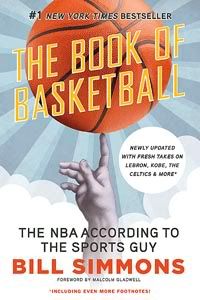
The Book of Basketball by ESPN's Bill Simmons (known as The Sports Guy) for a few weeks now and, as I'm now about halfway through the enormous (704 pages) book, I'd like to share a few thoughts on it. Specifically, I'd like to take a closer look at his list of undeserving MVP award winners throughout NBA history but first, some thoughts on the first five chapters.
Simmons' writing style is extremely readable. This book was one of many that I received for Christmas but once I started reading a couple pages, I was sucked into it and have mostly neglected the other books so far. There's really no doubt that he writes very well. What gets annoying very quickly, though, are the comically absurd number of footnotes on every single page. A glut of footnotes will always get annoying in any book because they interrupt or distract the reader's flow of information absorption, but here the footnotes almost seem to
mock and tease the reader, bothering him to stop and look to the bottom of the page when all that's there is a horrifically inane or misogynistic sex joke, reality TV or pop culture reference, or some other bullshit.
He also has a tendency to be self-aware and self-conscious (basically, talking about the sentence he's writing while he's writing it) a bit too much and while his background as a comedy writer allows for some gems (I laughed out loud about 5 times already) it also leads to plenty of overdone jokes that completely miss the humor target. I find myself zooming past sentences and passages at times just because I literally don't want to waste the 2 seconds of time (and 2 milliliters of brain juice) that it takes to read a joke about
Desperate Housewives or a Vegas strip club experience. Or dicks. Or cocaine. Enough already.
I'm giving complaints and criticism about it not because it's a terrible book, absolutely not. Overall the book is great and universally acknowledged as such. It was a New York Times bestseller, has a rating of 4 out of 5 stars on Amazon, and Simmons remains an extremely popular sportswriter. The
New York Magazine book section had
a nice series of columns discussing the merits and demerits of Simmons' basketball epic. I've been reading his NBA columns on ESPN.com for probably 5 or 6 years now and they alone usually awaken my NBA fanhood each season and get me following and caring about the games. I've definitely enjoyed the book and, when you dig past all the cloacal excess, there certainly is
a basketball book in here and a very good one.
* * *
Simmons is positively obsessed with basketball and has been for many years. His sheer depth of knowledge is entertaining in and of itself sometimes. His thoughts are long-winded but precise, well-delivered, and always organized either in lists, bullet-points, or a marked tendency to title his own theory or award name which occurs on pretty much every other page ("Dumbest Commish Moment Ever"; "The Mom Test"; "Great Player Turned Bad TV Analyst"; "The League That Was Too Black had become the League That Raked in Shitloads of Money"). The Sports Guy is highly opinionated and he pretty much always states his case convincingly. In the Wilt-vs-Russell chapter, he does occasionally take his subjective snark too far but he definitely has me convinced Bill Russell was a greater player than Wilt Chamberlain. The What-If chapter didn't seem like it would be that appealing at first but it turned out to be the best chapter thus far. He properly lambasts the Trail Blazers for their selection of Greg Oden over Kevin Durant in the draft and deftly deconstructs the follies of the Phoenix Suns during the Steve Nash era. This book is truly Simmons' philosophical treatise on the NBA.
But when I was reading the "Most Valuable Chapter," cutting through the vines of his many arguments, I couldn't stop thinking about the stats. Simmons describes eight past MVP choices as "Outright Travesties" and delivers his reasons but I was left thinking what the advanced NBA stats might say about it. Particularly the stats that work to come up with a single number for a player's value, like Win Shares. In the chapter, Simmons takes a small swipe at these kind of stats and the analysts who have developed them saying "over the past ten years, a series of stat freaks inspired by the baseball revolution pushed a variety of convoluted statistics on us." But then his first question in the criteria for evaluating the true MVP is: "If you replaced each MVP candidate with a decent player at his position for the entire season, what would be the hypothetical effect on his team's record?" Those "stat freaks" have come up with something to measure exactly that.
While I'm still pretty new to the highbrow basketball stats world (I read
Basketball Prospectus for the first time this year and loved it), I think it would be interesting to look at whether the basketball Win Shares statistic agrees with Simmons' assertions. Win Shares was originally a baseball stat created by Bill James to determine in one number, congealed and drawn out of a steaming stew of many statistics (including defensive numbers), how many wins a player was worth during a given season (it bears mentioning that, in baseball, a bunch of newer and better win value statistics have come about and surpassed James' relatively sloppy Win Shares by now, particularly Baseball Prospectus' WARP or Wins Above Replacement Player).
The stat was later adapted to measure the value of NBA players (you can read all the boring details
here). While it's certainly not perfect, and I'm not positing that Win Shares should be the main determinant of the MVP award, I think it'll be worth looking at.
In Chapter 5, after elaborating 14 "features and subplots" that distinguish basketball from every other sport (most of which don't seem particular to basketball at all), The Sports Guy asserts that the Most Valuable Player award in the NBA matters more than in any other sport. His argument:
Wait, you don't believe me? Can you name the last ten NFL MVPs? You can't. Can you name the last ten MVPs in each baseball league, then definitively say which guy was better each year? Nope.
Then he insults hockey, a common punching bag for ignorant sportswriters (if you and SportsCenter don't have interest in something that doesn't automatically disqualify it from being cool---hockey's awesomeness is at its heights right now, same with basketball) before traveling back in time to "correct every mistake in MVP history." He has three categories of false MVPs, in order: Fishy But Ultimately Okay, Fishy and Ultimately Not Okay, and Outright Travesties.
Let's look at his eight travesties starting with #8 and comparing the Win Shares leaders (taken from
basketball-reference.com) for each season in question. (FYI: Win Shares shows how many wins a player has created compared to what a dude-off-the-street, replacement player would produce.)
8. Kobe Bryant (2007-08 MVP)
Simmons rips Kobe often in the book and here he says this "should have been Chris Paul's trophy---nobody meant more to his team or his city---and if not him, then Garnett."
2007-08 Win Shares leaders
He's certainly right about Chris Paul. In fact, Paul is already leading the NBA in Win Shares this current season and he finished 2nd in 2009 but still hasn't won an MVP yet. So here, Simmons is on the money except for throwing Garnett in. He was 2nd in the league in Defensive Win Shares but overall was at just eighth in overall Win Shares with 12.9. (Although he was the leader and catalyst on the champion Celtics that season.)
7. Steve Nash (2004-05 MVP)
This one is preposterous for Simmons because it was the first time that "(a) a table setter won the award; (b) a non-franchise player won; and (c) a defensive liability won." He certainly admires Nash's game (who doesn't?) and describes him perfectly: "Here was a Canadian dude with floppy hair and a nonstop motor who looked like Kelly Leak, made throwback plays (like his trademark running hook), knew how to handle a fast break, made teammates better and always handled himself with class." But he feels that, in the MVP awards voting, "poor Shaq ended up getting robbed."
2004-05 Win Shares leaders
Looks like two of Nash's teammates may have been robbed. Though you can definitely argue that Nash propelled Amare and Marion to top-5 status that season and deserves a lot of credit for that. KG had a monster year but his team missed the playoffs, Dirk was great too but his Mavericks were knocked out of the playoffs by Steve Nash's Suns. Simmons (admitting "I'm no Bill James") makes the outlandish assertion that Shaq was responsible for a 40-game swing that season (the Heat gaining 17 wins once they acquired him and the Lakers losing 23) although Shaq sat out injured for 10 games and Win Shares-wise doesn't come close to the top even if considered on a per-minute basis. So, yes: Nash was a bad pick. But there are a few guys that should've had first dibs before Shaq.
6. Magic Johnson (1989-90 MVP)
"Everyone remembers Charles Barkley getting screwed when Jordan had a bigger gripe," he says before stating MJ's choice. He's got this one exactly right.
1989-90 Win Shares leaders
Simmons explains why Jordan didn't win the vote for this award, one of the reasons was because "the media kept perpetuating the bullshit that Bird and Magic 'knew how to win' and Jordan 'didn't know how to win yet.' (What a farce.)" That perpetuated bullshit "know how to win" idea seems to be dying a slow death in sports coverage right now. Baseball especially is seemingly starting to move from that penumbra of ignorance.
5. Dave Cowens (1972-73 MVP)
Simmons concludes: "Kareem got robbed" and it certainly looks that way.
1972-73 Win Shares leaders
Kareem had won the MVP in both seasons prior and, during a turbulent '72-73 season both on and off the court (seven friends were murdered at his house), led the league in Win Shares while carrying his debilitated team to 60 wins. Cowens does show up at the top of the Defensive Win Shares list but Kareem is far ahead of the rest of the pack on this one.
4. Charles Barkley (1992-93 MVP)
Here's where it starts getting heated (and the argumentative tone often produces the most entertaining and engaging writing in Simmons' opus). He lists the numbers for the top 3 MVP vote-getters that year: Michael Jordan, Hakeem Olajuwon, and Charles Barkley. "That's right, signature seasons from three of the best twenty players ever! Unfortunately, eighty-six voters overlooked the fact that Jordan and Hakeem were two of the most destructive defensive players ever and Barkley couldn't guard Ron Kovic."
1992-93 Win Shares leaders
On point once again. Sports Guy says it should have been MJ, Hakeem, then Barkley. MJ's Bulls went on to scorch the Suns in that year's championship giving Jordan vindication. The underappreciated greatness of Hakeem's 1990s domination was covered
lengthily and brilliantly at FreeDarko not too long ago.
3. Steve Nash (2005-06 MVP)
So, Nash has to hand in both of his trophies, huh? This was the part of the chapter that made me want to look up the Win Shares, as Simmons asserts that Kobe was worth a minimum of 25 victories for his Lakers that year.
2005-06 Win Shares leaders
He's about 10 wins off on Kobe. He doesn't even mention Dirk who carried his team to 60 wins and the NBA Finals (losing to the Heat). Regardless, it's definitely fun to read about Kobe's performance that season. "The dude scored 62 in three quarters against Dallas, then 81 against Toronto a few weeks later." And he was sure as hell fun to watch.
2. Willis Reed (1969-70 MVP)
Willis starred for the Knicks team that year that won a league-high 60 games and was such an endearing team that over a dozen books have been written about that Knicks season. As covered in
The Undisputed Guide to Pro Basketball History , even a bunch of the players on that team wrote books. One of those books,
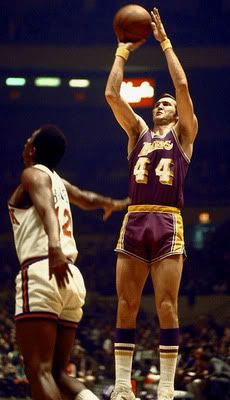
Rockin' Steady: A Guide to Basketball & Cool, was writ by the great Walt "Clyde" Frazier whom Simmons mentions as a viable candidate for co-MVP with Reed for 1970. But that's just because, with the way the Knicks took the league by storm that year, "a Knick was getting the MVP and that was that." But Simmons argues that Jerry West was the best player in the league that year.
1969-70 Win Shares leaders

I'm impressed with how on point he is with this one. It's no wonder he has this one at #2 on the travesties list because West was indeed more valuable than Reed and just a tick above Frazier, while dragging his beaten-up team (Wilt Chamberlain and Elgin Baylor missed a big chunk of the season) to 2nd place in the Western Conference and taking them all the way to a Finals matchup with the Knicks (they lost). He argues that this was West's finest year and, as one of the 8 greatest players of all time, he should've won at least one MVP trophy in his career. This was his best chance, and he lost it because the Knicks were so damn entertaining. As a Knicks fan, I say: tough shit.
1. Karl Malone (1996-97 MVP)
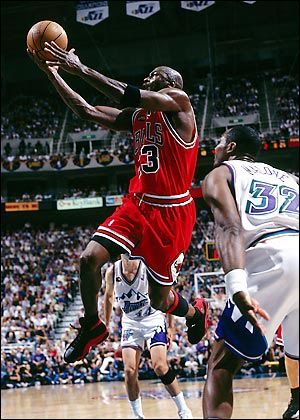
Jordan had won the previous season, would win the award the
following season, and should've won it this season too. The voting was pretty close and Karl Malone somehow came out on top. Simmons bubbles up a Vegas bachelor party story to state his case then blames it all on a silly "Malone-for-MVP" campaign among sportswriters that "got the ball rolling, and within a couple of weeks, this became the cute story du jour."
1996-97 Win Shares leaders
Not only was Jordan clearly the best player in the league, but his team won more games (69) than anybody that year and eventually met Karl Malone's Utah Jazz in the NBA Finals, smote them mightily and Jordan won Finals MVP. So there. Moral of the story: don't mess with Jordan.
While researching this post, I came across a cool piece by Kevin Pelton at Basketball Prospectus using win statistics to look at all the best players from the 1990s. Check it out here.