Showing posts with label potent quotables. Show all posts

Sunday, January 29, 2017

Secret Retributions


Secret retributions are always restoring the level, when disturbed, of the divine justice. It is impossible to tilt the beam. All the tyrants and proprietors and monopolists of the world in vain set their shoulders to heave the bar. Settles forever more the ponderous equator to its line, and man and mote, and star and sun, must range to it, or be pulverized by the recoil.
- Ralph Waldo Emerson

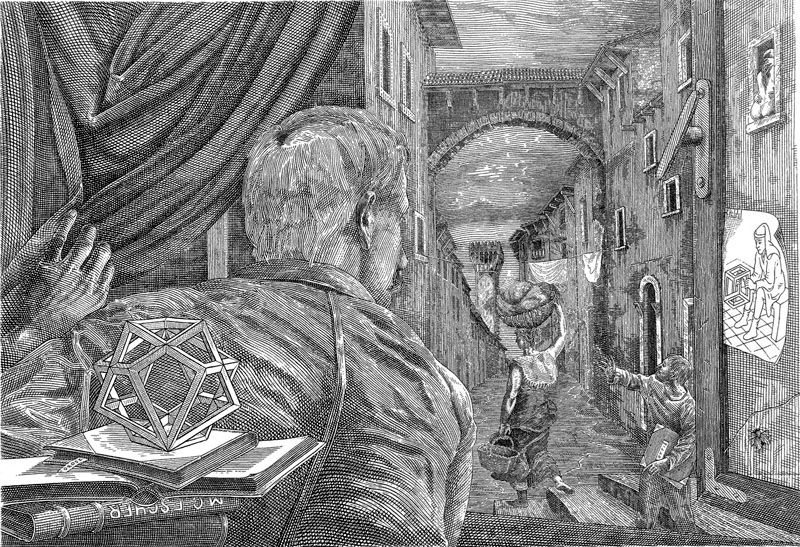
(quoted in Vineland by Thomas Pynchon, p. 369, where a character has memorized the passage after discovering it quoted "in a jailhouse copy of The Varieties of Religious Experience by William James." Artwork: Paris Dream by Max Ernst.)

Saturday, June 22, 2013

Potent Quotables: Woven into Nature

"Our skin shares its chemistry with the maple leaf and moth wing. The currents our bodies regulate share a molecular flow with raw sun. Nerves and flashes of lightning are related events woven into nature at different levels."
- Richard Grossinger, Planet Medicine

"I am part of the sun as my eye is part of me. That I am part of the earth, my feet know perfectly, and my blood is part of the sea. There is nothing of me that is alone and isolate, except my mind, and we shall find that the mind has no existence by itself, but is only the glitter of the sun on the surface of the waters."
- D.H. Lawrence, Apocalypse and the Writings on Revelation

(Taken from Rob Brezsny's excellent book Pronoia is the Antidote for Paranoia.)

Thursday, November 29, 2012

Potent Quotables: The Gutenberg Galaxy Edition


The year is quickly reaching its conclusion, the nights growing longer as the hours of sunlight decline daily. Going through some of the unwritten or uncompleted pieces I had intended to write this year, it occurs to me that a long-planned review of Marshall McLuhan's The Gutenberg Galaxy just isn't going to happen in the way I'd hoped. So I'm going to do something different.

First, some background info:
This incredibly dense and thoughtful text occupied a good portion of my mental energy in the final months of 2011 and into early 2012. Though it sparked many new ideas for me that completely altered my perspective on things, I mostly found it as puzzling and challenging to get through as my first reading of Ulysses. It certainly lacks the pleasing poetic language of Ulysses, but is equally massive in its references and often cuts jarringly from one huge concept to the next. I approached it thinking it'd be like any other analytical academic text but it's something very different.
Friday, September 21, 2012

Potent Quotables: Question Everything

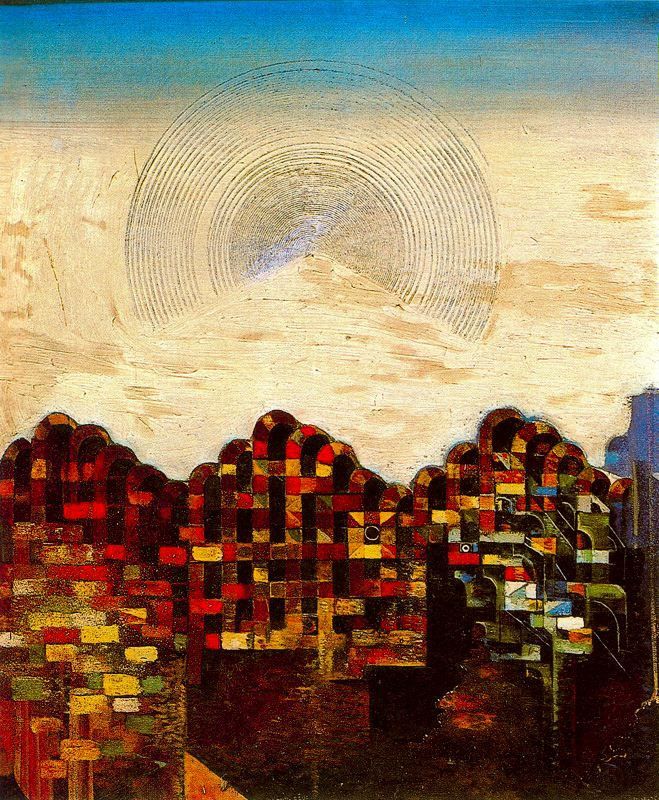
Escher in Italy (1987) by István Orosz

"The universe contains a maybe" 
- Robert Anton Wilson

"Question everything. Learn something. Answer nothing." 
- Euripedes

"I do not pretend to tell what is absolutely true, but what I think is true."
- Robert Ingersoll

Inspired by this quote from Rob Breszny's excellent book Pronoia:


"Objection, evasion, joyous distrust, and love of irony are signs of health. Everything absolute belongs to pathology." So proclaimed Friedrich Nietzsche in Beyond Good and Evil. Note well that he used the adjective "joyous" to describe distrust, not "cynical" or "grumbling" or "sour." The key to remaining vital and strong while questioning every so-called absolute is to cultivate a cheerful, buoyant mood as you do it. 
This is a key point in Robert Anton Wilson's book Quantum Psychology for which there is currently an online reading group going on over at Tom Jackson's excellent blog RAWillumination.net, check it out.

Friday, June 29, 2012

Potent Quotables: Speaking to the Superconscious Mind

"Stubborn mental or physical diseases always have a deep root in the subconsciousness. Illness may be cured by pulling out its hidden roots. That is why all affirmations of the conscious mind should be impressive enough to permeate the subconsciousness, which in turn automatically influences the conscious mind. Strong conscious affirmations thus react on the mind and body through the medium of the subconscious. Still stronger affirmations reach not only the subconscious, but also the superconscious mind---the magic storehouse of miraculous powers."
- Paramahansa Yogananda
This quote is exactly what Robert Anton Wilson speaks of in his wonderful book Prometheus Rising, particularly in his discussion of the so-called "fifth circuit" or Holistic Neurosomatic Circuit. Wilson uses the computer-technology language that was popular in the late 70s and 80s but he's talking about the same exact thing (faith healing, miraculous rejuvenation, etc are all discussed).

In Prometheus Rising (and a few of RAW's other books), there are exercises at the end of each chapter that are very much like the affirmations Yogananda speaks of; statements to speak or focus on that are so powerful they can activate the powerful energies of the unconscious. 

Here are some of my favorite exercises from RAW. These are all proposed as ways to reprogram your mind and your way of experiencing the world which eventually results in a revolution of you.
- Believe that you can exceed all your previous ambitions and hopes in all areas of your life.

- James Joyce said he never met a boring human being. Try to explain this. Try to get into the Joycean head space, where everybody is a separate reality-island full of mystery and surprise. In other words, learn to observe.

- If all you can know is your own brain programs operating, the whole universe you experience is inside your head. Try to hold onto that model for at least an hour. Note how often you relapse into feeling the universe as outside you.

- Try living a whole week with the program, "Everybody likes me and tries to help me achieve my goals."

- Try living a day with the program "I am God playing at being a human being. I created every reality I notice."

- Try living forever with the metaprogram, "Everything works out more perfectly than I plan it."


Sunday, March 18, 2012

Potent Quotables: Self-Reliance

From Ralph Waldo Emerson's essay "Self-Reliance":

"A man should learn to detect and watch the gleam of light which flashes across his mind from within, more than the lustre of the firmament of bards and sages. Yet he dismisses without notice his thought, because it is his.

In every work of genius we recognize our own rejected thoughts; they come back to us with a certain alienated majesty. Great works of art have no more affecting lesson for us than this...
Else tomorrow a stranger will say with masterly good sense precisely what we have thought and felt all the time, and we shall be forced to take with shame our own opinion from another."

Saturday, October 8, 2011

Potent Quotables: Cosmic Contemplation


"Ancient stars in their death throes spat out atoms like iron which this universe had never known. The novel tidbits of debris were sucked up by infant suns which, in turn, created yet more atoms when their race was run. Now the iron of old nova coughings vivifies the redness of our blood.

"If stars step constantly upward, why should the global interlace of humans, microbes, plants, and animals not move upward steadily as well? The horizons toward which we must soar are within us, anxious to break free, to emerge from our imaginings, then to beckon us forward into fresh realities.

"We have a mission to create, for we are evolution incarnate. We are her self-awareness, her frontal lobes and fingertips. We are second-generation star stuff come alive. We are parts of something 3.5 billion years old, but pubertal in cosmic time. We are neurons of this planet's interspecies mind."
--Howard Bloom, Global Brain: The Evolution of Mass Mind from the Big Bang to the 21st Century

"Physicist Roger Penrose, who helped develop theories about black holes, has said that the chance of an ordered universe happening at random is nil: one in 10 to the 10th to the 30th, a number so large that if you programmed a computer to write a million zeros per second, it would take a million times the age of the universe just to write the number down."
--from Rob Brezsny's book Pronoia (in fact, both quotes came from this excellent book)

Tuesday, April 5, 2011

Potent Quotables: Hum of dynamos

Stumbled upon this quote today while looking through some books on Ulysses.
For her, it was one of the moments when we are reminded that our lives are not in our keeping, and that whatsoever is to befall us originates in sources beyond our power. Our wills may indeed reach the length of our arms, or as far as our voices can penetrate space; but without us and within us moves one universe* that saves us or ruins us only for its own purposes; and we are no more free amid its laws than the leaves of the forest are free to decide their own shapes and seasons of unfolding, to order the showers by which they are to be nourished, and the storms which shall scatter them at last.---from The Mettle of the Pasture by James Lane Allen
*In Ulysses pg 242, Stephen walks by a powerplant and hears the electric humming which brings about this thought: "Throb always without you and the throb always within."

The quote is taken from a book review Joyce wrote in 1903.

Tuesday, March 15, 2011

Potent Quotables: Shells

Taken from Stuart Gilbert's famous study of Ulysses:

Esoterics use the name 'shells' to designate bodies discarded by the soul, tenements emptied of life. The 'facts' of history, its dates, battles, marches and countermarches, alarums and excursions, are shells, hollow shells into which the historian vainly seeks to pour the life of his own quick imagination. Such life as they may seem to gain is fictive; their own has passed on and cannot be recalled. The melee of history, 'joust of life,' is ever pushing forward to new fronts, leaving on the abandoned field a debris of discarded vehicles, empty shells.
-pg 115

Tuesday, March 8, 2011

Potent Quotables: Dali Dinner Reflections

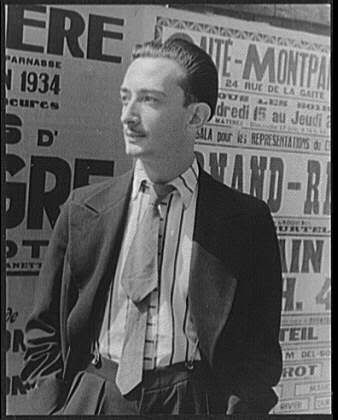
In the late 1920s, a young Salvador Dali left Spain with his lady Gala and moved to Paris to enter into the famous art scene there. At this point, Dali was unrefined, shy, and thrust into an unfamiliar bourgeois atmosphere. His reflections on this period contain funny anecdotes (written in a perfectly weird style) like this one.  
"One evening I was having dinner at the Vicomte de Noailles'. Their house intimidated me, and I was extremely flattered to see my painting The Lugubrious Game hung between a Cranach and a Watteau. At this dinner there were artists and society people, and I immediately realized that I was the chief object of attraction. I believe that the Noialles were deeply touched by my timidity. Each time the wine-butler came and whispered the name and year of the wine into my ear with an air of great secretiveness, I thought it was something very serious that he had come discreetly to tell me---Gala run over by a taxi, or a furious surrealist who was coming to beat me up---and I would turn livid, leap up and prepare to leave the table. Then, in a louder voice so as to reassure me, and looking with the utmost dignified intentness at the bottle lying prone in the little basket, the butler would repeat "Romanée 1923." At one gulp I would drink down this wine that had just so terrified me and thanks to which I recovered my hope of overcoming my timidity and of being able to talk.

I have always admired---and I did so particularly at this time---the person who, without having anything really sensational or important to say, manages throughout a whole dinner of twenty people to steer the conversation in whatever direction he chooses, to make himself heard in the midst of a general silence at the right moments without having to stop eating---in fact, eating more than the next fellow---and still has time for an occasional slyly calculated pause during which he gracefully and self-confidently stops the flow of conversation just long enough to brush aside the danger of anyone's taking advantage of his absorption to kindle fresh hearths of conversation, or---in the extreme case in which this should occur---is able to extinguish them at the desired moment without seeming to make the slightest effort, and at the same time give the recalcitrant ones the impression, when he interrupts their incipient conversation against their will, that it is they who are interrupting by asking him in a voice that verges on the impolite to repeat his last remarks so that they can follow the course of his argument in which they have not the slightest interest."

from The Secret Life of Salvador Dali pg. 258

Monday, December 6, 2010

"You Can't Handle the Truth!"

"Something might be true while being harmful and dangerous in the highest degree. Indeed, it might be a basic characteristic of existence that those who would know it completely would perish, in which case the strength of a spirit should be measured according to how much of the 'truth' one could still barely endure---or to put it more clearly, to what degree one would require it to be thinned down, shrouded, sweetened, blunted, falsified."
- Friedrich Nietzsche, Beyond Good and Evil Aphorism 39