Showing posts with label book reviews. Show all posts

Friday, November 27, 2020

New article in the James Joyce Quarterly on Lawrence Ferlinghetti

Front cover of JJQ volume 57.3-4. Cover art by David Nowlan.

I am excited to have a new piece that was published in the latest edition of the James Joyce Quarterly. This piece is a book review of the newest book from the legendary American poet Lawrence Ferlinghetti, a fascinating and entertaining text called Little Boy: A Novel. The full article is behind a subscription wall, but you can read the first half of it here

Here's the opening paragraph: 

The American poet Lawrence Ferlinghetti turned one hundred years old in 2019. To mark the occasion, he published Little Boy: A Novel, a compulsively readable feast for the mind stuffed into a breezy 192-page text. Though calling itself a novel, it is hardly fiction. The book reads more like a memoir written as an epic poem in a lyrical thought-stream prose style devoid of plot, bereft of punctuation, laced with literary criticism, and seared with socio-political commentary. It is a novel in the truest sense of the word: Ferlinghetti made something new.


If you're wondering why this review of Ferlinghetti's latest book was in the James Joyce Quarterly, it's because Little Boy is a sort of homage to Joyce. You can find Ferlinghetti quoting from Finnegans Wake and Ulysses from his earliest published works like A Coney Island of the Mind (1958). He continued to bring Joyce into his poetry for decades and Little Boy is a sort of culmination or capstone of Ferlinghetti's career, an epic poem in the form of a stream-of-consciousness in which he quotes and imitates Joyce frequently (among countless other literary allusions). Over at my "Finnegans, Wake!" blog I shared a post with a bunch of examples of Ferlinghetti alluding to Joyce throughout Little Boy: A Novel.

Besides the prominent Joycean element, the reason I wrote the review is because I absolutely loved Little Boy: A Novel. It has to be one of the best books I've ever read. Little Boy is both moving and laugh-out-loud funny, the language is incredibly rich and engrossing with sentences that go on for pages and build up momentum, mixing lyricism and mysticism with memoir, literary criticism with social commentary, the author's earliest memories and experiences with his observations on modern society while sitting inside a cafe in San Francisco. There are reflections on several famous literary figures Ferlinghetti was friends with like Allen Ginsberg, Jack Kerouac, William S. Burroughs, Neal Cassady, Gregory Corso, etc. Ferlinghetti has had a very rich century of existence---he commanded a sub chaser in the invasion of Normandy on D-Day in 1944, he went to Nagasaki in 1945 after the atomic bomb dropped and was so horrified he became a staunch pacifist and activist for the rest of his life. In 1953 he founded City Lights bookstore in San Francisco and went on to publish Ginsberg's Howl and Other Poems which led to him going to jail for obscenity charges. He's published dozens of books of poetry, novels, and plays and is also a talented painter.

In January I randomly picked up A Coney Island of the Mind from my bookshelf and started reading it. I had discovered the book back in 2018 on a trip to the Bay Area where the title had caught my eye as I perused the bookshelf of a friend I was visiting. Didn't know anything about it at the time, but having grown up in NYC and played hockey at Abe Stark Arena in Coney Island for many years, the title of that dog-eared slim volume intrigued me. So when I later visited City Lights bookstore on the same trip, I picked up a brand new copy of A Coney Island of the Mind. At the time I didn't know was Ferlinghetti's most famous book and that I was standing in Ferlinghetti's own bookstore purchasing it. Once I finally started reading it earlier this year, I got hooked immediately. 

For the next few months I read and re-read several books by Ferlinghetti, my favorite being the second volume of his epic poem on the history of America called Time of Useful Consciousness (published in 2012, the title is derived from an aeronautical term denoting the time between when one loses oxygen and when one passes out, the brief time in which some life-saving action is possible). Then I picked up his newest book, Little Boy: A Novel (2019), and it just blew me away. While I haven't read every single one of Ferlinghetti's books yet, I have read most of them now and I can say with some certainty that Little Boy is his greatest work. A perfect distillation of all the knowledge and experience he's acquired over a century of existence neatly packed into a relatively short book. The structure is economical because there are no chapter breaks and after the first 15 pages or so there are even very few sentence breaks. The text becomes a rushing river of poetic prose. The language is full of informal dialects, street talk, puns, and idioms. Ferlinghetti is a (now) 101-year-old poet who has owned a bookstore for more than six decades so his knowledge of literature is virtually unsurpassed among those walking the earth. He's also an old New Yorker with a great sense of humor. This creates an irresistibly rich and entertaining gestalt that never seems to leave anything out. 

I enjoyed it so much that when I finished reading Little Boy: A Novel, I immediately turned back to the first page and started reading it again. Then I finished it a second time and immediately read it again a third time. Reading books has been my main hobby for a while now and I can't recall having that kind of experience where I read one book cover-to-cover three times in a row. 

Trying to summarize why I love this book so much, I come up this: as a NY native, I relate to Ferlinghetti with all his memories of Yonkers where he was born (and where I played many hockey games at an outdoor rink where I once scored a hat trick); I relate to Ferlinghetti's obsession with Joyce, especially Finnegans Wake; the informal, playful language he uses makes him a joy to read; there's so much to learn from his literary allusions and stories; he also loves baseball and refers to it frequently in this book; Ferlinghetti views the world thru the eye of a mystic; with all of his experience, knowledge, and wisdom, he is exactly the person whose perspective I am hoping to learn from as he comments, in longwinded jeremiads, on our current political and environmental predicaments. 

The review I wrote for JJQ was restricted by a word count so I had to keep it short and here I am going on about this book and I've barely touched on its most moving element as a memoir. Besides all the cultural-political-social commentary and piles of literary allusions, the core of Little Boy is about the little boy Lawrence Ferlinghetti who had a difficult upbringing which impacted him the rest of his life. His father died shortly before he was born. His mother couldn't handle another child and ended up in a mental hospital so she gave the baby to her sister. Ferlinghetti was raised by his Aunt Emilie and learned to speak French. For a while they lived with a wealthy family who his aunt was working for until suddenly she just left with no explanation, never to be seen again, and young Lawrence grew up without any real family around. As the book carries on we get more insight into the imprint of his childhood in which he never received real love or affection.

There are so many passages in this book that I've starred, underlined, and annotated and I'm tempted to quote from it at length. As I describe in the JJQ review, the style of this book is totally unconventional. Sentences span several pages with no punctuation and he jumps from one thing to the next and back again. I will share a long section here from pgs 93-96 where you can get an idea of how this book works. Note: A big block of unbroken text ensues. Not always easy to follow, but always richly rewarding to read.  This selection begins immediately after Ferlinghetti quotes from an unusually profound Levi's advertisement he saw in San Francisco one recent summer: 


And who was that speaking if not Whitman or every common man on earth or elsewhere who else if not an American certainly not a European with all his baggage of centuries like Pasolini said when he came to New York in the 1960s and met the New Left rads and wrote that he envied these Americans who could act without first having to wade through thirty centuries of intellectual baggage like what would Heidegger do or what would Descartes do or what would Plato say or Plutarch or Herodotus or Gramsci or some other great looming intellect haunting their old Euro heads yeah you can imagine what with the European Communist parties tied up in knots and eventually destroying the student revolution or revelation of 1968 And what Tarquin said in his garden with the poppy blooms was understood by the son but not by the messenger and so today the messenger embodied now as the media spreads confusion and doubt as to any eternal verity as indeed so do the philosophers or other heavy-headed thinkers who spread doubt in every direction even as Socrates did So that so that today there is a veritable clearance sale of ideas strained through the semiliterate media which ends up giving us a kind of Gazpacho Expressionism or cut-up consciousness as in William Burroughs' Naked Lunch or in John Cage's cut-up of any classic text as he did Finnegans Wake annihilating the beautiful hushed talk of Irish washerwomen gossiping in the gloaming while doing their washing on a riverbank where field mice squawk and dusk falling and night descending into doubt and despair and fear and trembling O lord save us Blind in our courses we know not what we do or where we go O the semiconscious existential despair of not knowing who we are and the boy all his life looking for himself and where he came from Father lost Mother in a madhouse and he the little kid wandering around knowing nothing having been told nothing of where he came from and who was to tell him the little kid plunked down on earth somewhere alone like a stray cat or pup without a collar or name tag and how was he to find himself in this twirling world spinning to the music of the spheres which is the sound of Om in which all sound is absorbed in which all thought all feelings all senses are absorbed yes and Om the sound of living itself the great Om of all our breathing the voice of life the voice of our buried life the voice of the voice of the blood then coursing through us through even the penis that strange appendage a peninsula of sorts a third arm or leg that so imperiously asserts its authority and inopportunely rises up and inserts itself into affairs personal or worldly and then so arrogantly lets us down at critical moments at the very gates of paradise or Nirvana or hell and refuses all our incitements "of mind and hand" as some Frenchie philosophe said even as he let down his pants in the queen's chamber indeed indeed and we are left with the perpetual astonishment of man on earth when confronted with himself or his penis indeed what a piece of work is man and this his daybook his nightbook and I am not writing some kind of Notes from the Underground as if I had any idea where any underground is these days if I ever knew since I've always been off in my own burb in some suburb of consciousness dreaming away or otherwise goofing off or picking my nose in hopeless cellars with fellow travelers or their ilk imagining I'm going to change the world or something and so I'm just some kind of literary freak and my mind the constipated thought of the race all too shallow to be called nihilism while all the while all I want to do is walk around the earth cooking the Joy soup What else is there to do with the rest of eternity and would you tell me what it is we're all supposed to do on earth anyway I mean truly just sit right down and think of an answer to all that while there's still time just give me a concrete answer as to what humans are supposed to do with all our time what on earth that is are we just to sit around like blobs of perspiring protoplasm or like chimps in trees scratching our fleas or whatever I mean maybe in fact it's just dreaming that we're supposed to do after everyone is fed after all is said and done oh no that's just a big evasion of the basic burning question What I want to know is what in hell are we here on earth for anyway baby baby Am I your bedroom philosopher or Doctor of Alienation Am I a willing well-fed participant and protagonist in our consumer society a consumer-gatherer or a rebel antagonist revolutionary an enemy of the state or something in between neither fish nor fouling-piece Tell me tell me the night is young and you're so beautiful pardon me if I am overdutiful Babeee and that's what he was asking himself as he grew up into something new and strange at least in the eyes of some totally objective journalist sent down here to earth by some managing editor with a low tolerance for malarkey who wants the truth and nothing but the truth so let 'em have it tell us what is what and who we are and what we are doing down here anyway The top-dog editor wants to know the straight story and are you man enough to tell it or are you brain enough to tell it and are you man enough to say I love you man   (Little Boy: A Novel, pgs 93-96)

Wednesday, January 1, 2020

Looking Back on 2019 (Part 2)


Books Read in 2019:

1. Harpooning Donald Trump by Tom LeClair
A short book of essays by a literary scholar arguing for the importance of literature during times of political turmoil. LeClair goes into what he calls "systems novels" here, that is, enormous novels that seek to contain everything. These can be useful guides to crazy times. He especially highlights Robert Coover's The Public Burning, a satirical novel that features a caricatured Richard Nixon as the protagonist and narrator. The book's best chapter analyzes Trump from the perspective of Moby-Dick---what LeClair calls "the only book you'll ever need"---and concludes:
And we will need literate readers---like Ishmael---to counter Trump's unscrupulous monomania. Not just literate readers but literary, which is literate on Human Growth Hormone. Literary readers do not think any more carefully than literate people, but literature trains one to care about and care for language as a sensitive instrument, not just a blunt tool for propaganda and power. I'll quote Wittgenstein again: 'The limits of my language mean the limits of my world.' The world of literature is large with possibilities of imagination and thought and feeling. The world of pre-literate Donald Trump is small, impoverished by ignorance and fear and anger. Literary responses to Trump may not bring down a president or even affect his policies, but literary artists still must continue to provide models of rigorous thought and rich expression---just as medieval monks preserved manuscripts in an earlier dark time---for great and great-minded literature is in and of itself a harpoon, a weapon against the fake 'great' and small-minded demagoguery. (p. 95)

Sunday, December 9, 2018

More Notes on David Markson's "Notecard Quartet"

To an astronomer, man is but an insignificant dot in an infinite universe---said whoever. Though that insignificant dot is also the astronomer.---said Einstein. 
p. 433, The Last Novel

Before placing David Markson's spellbinding "Notecard Quartet" (namely, these four novels: Reader's Block; This is Not a Novel; Vanishing Point; The Last Novel) back on the shelf, I'd like to share a few more notes from my reading experience. (Page numbers are from the Dalkey Archive edition of Reader's Block and the Counterpoint omnibus edition of This is Not a Novel, Vanishing Point, and The Last Novel.)

1. In one of the many online essays devoted to Markson and his quartet (though I'm currently unable to identify which one), an author suggested that these books, composed almost entirely of an encyclopedic range of historical facts, quotes, and what Finnegans Wake calls "scrips of nutsnolleges" (FW 623.32), are not intended to spring the reader off to Google the history and validity of each item. I mostly adhered to that approach, streaking thru the pages with a growing sense for the vastness of the anomalous, paradoxical, occasionally confounding historical record of artists and thinkers. On the occasions where I was compelled to look stuff up, a vertiginous awe accompanied the realization of just how much color and feeling (love, pain, passion, humor, anger, confusion) can be extracted from any of Markson's terse lines once drilled into.

Sunday, November 11, 2018

Discovering David Markson, Wittgenstein's Mistress and "The Notecard Quartet"

Somebody is living on this beach.
- Wittgenstein's Mistress, p. 240

Quelqu'un vit sur cette plage.
[Somebody is living on this beach, French]

Alguien vive en este playa.
[Somebody is living on this beach, Spanish]
- Reader's Block, p. 178


My reading recently has quickly ricochet'd through the later works of author David Markson, catapulting from Reader's Block (1996) through This Is Not a Novel (2001) into Vanishing Point (2004) on the way to The Last Novel (2007). My binge through this tetrad of experimental novels known as "The Notecard Quartet," styled as meandering strands of loosely linked bits of art historical data written as terse one or two line paragraphs (and originally composed by Markson on index cards), this began on the strength of persistent hints from my Santa Cruz pals Charlie and Luke to read Markson's postmodern masterpiece Wittgenstein's Mistress. My copy of that novel was acquired in Austin a couple years back when I happened to be at a bookstore with Charlie and Luke and they both suggested I'd dig it. They were on point. During a recent trip to Santa Cruz and the San Fran area I finally cracked open Wittgenstein's Mistress and zipped thru it enthralled. The impact of jutting single line paragraphs presenting one mental nugget after another over and over becomes a compulsive reading experience, oddly addictive. Bookworm host Michael Silverblatt compared it to a nutritional snack food for the mind.

To compose an impactful page turner out of a staccato of epigrams and ephemera with no chapters or conventional story elements was Markson's stated goal and manifested gift, repeatedly achieved over the latter stage of his career. After starting out publishing a handful of pulp western and noir novels in the 1960s including The Ballad of Dingus Magee which became a film starring Frank Sinatra, David Markson eventually began to move toward more experimental and original uses of the written word. In the mid-1980s he wrote Wittgenstein's Mistress, a story consisting of the interlinked mental fragments of a narrator known as Kate who seems to be the last person alive on earth. Persevering through 54 (!!!) rejections from publishers who found it either too unconventional or unfit to sell, Markson finally got Wittgenstein's Mistress published in 1988 by Dalkey Archive Press, thanks to the brilliant Steven Moore. The book garnered some laudatory reviews, most notably from David Foster Wallace who described it as "pretty much the high point of experimental literature in this country."

Sunday, September 9, 2018

Book Review: Thomas Pynchon's Against the Day is Lit!


Last summer, topping off a binge of reading Thomas Pynchon books, I set forth on the long, arduous, and vastly entertaining excursion of reading his 1,085-page epic, Against the Day. Almost a year later, I'm still preoccupied with this multifaceted meganovel. Before putting the cinematic cinderblock of letters back on the shelf for a while I've got some thoughts I'd like to share on it here.

Mainly, I must declare that Against the Day is Lit!!! As in, Against the Day is Literature in extremis! Literary, narrative worlds taken to extreme levels of world building, as Bruce Allen of Kirkus Reviews captured it, "Pynchon is both wordsmith and world-smith." The book is all about journeys traversed around the world, and it is told in a bountifully rich style of extremely erudite yet comedically committed prose that serves to weave a vast interconnecting network of literally hundreds of characters across the span of a few decades surrounding the turn of the 20th century.

It's also Lit as in Bonkers as in yo this book is lit af. (Millenial slang for "yo it's wild as fuck!") In Against the Day, Pynchon takes risks, letting the imagination expand in full flourish of zany, unpredictable explosive interactions and storylines, straining the limits of credulity as he works within the genre of what Wikipedia calls historiographic metafiction or metahistorical romance. The powerful electrical experiments of Dr. Nikola Tesla himself make up part of the story, mixed with the ominous tensions of turn-of-the-century political revolutions and the buildup to World War I, witnessed by a team of globe-trotting, time-traveling aviator adventurers (the Chums of Chance), with the overall storyline centered around a decades long struggle between the family of a murdered anarchist bomber (Webb Traverse) against a merciless robber baron/cartel boss (Scarsdale Vibe). It is the grandest manifestation of Pynchon's consistent theme of the struggle throughout history between what he labels the elect vs the preterite or the rich and powerful vs the common man. Serious, important historical stuff. But as Steven Moore noted in his review, the book's Marxist melodrama is laced with the comedic strain of Groucho Marx. Since this is Pynchon in full force, the novel is completely bonkers, often hilarious or silly, and sometimes ridiculous in its sexual excesses.

For example, flipping open the book at random, on page 384 we encounter a freedom fighter in the Mexican Civil War named El Ñato described as an "energetic presence" dressed in an "officer's jacket from the defunct army of some country not too nearby" with a ridiculously oversized parrot perched on his shoulder, "so out of scale in fact that to converse with its owner it had to lean down to scream into his ear." Then we meet the parrot:
"And this is Joaquin," El Ñato smiling up at the bird. "Tell them something about yourself, m'hijo."
"I like to fuck the gringo pussy," confided the parrot.
Later on when one of the main characters is about to strangle the insolent parrot, Pynchon describes El Ñato "sensing psitticide in the air." Parrots being of the Latin order Psittaciformes, Pynchon invents a clever word for parrot murder.

And finally, the novel is also Lit in the sense of Illumination. One of the main preoccupations of Against the Day is Light. The novel is full of newly lit cities, luminous prose, an ever expanding glow of creativity and proliferant storylines intent on covering everything under the sun. The force of the Tunguska event plops upon the text with "A heavenwide blast of light" (p. 779) that leaves the sky over the European continent alight for weeks. The light-refracting crystal Iceland Spar is a recurrent element in Against the Day. We experience frequent digressions into philosophical, scientific or occult contemplations of Light itself, as in the scene where the young genius mathematician/engineer Kit Traverse argues with his cynical brother Reef on science vs mysticism, pointing out how wireless waves were complete "bunk" not very long ago, then he reminds us: "Seems every day somebody's discovering another new piece of the spectrum, out there beyond visible light, or a new extension of the mind beyond conscious thought, and maybe someplace far away the two domains are even connected up." (p. 670)

To illustrate the ways in which Against the Day is totally lit, let's further expand on each aspect of its lit-ness:

Sunday, July 30, 2017

Book Review: How Thomas Pynchon's Novel Bleeding Edge Hit Close to Home


When the miasmic shitstorm of authoritarianism and real-life Idiocracy gained full force earlier this year, I felt compelled to dive into Thomas Pynchon's novel Vineland in search of informed, anti-authoritarian entertainment and guidance. The novel mostly takes place in the year 1984 (a recent edition of Orwell's 1984 has an introduction from Pynchon) depicting Californians fleeing the militarized police state carrying out Reagan's war on drugs, with frequent flashbacks to the impact of COINTELPRO's insidious dismantling of resistance movements in the 60s. It sounds dark and bleak, but Vineland is a hilarious and uplifting adventure.

Nobody does it like Pynchon. His works feel like an essential road map for navigating our contemporary political madness. It seems every damn dumb, absurd or gross thing that unfolds in the Trumpocalyptic age begs the question of whether this is actually Thomas Pynchon's world and we're all just living in it. Even the fucking names! When I saw that the source behind a recent NSA leak was a 20-something blonde girl from Texas named Reality Leigh Winner, I thought: go home Thomas Pynchon, you're drunk!

I've been seeing tweets like this every day:


After zipping through Vineland, I was craving more Pynchon but had my own anti-authoritarian writing to do, an essay on the treatment of warfare and invasion in Finnegans Wake for the Diasporic Joyce Conference in Toronto (an experience chronicled here). Once that was completed, I took a much-needed break from Joyce to crack open Pynchon's latest novel, Bleeding Edge, and holy shit what a treat it turned out to be.

Bleeding Edge completely stunned me. Not only is it a funny and engrossing web of stories carried by characters engaged in sharp, witty dialogue, but also the setting of turn-of-the-millennium New York City spoke directly to me and my background in a way Pynchon's work never has before. More than anything else, the prime display of the master author's precisely researched rendering of setting just blew me away. Pynchon was born in 1937, a year after my dad. He's a pretty old dude. Yet the cultural milieu he recreates out of the minutia of video games, TV shows, internet culture, rap music, pro sports, etc from that 9/11 time period in Bleeding Edge (published in 2013) suggests an old man who's as with-the-times as anybody alive. He references Dragon Ball Z and Pokémon, for instance, and describes nuances of the Metal Gear Solid video games in such shocking detail that one internet reader suggested the only explanation is he must've had input from his then-teenage son. The book is littered with nuggets of culture like a character holding "a mug that reads I BELIEVE YOU HAVE MY STAPLER." (p. 77)

That mug appears in a scene with weed smoke hovering in a hacker's lair, as our protagonist Maxine Tarnow explores the dimensions of her techy friends' creation called DeepArcher, a sort of cross between virtual reality and online multiplayer games. Maxine (who Pynchon helpfully describes as a Rachel Weisz doppelgänger early in the novel) is a fraud investigator in Manhattan in the years following the dot-com bubble, hot on the trail of a shady Internet security firm called "hashslingerz," itself a sort of pun encompassing Pynchon's penchant for pot references and the term hash used for computer coding. This is a novel full of tech geeks, subversive bloggers, radical filmmakers, hackers, stoners, Mossad agents, Russian mobsters, shadow government assassins, and every other variety of spooks and weirdos. A typically Pynchonian web of colorful characters expanding so far out that I finally had to jot down a who's-who primer in the back of the book.

A book jacket blurb mentioned that, "We are all characters in Pynchon's mad world" and that starts to feel true. He creates such a broad network of characters, male and female, with all range of backgrounds and quirks, that I begin to see myself and my friends appearing in there. That's part of what is so special about Pynchon---his fiction hems fairly close to realism while always keeping things zany, off-beat, and funky with every person, place, and thing having some deliberately weird or funny name (I burst out laughing on a flight when I read of a strip club called "Joie de Beavre") so that you eventually start to view this world a little differently, noticing its inherent weirdness.

*   *   * 

Monday, July 4, 2016

Reviewing a Baseball Reading Odyssey: Some Thoughts on Ten Baseball Books Consumed This Year

My baseball literature cup runneth over.

Every year with the return of baseball, I indulge in a period of fairly intensive baseball reading. This year it got a little out of control. My excitement about the game combined with an insatiable reading habit and a batch of new (or newly acquired) books leading to a gluttonous binge that began in late January stretching into the summer with ten books polished off and a few more lingering. Somehow, after absorbing so much information about baseball through this stack of books (in between watching baseball games and reading baseball articles), my appreciation for the game stands as heightened as ever.

Without further ado, here are my thoughts on this year's baseball reading binge.


Baseball Prospectus 2016

A recent trip home to the isle of Staten in New York where my full baseball library resides reminded me that I've been picking up the Baseball Prospectus annuals since 2003. During that time I've become a fairly obsessive and very particular reader of these gigantic info-dense texts, always closely scrutinizing their quality and making comparisons to the book's glory days. Like every other organization, the BP conglomerate of writers has experienced plenty of transition over the last 15 years so the book has inevitably evolved. There was a distinct fallow period leading to the abominable 2013 edition that had diehard readers like myself flipping out. Since then, a new crew of overseers has guided this unique annual book back to prominence.


This latest edition of the BP annual is one of their finest books ever. I love just about everything about it down to the physical presentation and quality of the paper. What we diehard readers tend to look for in this book is a perfect blend of intelligent insight and witty levity. When executed correctly, this combo can propel a reader straight through the 600-page behemoth and that's exactly what happened for me this year. The book arrived earlier than usual in late January and I was through the entire thing in a few weeks. The great thing about the BP annual is that, even after you've read it all, it becomes an essential reference book for the next six months.

Friday, February 5, 2016

5 Strange Facts from Stranger Than We Can Imagine: An Alternative History of the 20th Century by John Higgs


To compose a history book about a period so filled with cultural, political, and scientific paradigm shifts as the 20th century would be a Herculean task for any writer. John Higgs, who previously wrote a highly praised book on The KLF and a wonderful biography of Timothy Leary, has tackled the tumultuous 20th Century in his newest book, Stranger Than We Can Imagine: An Alternative History of the 20th Century, and succeeded wildly.

Higgs writes with an enviable lucidity, encapsulating the key themes that shaped mankind in the 1900s through concise chapters composed of fascinating stories about significant topics of the century like Relativity, War, Science Fiction, Sex, Postmodernism, etc all weaved together neatly into a coherent argument. The prose is so clear and the stories so intriguing that this history book reads like an entertaining page-turner. I enjoyed it immensely and look forward to reading it again.

It seemed to sneak its way into every conversation I had around the time I was reading it. I learned so much from it. Befitting the title (a paraphrasing of geneticist J.B.S. Haldane's statement on the universe being "not only queerer than we suppose, but queerer than we can suppose") there is a wealth of strange facts littered throughout this book.

Here are 5 of the strangest facts I encountered in my reading of Stranger Than We Can Imagine.

Sunday, May 10, 2015

Reviewing a Recent Baseball Book Reading Binge

The end of winter each year inevitably brings with it a rekindling of my intense passion for baseball and 2015 was no different. I've been on a steady binge of absorbing baseball books for a few months now so here are some reflections on what I've been reading.

Baseball Prospectus 2015

Now in its 20th year of existence, this annual guide (featuring essays covering all 30 teams plus analysis/commentary on over 2,000 players) has undoubtedly faded a bit from its glory days but the 2015 version is the best one they've produced in many years. With editors Sam Miller and Jason Wojciechowski taking over in 2014 there were significant changes made to the format in an attempt to recapture what made the BP annual so special in the first place. Last year's edition was the first one ever to have by-lines on each of the 30 team essays while they brought in a bunch of recognizable baseball scribes to write each one. This experiment continued with the 2015 edition and works mostly for the better, but the luster of this fresh approach is starting to wear off. Bringing in a bunch of outside writers to cover each team has begun to feel rather gimmicky. I'd prefer to see BP make greater use of their own impressive stable of writers.

That complaint aside, BP 2015 is a terrific read that I'll be going back to throughout the baseball season. They've really revved up the wit, snark, and silliness (witness the emoji in Clay Buccholz' comment, the poetry for Hiroki Kuroda, and the oddity of Didi Gregorious' channeling of Derek Jeter) with an abundance of impressive, extremely creative writing while not sacrificing anything in the way of hardcore statistical analysis. That is what's always made this book so special after all; the extreme amplitude of information and heavy analysis held up by the light-hearted, creative, humorous writing style. I love the BP annual not so much for its acute baseball insights as for its stats-based writing about the game. This edition certainly provides that.

Saturday, March 28, 2015

The Allure of Gravity's Rainbow and Its Mysterious Author

Japanese cover for Gravity's Rainbow

[Preface: Last year I developed a fascination with Timothy Leary's deep interest in author Thomas Pynchon & Gravity's Rainbow which led me to reach out to the highly knowledgable OG (Michael from Overweening Generalist) for his input on this topic. A lengthy e-mail discussion ensued and out of that grew a two-part crossover collaboration between "A Building Roam" and "Overweening Generalist". While my piece focuses on the intrigue of Gravity's Rainbow, the mystery of Pynchon, and Leary's role in all of this, the OG further explores Leary's relationship with Pynchon's postmodern epic. So read my piece, go read OG's piece (entitled "Fugitive Thoughts: Timothy Leary's Reading of Gravity's Rainbow") and let us know what you think.]


What could possibly compel someone to read such a beastly and tedious book as Gravity's Rainbow? For me, it was a series of reinforcing recommendations that sparked a compulsive interest.

My initial fascination with the work of heralded author and notorious recluse Thomas Pynchon can be traced back to three events. First, I heard Michael Schur (aka Ken Tremendous), the creator of Parks and Recreation, tout Pynchon's work passionately on a baseball podcast a few years ago. That led me to at least familiarize myself with the author. Then, while discussing books once with my remarkably well-read friend Charlie, he insisted I read Pynchon's work, particularly Gravity's Rainbow, in response to both my love for Joyce and my interest in paranoia. And, most significantly, I was struck when I heard Dr. Timothy Leary rave about Pynchon and express intense adoration for Gravity's Rainbow in multiple lectures and interviews from the Psychedelic Salon podcast archives.

Leary flat out declared Gravity's Rainbow "the best book ever written in the English language" and hailed the genius of Thomas Pynchon on many occasions. While his pal Robert Anton Wilson was known to frequently evangelize about the genius of Joyce, Leary championed Pynchon as a literary god any chance he got. An old 1980s interview clip on YouTube shows Leary calling Pynchon his "hero" and the finest living writer, pleading for the aloof Pynchon to get in touch with him. There are accounts of Leary, stuck in solitary confinement during the mid-1970s, receiving and repeatedly reading the recently published Gravity's Rainbow. He also praises Pynchon in his autobiography Flashbacks, likening him to Joyce and Dante.

How great could this Pynchon guy possibly be to elicit such fervent admiration? Somehow a modern, contemporary writer being so historically special didn't seem possible to me. All the very best writers are dead, aren't they? My inquiries in Google brought back frequent comparisons to Joyce, especially holding up Gravity's Rainbow next to Ulysses and Moby-Dick as the grandest epics of Western literature. My fascination swelled.

*   *   *

Gravity's Rainbow made quite a splash when it landed in 1973. It was the third book to appear from the completely hidden-from-the-public-eye author Pynchon, whose writing had established a lofty reputation from his first novels V. (1963) and The Crying of Lot 49 (1966). A gigantic, densely elaborate and confounding epic, a huge messy tale revolving around German rocketry and the end of WWII, Gravity's Rainbow would go on to win the National Book Award (Pynchon sent comedian Irwin Corey to accept the award on his behalf) and generate controversy when it was unanimously selected for the Pulitzer Prize in fiction yet ultimately rejected because of a passage involving coprophilia. So turned off by the perversions of Pynchon, the Pulitzer board elected to give the prize for fiction to nobody. The Pulitzer board described the novel as "unreadable", "turgid", "overwritten" and "obscene" and, after reading the book, I can't help but agree wholeheartedly with each of those adjectives, though I certainly did enjoy the experience overall.

Despite some annoying, disturbing, and offputting qualities ("turgid" really sums it up well), it's undoubtedly a brilliant work of literature by one of the finest writers of the last hundred years. The New York Times lavished it with praise upon its release, likening it in scope to Ulysses and Moby-Dick, and Richard Lehmann-Haupt poured it on pretty thick in a humorous review published in the New York Times Book Review:
'The Adventures of Rocketman' 
Gravity's Rainbow is fantastic---fantastically large, complex, funny, perplexing, daring, and weird---weird as an experience you've never really been through before. Fantastic! ...  
So what can I tell you? That Pynchon writes like an angel and clowns like the very devil? ...  
Perhaps I can only say this: if I were banished to the moon tomorrow and could take only five books along, this would be one of them. And I suspect that's a feeling that's going to last.

Sunday, January 4, 2015

A Quick Rundown of Books Read in 2014


Breakfast of Champions by Kurt Vonnegut
Zipped through this hilarious little gem on my flight to Portugal in the spring. This was my second foray into Vonnegut and, while my socks certainly weren't knocked off by this book, I'm starting to love the guy. His style of writing is just so damn clear and concise, the humor always incisive. With a rather mundane story focused in middle America, Vonnegut brings the absurdity of our modern existence to light as only he can. Few books have made me laugh out loud as much as this one. Upon finishing it, I planted my copy in the bookshelf of the Lisbon apartment we stayed at. Hopefully it will bring someone else joy and bewilderment.

Cat’s Cradle by Vonnegut
A friend, whose brother had originally insisted I read Slaughterhouse Five last year, handed me a copy and urged me to read Cat's Cradle, which he feels is Vonnegut's best book. Much like Breakfast of Champions, Vonnegut's economy of style and constant wit blew me away but the story didn't capture me until a sudden plot twist toward the end. The last 100 pages or so have many quotable lines, here's one of my favorites: "When a man becomes a writer, I think he takes on a sacred obligation to produce beauty and enlightenment and comfort at top speed." There's a strange affect I've noticed when reading Vonnegut that compels you to crave more. I now see why his easily digestible books are so adored. Can't wait to dig into the next one.

Joyce’s Book of the Dark by John Bishop
The premier critical text of James Joyce's Finnegans Wake, occupied an inordinate amount of my brain energy for most of the year. While I completed it in January of 2013 (it shows up on my book list for last year), I felt so adamant that a thorough summary review needed to be written that I spent all of 2013 re-reading it, then spent most of 2014 re-re-reading it and writing a review which became one of the longest pieces I've ever written. You can read all about it here.

Baseball Prospectus 2014
The ol' reliable doorstop made some drastic changes with its 2014 edition. After major complaints from readers (myself included) about the 2013 edition with its shortened team essays and run-of-the-mill writing, the BP editors not only brought back the extended-length essays but brought in outside writers to cover each team. They also broke with a long tradition of leaving the essays without a byline, presumably for the appeal of having some well-known baseball writers featured. It made for a great edition of this often terrific annual, but I remain perplexed at the direction it's headed. Bringing in 30 outside writers is a nice gimmick, but I'd like to see the actual cadre of Baseball Prospectus analysts get back to banging out unique, awesome essays on their own like they used to.

Football Outsiders 2014
This book was partly responsible for me winning my second fantasy football championship in a row. I wrote about it a bit more extensively here. It's an encyclopedic annual overflowing with stats and elevated by always impressive analytical essays. The heyday of Baseball Prospectus has passed, the fantastic Pro Basketball Prospectus series got snatched up and turned into online content by ESPN, but the Football Outsiders/Prospectus group maintains its powers. This is a must-read every year for devoted football fans and fantasy football geeks.

Sunday, November 2, 2014

The Lingerous Longerous Book of the Dark


One of the larger, more challenging pieces I've ever written is finally finished. For almost two years now I've been studying John Bishop's classic work of Finnegans Wake analysis, Joyce's Book of the Dark, and spent the last year writing a walkthrough/summary of its important ideas. The final part of that 4-part review is now posted at my other blog. I encourage you to go give it a read.

This final part is all about the female archetype in the Wake, the river goddess Anna Livia Plurabelle, and what she comes to represent in Bishop's interpretation. His entire book is built around the premise that the Wake is the account of what goes on inside the body of one man as he sleeps. Having constructed a towering argument on the basis of his thesis, Bishop concludes with an in-depth analysis of the 8th chapter of the Wake, the Anna Livia Plurabelle chapter. He finds that the sounds of "the hitherandthithering waters of" night (FW p. 216) described throughout the chapter are actually the consistent systole and diastole thumps of the sleeper's pulse. As he falls into deep sleep his vigilant ears focus on the sounds of his heartbeat leading him to reminisce, regress back to the prenatal bliss of "foetal sleep" (FW p. 563) inside the womb.

It's a groundbreaking argument, unlike anything I've read about the Wake, and Bishop presents his ideas so thoroughly and with such scientific rigor that it transforms not only the way one looks at Joyce's book but the phenomenon of sleep in general.

That is why I had to write about it. To be honest, I have wanted to write about Bishop's book since I first discovered it, years before I actually read it. One of the reasons I decided to start writing a blog in the first place was so I could eventually share an in-depth look at Bishop's text. (In fact, the title and subtitle for my other blog come from Bishop's text.) I discovered it back in 2009 or 2010, thumbed through it in amazement and was shocked and disappointed to find that the internet contains virtually zero discussion of this great book.

It's often said that you can find everything on the internet. While there's plenty of great material out there about Finnegans Wake, somehow the finest analysis of the Wake was not discussed anywhere. I wanted to change that. It took me an absurdly long time, but now I've finally finished it and web surfers curious about the Wake will be able to experience a surface-skimming glimpse at what makes Bishop's book so special.

I've also provided links to a video lecture of Bishop discussing the Wake, an audio interview with Bishop, and the iTunes University series of free lectures from Bishop discussing modern English literature.

I hope you'll find the time to go have a look.

Here are the links to the full four-part series.

Discussing the basics of Bishop's theory and the psycho-archeological approach Joyce adapted from Vico.

 On the Wake's science of sight and sound for the sleeping.

How to read Finnegans Wake.

 An examination of Bishop's "Riverbabble Primer".

Wednesday, October 30, 2013

Short Reviews for Books Read in 2013

In loosely chronological order...

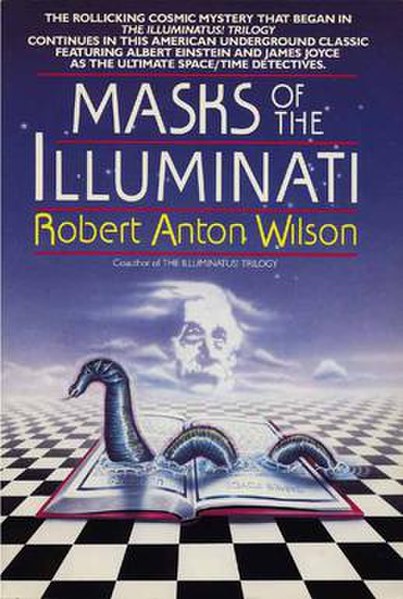
1. Masks of the Illuminati by Robert Anton Wilson
This was my first experience of RAW's fictional work and I enjoyed it thoroughly. A very entertaining, smooth read, this story takes place in the early 20th century and stars none other than James Joyce and Albert Einstein teaming up to help a distressed man who fears he's been the victim of a conspiracy perpetrated by Aleister Crowley. It reads like a detective novel, the clues generated through flashbacks and chewed on by our sleuths, two of the greatest geniuses of their generation, drawing the reader into its mystery until a somewhat ridiculous, confounding (though humorous) conclusion. The novel's shifting writing style often mimics the various styles employed by Joyce in Ulysses and there's even a subplot here of the young Joyce, thanks to his conversations with Einstein on relativity, fully conceiving his grand idea for a new book that would become Ulysses. Joyce describes his idea for "A multi-dimensional, multi-level, multi-meaningful book. A puzzle-book, one might say---and what could be more appropriate to our times, when all the best minds recognize increasingly that our existence is a profound puzzle?" (I read this book along with Tom Jackson's reading group over at his site RAWillumination.net. Go here to see more about the reading group.)


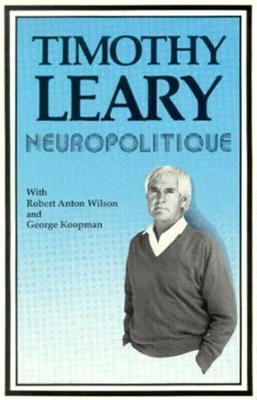
2. Neuropolitique by Timothy Leary and Robert Anton Wilson
A collection of essays from Leary mainly from the early-1970s, this features a wide array of pieces mostly written while in prison. I most enjoyed his overview of what occurred during the 1960s and early 70s which morphs into an incisive (and humorous) condemnation of the system of glorifying crime and punishment in the US, eventually covering his arrival and assimilation into maximum security prison culture, being in a cell next to Charles Manson, and working a deal with law enforcement to shorten his sentence. There are also essays on the 8-circuit model of consciousness (including one written by RAW) and space migration. My favorite aspect of Leary's spiel tends to be his view of DNA and evolution and I love the way he ties space migration into this. He likens space migration to "the movement from marine to amphibian life or from reptile to mammalian." Why don't people say this kind of stuff anymore? The quality of the pieces definitely seems to tail off towards the end but this book is worth reading for the first half. (This also seems to be the only Leary book without his enduring wide grin on the cover. He means business here.)

3. Info-Psychology: A Manual for the Use of the Human Nervous System by Timothy Leary
Continuing my foray into the life and work of Leary (temporarily put on hold at the moment as I work on some big writing projects), this was the book that always seemed most appealing to me since it's Leary's own introduction to the 8-circuit model of consciousness, which RAW so perfectly examined in his book Prometheus Rising. While it has its bright spots, I found this book lacking in many respects (including its physical appearance, the New Falcon re-issue feeling cheap with rigid, stiff paper). While it gave me a better understanding of the overall picture, especially the higher four circuits, the book doesn't make the ideas seem very intriguing at all and even frequently refers to other books of his for further elaboration (whereas I thought this was the key text). At the same time, its subtitle claims it to be a manual but there really isn't anything interactive here, unlike Prometheus Rising which is a book that can literally change your life. You also get a clear sense that Leary was still hammering out some of the details of his model while writing this book, the re-issue even has an awkward set of footnotes at the end suggesting alternatives or retractions for the preceding material. This is another book that Leary wrote while in prison and, while the ideas and insights are staggering at times, it all seems a little disorganized. I don't blame him.

4. Quantum Psychology by Robert Anton Wilson
This is essentially the sequel to his classic Prometheus Rising. Here RAW makes use of the worldview(s) suggested by discoveries in quantum physics and attempts to work these into our experience of everyday life, with lots of interactive exercises that would work best in a group setting. (Once again, Tom Jackson's RAW-focused website had an online reading group for this one.) While there's certainly plenty of fascinating and important stuff here with RAW's usual combo of Zen parables, historical anecdotes, and hard science examining things like psychosomatics, relativity and the 8-circuit model of consciousness, I managed to breeze right through this book without too much of it really sticking in my head. Maybe I'll need to read it again with a more focused attitude and willingness to try all the exercises.

5. The Book of the Breast by Robert Anton Wilson
I picked up the original version, a hardcover edition with pictures, published by Playboy Press (it was later revised and reissued by New Falcon under the title Ishtar Rising). It's one of RAW's earlier works and provides an interesting glimpse at the period when he worked as an editor with Playboy. The subject matter is anthropological and very sophisticated for a book published by Playboy, it reminds me Joseph Campbell's books with its insights developed by a combination of psychology, history, poetry, art, myth, and sociology. At the same time, any regular reader of RAW's works will notice his prose feels a little bit different. Probably due to some combination of the intended audience, the era, the publisher, and the stage of his craft, the writing occasionally tries too hard to come across as hip and cool, man. Ya dig?

6. Baseball Prospectus 2013
This annual stalwart took a major dive by changing its structure, junking its unique, creative essays for a boring, uniform style. Wrote a full review here. Thankfully, they've considered the harsh feedback and are going back to the fun style.

7. Operating Manual for Spaceship Earth by Buckminster Fuller
A very short book but not a very quick read. The eminent architect-engineer-poet Bucky Fuller conveys his thoughts in a dense manner, heavy on metaphors. Great insights, though, and certainly a book that arouses one's optimism as he asserts the essential truth about our global problems---that they are entirely solvable if we restructure our attitudes.

8. Slaughterhouse-Five by Kurt Vonnegut
Somehow I'd never before read this classic, so a friend insisted I borrow it. What a beautiful prose stylist, this Vonnegut guy. I zoomed straight through this excellent and hilarious story of the misadventures of some American POWs in the German city of Dresden toward the end of World War II. A quirky, spectacularly awkward soldier/time-traveler/dentist named Billy Pilgrim is the star of the show and Vonnegut has fun with his pathetic hero. The prose is very simple, poignant, plain, practical. Repeated motifs like the simple phrase "So it goes" give the novel a vital continuity. With the firebombing of Dresden at its epicenter (in which an entire city was reduced to ashes, killing more people than the bombing of Hiroshima), the depiction of the horrors of war is piercing and unsettling but not overly teary or sentimental. Vonnegut's curt prose lets the reader fill in the blanks. Definitely a book to be read multiple times through one's life.

9. Manage Your Day-to-Day: Build your routine, find your focus & sharpen your creative mind by the team at 99u
This little book speaks perfectly to my struggles as an aspiring writer---it's a collection of essays on how to remain focused and manifest your creativity in an era of technology and distractions galore. What it all seems to boil down to is showing up every day, never waiting for inspiration, instead getting your ass to the desk and working. The name for their website comes from the Thomas Edison quote, "Genius is is one percent inspiration, ninety-nine percent perspiration." Basically, put your nose to the grind and work. Highly recommended book for all creative people out there.

10. Joyce's Book of the Dark by John Bishop
I'm almost done with my second reading of this book. Began it last December upon completing Finnegans Wake and, when my attempts to write a summarizing review failed, I had to jump back in and read it again for a better understanding. It's a vast and rich study, a dizzying deconstruction of that most obscure of books, Finnegans Wake, and it may actually be one of the all-time great works of art criticism. In an attempt to explain just what the hell Finnegans Wake is, Bishop begins with Joyce's own frequent hints that it is a book of the night, of the sleeping state, and then proceeds to wrap an astounding array of material from the Wake around his argument through increasingly fascinating chapters, hammering home his points thoroughly and highlighting the deep mysteries of our nightly descent into unconsciousness. His analysis includes large etymological flowcharts, illustrations and diagrams, and even giant maps representing the domain of a sleeping body ("Nocturnal Geography" he calls it). It's definitely not an easy read, but it's arguably the best book ever written about Finnegans Wake and contains some of the most unique and well-argued takeaways from Joyce's puzzling masterpiece I've thus far encountered. Look out for my full review coming soon at my other blog Finnegans, Wake!

Honorable Mention:
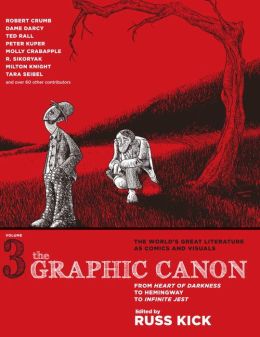
The Graphic Canon Vol. 3: From Heart of Darkness to Hemingway to Infinite Jest

Putting it down here because I haven't read this one in its entirety. Not even close. It's an enormous
book, sort of like an illustrated almanac of 20th century literature featuring a wide array of artistic styles. This serves as both a grab bag of visual candy and a nice primer to the best literature of the last 100 years. It's got just about everything from Joyce and Yeats to Pynchon and Wallace, Aldous Huxley and Hemingway, Kafka, Faulkner, Eliot. You name it, it's here. More importantly, the artwork is awesome. Sometimes it's in graphic novel form, other times weird, trippy, psychedelic paintings, or sharp colorful computer-generated graphics. It's a perfect book to leave out on a coffee table and flip through randomly. So much good stuff here, you'd probably never get through it all.

Saturday, April 13, 2013

Book Review: Baseball Prospectus 2013


For the last ten years, each February has brought a new edition of the Baseball Prospectus annual book to my doorstep. Covering every team and every player with essays, statistics, and commentaries, it's always a treasured new arrival which I somehow manage to devour entirely, all 500+ pages of it, within a few weeks.

While it has the physical appearance of a college accounting textbook, the BP annuals have always been known to be densely stuffed with great writing. The statistics serve as the structural spine of the book but the essays and player commentaries are always the highlight, making it so addictive to read for a baseball nut.

This year's edition made some unwelcome changes to the formula, though, and as a big-time baseball obsessive and Prospectus geek, it's a major disappointment. The BP venture has seen lots of turnover in its writerly ranks over the last 5 or 6 years with the style and content they produce gradually evolving away from what made them so successful in the first place.

Thursday, November 29, 2012

Potent Quotables: The Gutenberg Galaxy Edition


The year is quickly reaching its conclusion, the nights growing longer as the hours of sunlight decline daily. Going through some of the unwritten or uncompleted pieces I had intended to write this year, it occurs to me that a long-planned review of Marshall McLuhan's The Gutenberg Galaxy just isn't going to happen in the way I'd hoped. So I'm going to do something different.

First, some background info:
This incredibly dense and thoughtful text occupied a good portion of my mental energy in the final months of 2011 and into early 2012. Though it sparked many new ideas for me that completely altered my perspective on things, I mostly found it as puzzling and challenging to get through as my first reading of Ulysses. It certainly lacks the pleasing poetic language of Ulysses, but is equally massive in its references and often cuts jarringly from one huge concept to the next. I approached it thinking it'd be like any other analytical academic text but it's something very different.

Thursday, March 15, 2012

Thirst for Knowledge Thursdays: Jung's World-View-Flipping Memories, Dreams, Reflections

"A man who has not passed through the inferno of his passions has never overcome them. They then dwell in the house next door, and at any moment a flame may dart out and set fire to his own house. Whenever we give up, leave behind, and forget too much, there is always the danger that the things we have neglected will return with added force."
- Carl Jung, Memories, Dreams, Reflections pg. 277

In the midst of a conversation with my girlfriend the other day, the subject of which escapes me now, I was led to pick up an old favorite book of mine from the bookshelf and talk a bit about it to her. The book was Carl Jung's autobiography Memories, Dreams, Reflections. I went through a phase of closely studying Jung's writings and nothing came close to the powerful impact of that book. A highly influential psychologist with stacks and stacks of fresh ideas and insights, Jung never seemed to go deeper than he does in this book.

As is perfectly fitting for the man who coined the term "synchronicity," Jung's book suddenly popped up in my atmosphere again that same night as I was reading a recently-discovered blog called Brain Pickings. Seemingly out of the blue, there was Jung's Memories, Dreams, Reflections at the top of the page with a little blurb and even an illustrated diagram summarizing the book's story. This, of course, prompted me to start piecing together ideas for a blog post and I faintly remembered taking copious notes on the book when I had first read it in early 2009.

It was in November of 2009 that I initially started writing this blog, but before I ever decided to start sharing my own thoughts on the internet I had been practicing my writing privately in notebooks for a few years. Digging up my old notes for Jung's book I came across not only a dozen or so pages worth of quotes I had copied down from it, but even a thorough, glowing 8-page review I wrote for it. Looking back at the review, I'm glad to see that I meticulously documented the strong effect the book had on me because I've only read it once but I recall that it struck me powerfully. As I wrote back then, "Upon first rendering, it's a glorious flash of light but it is necessary to approach the material again and sit in its glow for a time. This is extremely powerful, illuminating stuff."

Wednesday, February 15, 2012

Book Review: The Illuminati Papers by Robert Anton Wilson

It is not very often that I shell out the cash for a brand new book. Most of the books I read are worn-out, tattered pre-owned texts that I buy as cheaply as possible either online or from one of Austin's many wonderful used bookstores (the Half Priced Books chain is one of my favorite things about this city). Whenever I do opt to purchase a brand new book it's usually something that has just been released (like the Baseball Prospectus annual which I always need to have as soon as it drops) or something so special that I couldn't resist paying full price.

In the early stages of my addiction to reading Robert Anton Wilson's work, I couldn't resist snatching up a fresh copy of his book The Illuminati Papers from a local New Age bookstore. Many months and re-readings later, I'm very happy with my decision. After quickly zipping through six different RAW books, this is definitely one of my favorites.

Saturday, November 12, 2011

Four Books Reviewed

"The critic...tells of his mind's adventures among masterpieces"
- Anatole France

A tetrad of loosely interrelated books has been occupying my moments of free time the last couple of months and now that I'm just about finished reading all of them, I'd like to share my thoughts on all four.
 
Prometheus Rising 
by Robert Anton Wilson

The legend known among fans and followers as RAW first began to interest me a couple of years ago when I discovered the Maybe Logic blog and all the rich brain food that's been roasting over there. I was led to the site through messing around with Google, searching for combos of names like Joseph Campbell and James Joyce until eventually I stumbled upon this incredible audio interview in which Robert Anton Wilson discusses Finnegans Wake and Campbell's Skeleton Key. The raspy voice and thick Brooklyn accent pouring out infinite multifaceted knowledge was very appealing (I grew up listening to mostly Brooklyn/Staten Island accents) but it wasn't until this summer that I finally started looking into Wilson's body of work. The first book I picked up was his collection of essays entitled Coincidance which features a good chunk of Joyce analysis unlike anything you'll find elsewhere, along with some humorously written conspiracy pieces and brain exercises.

I found his writing style so engaging and captivating that I put some of his other books on my future reading list and eventually picked up the highly-regarded Prometheus Rising. The book has been such a great read that RAW has rapidly shot up into my list of favorites and lately I can't get enough of his writings, interviews, and YouTube lectures. The book is primarily a study of the evolution of human consciousness and how most human beings advance only to a certain level (barely half way up the ladder) and remain there all their lives, condemned to view the universe through a narrow "reality tunnel." Using psychology, biology, neurology, mythology, history, and plenty of other elements, Wilson weaves an engaging and entertaining analysis of Timothy Leary's eight-circuit model of consciousness in an attempt to shake the reader's perspective of reality and allow us to elevate to higher levels of consciousness. Each chapter includes exercises at the end to help break out of our imprinted "circuits" or systems of receiving and reacting to the world.

His main goal is to make us think, to shake us free from the shackles of preconceived notions that are constructed during our upbringing and experiences. The end-of-the-chapter exercises often consist of things like "if you're liberal, subscribe to a conservative magazine for a few months" or "if you're straight, pretend you're gay for a week" and so on; the point, of course, is not to turn liberals into conservatives and make straight folks gay but to allow us to understand that we (and everyone else) sees the world through their own conditioned reality tunnel. It is not all about seeing things the way others do, though, a main point made in the book is also the fact that we convince ourselves that we can't change, can't excel, can't elevate. My favorite exercise thus far is "convince yourself that you can exceed all your previous hopes and ambitions."

It's an extremely eye-opening book and really changes the way I look at humanity (and I'm still not even finished reading it). I can't recommend the book highly enough and I will definitely be devoting another blog post to expanding on its material in the near future. For now, if you're interested in getting a taste of what the book is all about, go check out this roughly one-hour lecture in which he summarizes virtually the entire thing. Wilson's work is quickly sucking me in like a blackhole so you can expect plenty more posts about it in the future.


War and Peace in the Global Village
by Marshall McLuhan

Along with Robert Anton Wilson, McLuhan has become someone whose work I can't get enough of lately. After reading a couple of books summarizing his life and philosophies, I finally decided to pick up a few original books by the man himself. I've got The Gutenberg Galaxy and Understanding Media waiting on the shelf and I devoured War and Peace in the Global Village over the last few weeks. It looked to be the most appealing of the three books I received, with illustrations and photos on every page, plus Finnegans Wake quotes on just about every page (he provides a fascinating little breakdown of the ten one-hundred-lettered thunder claps that appear in the Wake), and a small stature, small enough to squeeze in one's back pocket. I got an original 1968 edition but it looks barely touched.

The first thing that struck me about it is that I could easily see why McLuhan was often a hated figure among his contemporaries in the 60s and 70s. His style of writing is strange, meandering and very difficult to follow (he calls this style "probing"). Rarely does he write two paragraphs without resorting to quoting some other author, often at absurd lengths (two or three pages). He also doesn't ever explain his ideas in clear terms, usually making opaque assertions and trying to back them up with big quotes or seemingly unrelated allusions. It's obvious he had a very unusual mental structure.

A few flashes of bright insight show that he was also quite clearly a genius. The book is broken up into about 5 sections, some very long and some very short. He opens by circulating around his famous vision of the modern technological world as a Global Village. This was in the late 60s, long before the rise of the internet and smartphones but he was so on point, it's unbelievable. McLuhan speaks of all technology as extensions of the human body. So the telescope is an extension of the eye, the wheel an extension of the foot, etc and this leads to computers and digital devices as an extension of the human nervous system. The entire planet is now covered in an invisible nervous system that connects everybody together so that an event that occurs in New York City is instantly felt in Hawaii, Japan, and the remote reaches of the Russian Tundra.

He goes on for far too long in this first section, starting out by detailing how the advances of technology over the last 2,500 years specialized military and warfare while facilitating the growth of empires (he gets things a bit twisted in the process) and moving to a discussion of the proliferation of psychedelic drugs among young people in the 60s, arguing that it was a response to the rise of technology, comparing the effect of TV and computers to a "high" state that must be replicated or dilated through the use of drugs. He also makes a much more salient point on this last subject (and this starts to bring in what I see as McLuhan's main theme) which is that as humanity moves from the fragmented industrial age to the revival of the tribal atmosphere in a digital global village, the ritual becomes much more important and prevalent among the new generations, and here he quotes drug users lauding the ritual aspect of communal drug use.

It is in the next sections that the book finally gets engaging and truly fascinating as he first talks about "War as Education" and then "Education as War." The former has to do with the rapid advances in knowledge and technology during times of war, the latter with our culture's way of imprinting old and out-dated ideas onto our youth. This discussion of education actually perfectly aligned with what Robert Anton Wilson was saying in Prometheus Rising. As McLuhan writes:
"In the information age it is obviously possible to decimate populations by the dissemination of information and gimmickry...It is simple information technology being used by one community to reshape another. It is this type of aggression that we exert on our own youngsters in what we call 'education.' We simply impose upon them patterns that we find convenient to ourselves and consistent with available technologies. Such customs and usages, of course, are always past-oriented and the new technologies are necessarily excluded from the educational establishments until the elders have relinquished power."
Wilson talked about this exact same thing in his elaboration of the so-called "semantic" circuit or level of consciousness:
"Cynics, satirists, and 'mystics' [McLuhan can be considered something of a satirical mystic, actually] have told us over and over that 'reason is a whore,' i.e. that the semantic circuit is notoriously vulnerable to manipulation by the older, more primitive circuits."
Further exploration of the similarities between RAW and McLuhan will be forthcoming in a separate blogpost, but for now I will stick to the script. Overall, War and Peace in the Global Village is a fascinating and often frustrating book; it's visually pleasing and there are plenty of great insights but for a tiny book it can get boring quickly.

The first two books reviewed here are ones that I've been reading as part of the preliminary process of preparing for the big study of Ulysses I am hoping to begin soon. Both Wilson and McLuhan are obsessed with Joyce and offer interpretations of his work unlike anything you'll find in regular Joyce critiques and analyses so I want to soak up whatever I can from them right now (while also familiarizing myself with their work). The two reviews below are of books that I'm reading more for fun and personal development.


Integral Life Practice
by multiple authors

This book is a kind of instruction manual or school textbook written by a bunch of people. It is a very clear and simple-to-understand exposition of Ken Wilber's Integral Theory and how to apply it to all aspects of life. Back in 2008, while visiting a graduate school in San Francisco I had gotten into a nice discussion with the clerk at the school bookstore. We were discussing Carl Jung, Stanislav Grof, Joseph Campbell and some of my other favorites when he brought up Ken Wilber and started gushing about how he's the best philosopher/writer/psychologist there is right now and his books are the greatest shit ever. Despite his proselytizing, I decided to push off reading Wilber's stuff for the future and picked up Richard Tarnas' latest book instead.

Four years later, I came across this Integral Life Practice book in a used bookstore and finally decided to give it a chance. It's not really written by Wilber; he wrote the introduction and oversaw the book's production but other than that, a group of devotees took his ideas and expanded on them in terms that a layman could understand.

The subtitle for the book is "A 21st-Century Blueprint for Physical Health, Emotional Balance, Mental Clarity, and Spiritual Awakening" and that just about sums it up. It's more vanilla consciousness-expanding tutorial than New Age, esoteric tome. The whole Integral theory is built from a simple foundation: a quadrant. In the upper left is the individual interior (feelings, emotions, consciousness), the upper right is the individual exterior (physical body and its actions), bottom left is the collective interior (culture, society, morals), and the bottom right is the collective exterior (the planet, the state, community). 

From the base of this very useful quadrant, the reader is taught how to achieve their highest potentiality in four fields: the shadow, the mind, the body, and the spirit. The inclusion of the shadow within the normal "mind, body, spirit" bunch seemed strange at first but the authors stress that it is important for us to confront and assimilate our psychological shadows first before progressing through advancement in other states. Each of the four fields (shadow, mind, body, spirit) include very simple tutorials and directions for practice, the so-called "shadow work" was actually very beneficial in my experience and I'm thankful to have come across such a thing. The other practices were also very rewarding.

It's easy to see what is so special about Wilber and his integral theory; it is a pretty damn admirable attempt at integrating the greatest wisdom and knowledge of all possible fields, presented in a relatively simple manner. The highest advances in psychology, nutrition, exercise, yoga, physics, spirituality, sociology and more are combined to formulate the elevation of humans to their highest potential. It's not too far off from Prometheus Rising in that sense, though with RAW the writing is much more entertaining and often daring. I would definitely recommend this book to anyone trying to elevate their consciousness, mind, body, etc. A consistent approach to carrying out its methods will undoubtedly reap huge benefits.

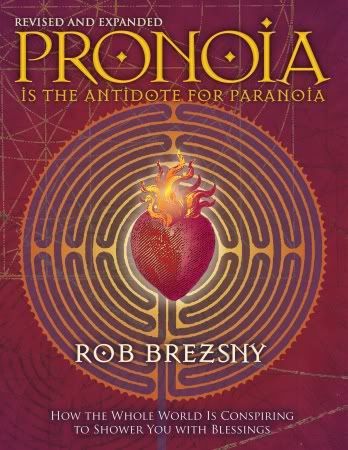
Pronoia is the Antidote for Paranoia: How the Whole World is Conspiring to Shower You with Blessings
by Rob Brezsny

In a way, this book combines all three of the other ones. What a whacky and spectacular book this is...

This book sort of found me, I was at the house of one my girlfriend's co-workers and it was sitting innocently on the couch, unnoticed by anyone. It's a large book (thick but also tall) and the huge glowing mandala on the cover caught my eye. I flipped it open and found a mention of Joseph Campbell and thought "okay, it's got my attention." Wondering what else it might have to offer, I flipped through it a bit more and came across a mention of Finnegans Wake and then Robert Anton Wilson and I was officially hooked in. Bought it a few days later.

The message of the book is quite perfectly summed up in its title---the author argues that the entire universe is designed to shower you with blessings (if you can learn to see it that way). It sounds silly and, of course, it is kind of silly but through all kinds of whacky humor and stunning intelligence in this unusual book, the point is made quite strongly. The more I read RAW's work, the more I see this book as a descendant of it, but nevertheless it is still a special achievement. Once again, here is a book attempting to shake you out of your rigid bounds, to burst you free of your shackles.

It looks sort of like a big coloring book or the type of workbooks kids use in elementary school. There are mandalas and every other conceivable spiritual symbol flooding each page while Brezsny jots a handful of personal stories of creative awakening and spiritual liberation in a wonderfully humorous and intelligent manner. He's got a gift for writing and coming up with the funniest-yet-profoundest phrases, very often it seems like he's poking fun at himself and the book itself but he's delivering powerful messages at the same time. A perfect example is in the book's outlined objective on page 7: "To explore the secrets of becoming a wildly disciplined, fiercely tender, ironically sincere, scrupulously curious, aggressively sensitive, blasphemously reverent, lyrically logical, lustfully compassionate Master of Rowdy Bliss."

As funny as it can be sometimes, it's also a book that continually shocks me with how much intellect it contains. As I mentioned, there's discussion of Joyce, Campbell, and RAW but also Jung, Freud, Shakespeare, Dante, and pretty much everything else I've ever been even remotely interested in and then some. Besides the handful of personal stories that are shared, there are 15 chapters featuring great quotes on particular subjects (dreams, the shadow, the universe, etc), thought-provoking collections of (positive) world news & events, and so-called "Pronoia Therapy" which consists of exercises (888 of them altogether) in a similar sense to those presented in RAW's books, except much whackier. Similar to how Joyce's greatest books contain a sort of alchemy or black magic ritual under the surface, Brezsny loads this book up with all kinds of masonic, occult, religious, mythological symbols and twists their axioms to promote the pronoiac, positive aura in the reader. It's been a very nice panacea for me after all the deep study I did on the subject of paranoia for my Dali-Joyce paper, plus it really is a perfect antidote to the cynical, world-renouncing feeling one gets when reading or thinking about the numerous atrocities and abuses of power destroying the planet. It's perfect for those who desperately need to balance their minds from too much conspiracy (Illuminati, world government, evil oligarchy) material.

This is a book that I can't seem to ever stop reading, I imagine it will be in my pile of books for at least another 5 years. It's not quite inexhaustible but flipping it open to a random page any time always yields some bright light and sends me off on some rewarding path. Mounds and mounds of ponderous, positive, and productive stuff in here. To close, here's a selection from the book that quite perfectly ties all 4 of these reviewed books together while also aptly applying to the turmoil of our times.
As much as we might be dismayed at the actions of our political leaders, pronoia says that toppling any particular junta, clique or elite is irrelevant unless we overthrow the sour, puckered mass hallucination that is mistakenly called "reality"---including the part of that hallucination we foster in ourselves.

The revolution begins at home. If you overthrow yourself again and again and again, you might earn the right to help overthrow the rest of us.