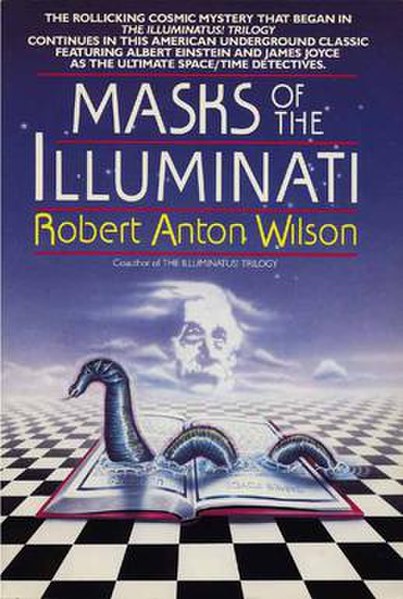
1. Masks of the Illuminati by Robert Anton Wilson
2. Neuropolitique by Timothy Leary and Robert Anton Wilson
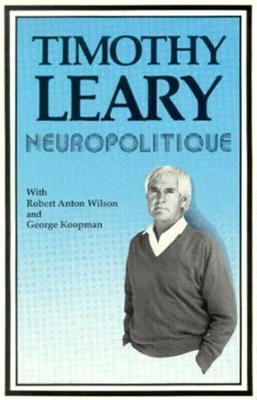 A collection of essays from Leary mainly from the early-1970s, this features a wide array of pieces mostly written while in prison. I most enjoyed his overview of what occurred during the 1960s and early 70s which morphs into an incisive (and humorous) condemnation of the system of glorifying crime and punishment in the US, eventually covering his arrival and assimilation into maximum security prison culture, being in a cell next to Charles Manson, and working a deal with law enforcement to shorten his sentence. There are also essays on the 8-circuit model of consciousness (including one written by RAW) and space migration. My favorite aspect of Leary's spiel tends to be his view of DNA and evolution and I love the way he ties space migration into this. He likens space migration to "the movement from marine to amphibian life or from reptile to mammalian." Why don't people say this kind of stuff anymore? The quality of the pieces definitely seems to tail off towards the end but this book is worth reading for the first half. (This also seems to be the only Leary book without his enduring wide grin on the cover. He means business here.)
3. Info-Psychology: A Manual for the Use of the Human Nervous System by Timothy Leary
Continuing my foray into the life and work of Leary (temporarily put on hold at the moment as I work on some big writing projects), this was the book that always seemed most appealing to me since it's Leary's own introduction to the 8-circuit model of consciousness, which RAW so perfectly examined in his book Prometheus Rising. While it has its bright spots, I found this book lacking in many respects (including its physical appearance, the New Falcon re-issue feeling cheap with rigid, stiff paper). While it gave me a better understanding of the overall picture, especially the higher four circuits, the book doesn't make the ideas seem very intriguing at all and even frequently refers to other books of his for further elaboration (whereas I thought this was the key text). At the same time, its subtitle claims it to be a manual but there really isn't anything interactive here, unlike Prometheus Rising which is a book that can literally change your life. You also get a clear sense that Leary was still hammering out some of the details of his model while writing this book, the re-issue even has an awkward set of footnotes at the end suggesting alternatives or retractions for the preceding material. This is another book that Leary wrote while in prison and, while the ideas and insights are staggering at times, it all seems a little disorganized. I don't blame him.
4. Quantum Psychology by Robert Anton Wilson
This is essentially the sequel to his classic Prometheus Rising. Here RAW makes use of the worldview(s) suggested by discoveries in quantum physics and attempts to work these into our experience of everyday life, with lots of interactive exercises that would work best in a group setting. (Once again, Tom Jackson's RAW-focused website had an online reading group for this one.) While there's certainly plenty of fascinating and important stuff here with RAW's usual combo of Zen parables, historical anecdotes, and hard science examining things like psychosomatics, relativity and the 8-circuit model of consciousness, I managed to breeze right through this book without too much of it really sticking in my head. Maybe I'll need to read it again with a more focused attitude and willingness to try all the exercises.
5. The Book of the Breast by Robert Anton Wilson
I picked up the original version, a hardcover edition with pictures, published by Playboy Press (it was later revised and reissued by New Falcon under the title Ishtar Rising). It's one of RAW's earlier works and provides an interesting glimpse at the period when he worked as an editor with Playboy. The subject matter is anthropological and very sophisticated for a book published by Playboy, it reminds me Joseph Campbell's books with its insights developed by a combination of psychology, history, poetry, art, myth, and sociology. At the same time, any regular reader of RAW's works will notice his prose feels a little bit different. Probably due to some combination of the intended audience, the era, the publisher, and the stage of his craft, the writing occasionally tries too hard to come across as hip and cool, man. Ya dig?
6. Baseball Prospectus 2013
This annual stalwart took a major dive by changing its structure, junking its unique, creative essays for a boring, uniform style. Wrote a full review here. Thankfully, they've considered the harsh feedback and are going back to the fun style.
7. Operating Manual for Spaceship Earth by Buckminster Fuller
A very short book but not a very quick read. The eminent architect-engineer-poet Bucky Fuller conveys his thoughts in a dense manner, heavy on metaphors. Great insights, though, and certainly a book that arouses one's optimism as he asserts the essential truth about our global problems---that they are entirely solvable if we restructure our attitudes.
8. Slaughterhouse-Five by Kurt Vonnegut
Somehow I'd never before read this classic, so a friend insisted I borrow it. What a beautiful prose stylist, this Vonnegut guy. I zoomed straight through this excellent and hilarious story of the misadventures of some American POWs in the German city of Dresden toward the end of World War II. A quirky, spectacularly awkward soldier/time-traveler/dentist named Billy Pilgrim is the star of the show and Vonnegut has fun with his pathetic hero. The prose is very simple, poignant, plain, practical. Repeated motifs like the simple phrase "So it goes" give the novel a vital continuity. With the firebombing of Dresden at its epicenter (in which an entire city was reduced to ashes, killing more people than the bombing of Hiroshima), the depiction of the horrors of war is piercing and unsettling but not overly teary or sentimental. Vonnegut's curt prose lets the reader fill in the blanks. Definitely a book to be read multiple times through one's life.
9. Manage Your Day-to-Day: Build your routine, find your focus & sharpen your creative mind by the team at 99u
This little book speaks perfectly to my struggles as an aspiring writer---it's a collection of essays on how to remain focused and manifest your creativity in an era of technology and distractions galore. What it all seems to boil down to is showing up every day, never waiting for inspiration, instead getting your ass to the desk and working. The name for their website comes from the Thomas Edison quote, "Genius is is one percent inspiration, ninety-nine percent perspiration." Basically, put your nose to the grind and work. Highly recommended book for all creative people out there.
10. Joyce's Book of the Dark by John Bishop

Honorable Mention:
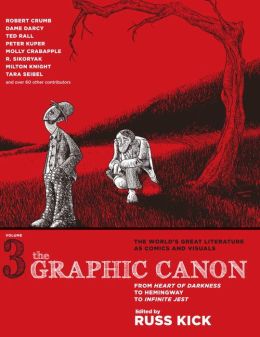
The Graphic Canon Vol. 3: From Heart of Darkness to Hemingway to Infinite Jest
Putting it down here because I haven't read this one in its entirety. Not even close. It's an enormous


.JPG)