Saturday, July 31, 2010

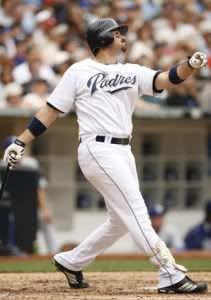
How 'bout them Padres?

It's certainly been a great season for the Padres so far. I managed to secure great seats to Thursday afternoon's battle with their rival Dodgers and watched a tense 2-2 game that was won in the bottom of the 9th by Padre pinch-hitter Oscar Salazar. On "Throwback Thursday" with the Padres sporting their 1978 brown-and-yellow uniforms, it was fitting that the game was won by one of the only players wearing the true 70s high stirrups.

*   *  *
It was announced during the game that the Padres had just traded for Miguel Tejada from Baltimore and a great buzz hummed throughout the 42,000-plus in attendance. I heard some bad words about current struggling shortstop Everth Cabrera and grumblings about what Tejada has left. But I like the deal very much and was excited when I heard about it.

Make no mistake about it, this Padre team has some run-scoring issues. Their pitching is so unbelievably amazing that this hasn't hurt their success but general manager Jed Hoyer recognized the team's main issue and made clear improvements with some offensive reinforcement for the pennant race the Padres are now seriously involved in. In his first year running the team, he's already shown a knack for shrews trades. This morning he picked up a solid corner outfield bat in Ryan Ludwick from the Cardinals.

*   *   *
The key in acquiring Tejada is that the Padres have gotten pretty much nothing offensively out of their shortstop position. After a strong rookie season last year, Everth Cabrera has struggled terribly this year with a .198 average and .270 OBP. He's looked pathetic at the plate recently as he's receded further into a slump and taken to bunting in almost every at bat to try and beat out an infield base hit. With David Eckstein injured, Jerry Hairston Jr. has had to cover for him at second base and so Cabrera has been left to rot out there. Now he'll be a back-up and pinch runner.

Tejada hasn't hit well in Baltimore this year but escaping that decrepit failure of a franchise (and the highly competitive AL East division) for the first place Padres should enliven him a bit. He had a very good year for the Astros last season, leading the National League in doubles with 46 so he probably has something left to show NL foes. His diminished defensive range shouldn't be a huge problem with the Padres pitching staff leading the majors in strikeout rate and thus putting fewer balls in play. He's also a perfect platoon partner for Chase Headley at third: Headley struggles with a .194/.263/.242 line against lefties while Tejada has a strong .821 OPS against southpaws for his career.

Ryan Ludwick is a huge addition for this team. Not only is he a very good fielder with a cannon arm (thus not disrupting but perhaps adding to the excellent Padre defense) but he's a solid above-average hitter (.288 True Average) who immediately becomes the Padres' second best offensive player. As a fan, I'm very excited about this upgraded lineup.

Best of all, the Padres didn't have to give up very much to get these two hitters. The best player given up is probably minor league pitcher Wynn Pelzer who they sent to the Orioles in exchange for Tejada. Pelzer was the #5 prospect in their system before this season according to Baseball Prospectus but he's struggled at Double-A this season and will probably end up in the bullpen.


Friday, July 30, 2010

Epiphanic Morsels

Briefly apprehending the nascent ice cubes in my freezer's ice tray conjured this: ice as metaphor for human life span.

The trapped, individual soul in between periods of flowing aqua-essence and floating gaseous mist.

Also the evolution of stars, solar systems, planets, the cosmos.
*   *   *
Came across this quote from Nietzsche this afternoon:

"In some remote corner of the universe, poured out and glittering in innumerable solar systems, there once was a star on which clever animals invented knowledge"
--Nietzsche

Tuesday, July 27, 2010

Further 'Inception' Awesomeness


This makes me want to go see the movie a third time.

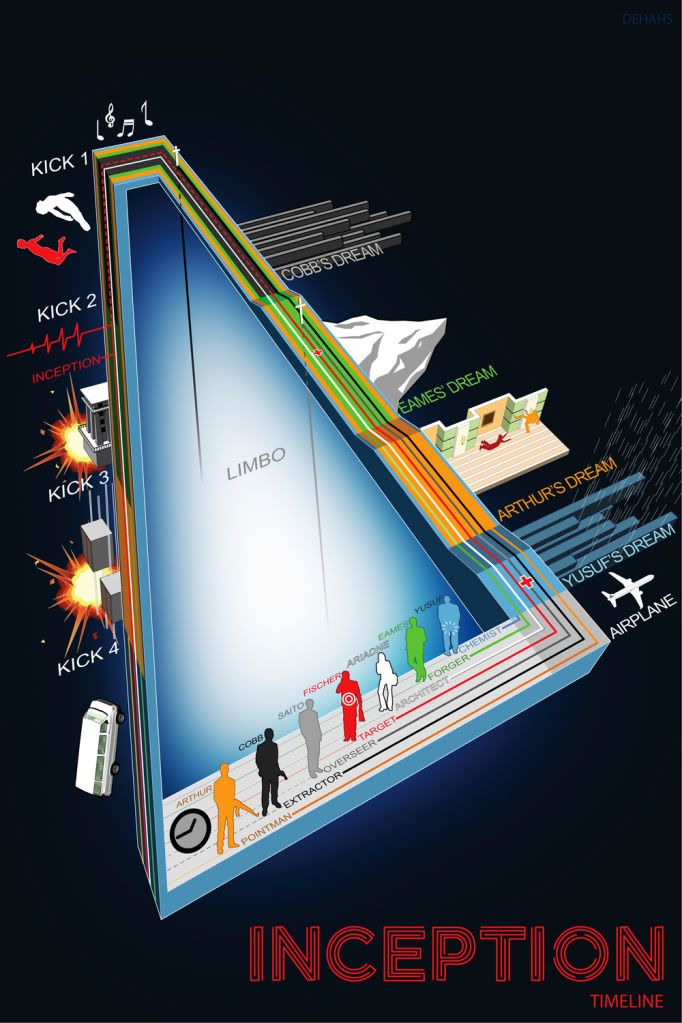
And then there's this cool graphic representation of the whole dream heist. Click for a larger view and zoom in to study it.
A couple things I didn't catch in my first viewing of the film but which stuck out when I saw it a second time, both involve the chemist Yusuf:

*When they go to meet Yusuf for the first time, he takes them into a dark dreary backroom where people come to take sedatives and dream for hours (in deep dreams that feel like days or weeks). Both Yusuf and his creepy dream den attendant eerily insinuate that they know Cobb and that he's done this before and been there before even though, as far as we can tell, this is the first time he's met these people. It's a very dark, dank, spooky scene that feels like the inside of a cave, and after Cobb tests out Yusuf's special sedative he's a bit of a mess. We see him in the bathroom splashing water on his face and looking in the mirror (very reminiscent to the opening of "Shutter Island") trying to convince himself it's not a dream. When he tries to spin his totem it goes flying off the table and this was actually a part where many people have suggested Dom proved he was dreaming. I'm not so sure about that, but the way Yusuf and the old guy talk to Dom with familiarity is weird and never explained.

*This one is a lot less relevant (or at least I think it is), but I caught on to the line where Arthur derides Yusuf for not going to the bathroom on the plane. Apparently his feeling of having to pee (or, since he's heavily sedated, peeing on himself) is what caused the heavy rain in that dream level.

Monday, July 26, 2010

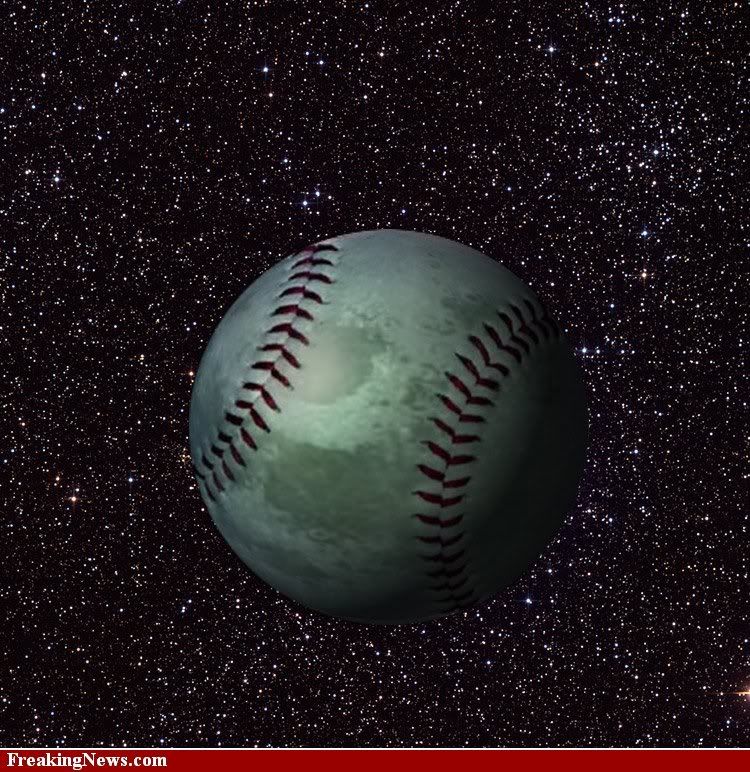
The Big Baseball in the Sky

Last month when Edwin Jackson threw a no-hitter against the Rays in Tampa Bay, I wrote a post about the weird coincidence between the evening's odd baseball events (an 8-walk no-hitter, the Phillies playing a road game in their home park) and the lunar eclipse that occurred that night. It was not only a lunar eclipse that night but also a full moon and I noted the other strange coincidence: the previous no-hitter (Roy Halladay in Florida) was also on a full moon. So you could imagine I was pretty stunned when I learned this evening that Matt Garza had thrown a no-hitter in Tampa Bay against the Tigers because tonight is a full moon. That's 3 straight full moon/no-hitters.

*   *   *
Since we're on that topic, here's a superbly written article about baseball and metaphysics. Very tongue-in-cheek, almost satirical actually but it's still a great read. Very impressive and, despite the absurd hyperbole, much of it is true.
All these variations, all these hints of arbitrariness, are absolutely crucial to the aesthetics and moral metaphysics of the game because they remind us that fair territory is, in fact, conceptually limitless and extends endlessly beyond any outfield walls. Home plate is an open corner on the universe, and the limits we place on the game’s endless vistas are merely the accommodation we strike between infinite possibility and finite actuality. They apprise us, yet again, that life is ungovernable and pluriform, and that omnia mutantur et nos mutamur in illis. They speak both of our mortality (which obeys no set pattern or term) and of the eternity into which the horizons of consciousness are always vanishing (the primordial orientation of all embodied spirit). And something similar is true of the juncture of infield and outfield, where metaphysics’ deepest problem—the dialectical opposition but necessary interrelation of the finite and the infinite—is given unsurpassable symbolic embodiment.
          ...
Really, the game has such an oddly desolate beauty to it. Maybe it is the grindingly long, 162-game season, which allows for so many promising and disheartening plotlines to take shape, only to dissolve again along the way, and which sustains even the most improbable hope past any rational span; or maybe it is simply the course of the year’s seasons, from early spring into mid-autumn—nature’s perennial allegory of human life, eloquent of innocent confidence slowly transformed into wise resignation. Whatever it is, there is something of twilight in the game, something sadder and more lyrical than one can quite express. It even ends in the twilight of the year: All its many stories culminate in one last, prolonged struggle in the gathering darkness, from which one team alone emerges briefly victorious, after so long a journey; and then everything lapses into wintry stillness—hope defeated, the will exhausted, O dark, dark, dark, all passion spent, silent as the moon, and so on. And yet, with the first rumor of spring, the idiot will is revived, the conatus essendi stirs out of the darkness, tanha awakens and pulls us back into the illusory world of hope and longing, and the cycle resumes.
A much more eloquent and academic version of George Carlin's classic sermon.

Sunday, July 25, 2010

Examining James Joyce/Stephen Dedalus' Esthetic Philosophy (part 2)

"Aristotle has not defined pity and terror. I have."

Thus Stephen Dedalus boldly begins his discussion on esthetics. He is referring to Aristotle's Poetics in which the Greek philosopher says that tragedy evokes pity and terror to achieve catharsis. But since Aristotle did not define pity and terror, scholars have misinterpreted him for the last 2,300 years, interpreting catharsis as a purging of these emotions, getting rid of them by a large dose of the same. Friedrich Nietzsche, in his study of Greek drama The Birth of Tragedy, has written of this misinterpretation:
Now the serious events are supposed to prompt pity and terror to discharge themselves in a way that relieves us; now we are supposed to feel elevated and inspired by the triumph of good and noble principles, at the sacrifice of the hero in the interest of a moral vision of the universe. I am sure that for countless men precisely this, and only this, is the effect of tragedy, but it plainly follows that all these men, together with their interpreting aestheticians, have had no experience of tragedy as a supreme art.
The emphasis is Nietzsche's, not mine.

Let’s look at the usage of this word “catharsis,” a term which has led to some confusion among scholars unsure whether Aristotle had in mind a medical (his father was a physician) or moral significance. The word “catharsis” comes from the Greek katharsis derived from katharein, “to cleanse.” As Joseph Campbell tells us in Mythic Worlds, Modern Words, in Greek religious vocabulary the term referred to “a spiritual transformation brought about by participation in a rite. The mind, ‘cleansed’ of attachment to merely secular aims, desires and fears, is released to a spiritual rapture.” Campbell also notes that the Greek theater was associated with the shrines and festivals of Dionysus, in fact the tragedies were performed during the Great Dionysia at Athens, a yearly festival. Dionysus was the god of wine and ecstasy “but also, more fundamentally, of the generative power of all life, the will in nature."

In Nietzsche’s aforementioned book, he analyzes what he believes to be the main factors at work in Greek tragedy and calls these the Dionysian and the Apollonian. The Dionysian is essentially the ego-shattering, sublime experience of one-ness with all things.
Under the charm of the Dionysian not only is the union between man and man reaffirmed, but nature which has become alienated, hostile, or subjugated, celebrates once more her reconciliation with her lost son, man…Transform Beethoven’s ‘Hymn to Joy’ into a painting; let your imagination conceive the multitudes bowing to the dust, awestruck--then you will approach the Dionysian…Now, with the gospel of universal harmony, each one feels himself not only united, reconciled, and fused with his neighbor, but as one with him, as if the veil of maya had been torn aside and were now merely fluttering in tatters before the mysterious primordial unity.
Now, let us go back for a moment to Stephen’s definitions of pity and terror. He says:
Pity is the feeling which arrests the mind in the presence of whatsoever is grave and constant in human sufferings and unites it with the sufferer. Terror is the feeling which arrests the mind in the presence of whatsoever is grave and constant in human sufferings and unites it with the secret cause.
He uses the word arrest, that static emotion of complete rapture that we looked at in Part 1 of this post. The mind perceiving the “grave and constant” in the sufferings of man, the inevitability of death and pain, is risen beyond individuality to compassion and a recognition of shared humanity. The feeling of terror (something different than fear, mind you) shatters us in awe at the workings of the life-giving and life-consuming universe.
Suppose a human being has thus put his ear, as it were, to the heart chamber of the world will and felt the roaring desire for existence pouring from there into all the veins of the world, as a thundering current or as the gentlest brook, dissolving into a mist---how could he fail to break suddenly? How could he endure to perceive the echo of innumerable shouts of pleasure and woe in the ‘wide space of the world night,’ enclosed in the wretched glass capsule of the human individual, without inexorably fleeing toward his primordial home, as he hears this shepherd’s dance of metaphysics?
That’s Nietzsche describing the feeling of Dionysian rapture again. But, as I’ve said, there’s also the Apollonian factor in Greek tragedy. The Apollonian is the dream illusion, the veil placed in front of infinity to make us feel as though we’re individuals confined in bodies within space with its separate objects. While the Greek tragedy is eliciting that feeling of Dionysian one-ness, the Apollonian illusion brings us back to realize that this is all being enacted by characters in one single image of the world, a stage. (This is also, in Stephen’s view, the wholeness, harmony, and radiance of a beautiful self-contained image.) In The Birth of Tragedy, Nietzsche wrote:
Thus the Apollonian tears us out of the Dionysian universality and lets us find delight in individuals; it attaches our pity to them, and by means of them it satisfies our sense of beauty which longs for great and sublime forms; it presents images of life to us, and incites us to comprehend in thought the core of life they contain. With the immense impact of the image, the concept, the ethical teaching, and the sympathetic emotion, the Apollonian tears man form his orgiastic self-annihilation and blinds him to the universality of the Dionysian process…
And so Aristotle either had it wrong or was misinterpreted. The tragic emotions, pity and terror, are evoked so that the audience can come to a deep realization. I’ve already made such heavy usage of Nietzsche’s work that I’ll let him have the final word on the matter (this one from Twilight of the Idols):
Affirmation of life even in its strangest and sternest problems, the will to life rejoicing in its own inexhaustibility...that is what I called Dionysian, that is what I recognized as the bridge to the psychology of the tragic poet. Not in order to get rid of terror and pity, not in order to purge oneself of a dangerous emotion through its vehement discharge—Aristotle misunderstood it that way—but, beyond pity and terror, to realize in oneself the eternal joy of becoming.

Saturday, July 24, 2010

Listen and Learn

Just listen. And pay attention.

Note: It's a bit long (6 parts about 9 minutes each) so you may need to take it in slices.


Thursday, July 22, 2010

Scattered Thoughts on "Inception"

**Spoiler Warning: I'll be discussing elements of the story that might spoil the film for someone who hasn't seen it yet. I'm warning you!**

Sunday, July 18, 2010

Examining James Joyce/Stephen Dedalus' Esthetic Philosophy (part 1)

James Joyce cannot be described as simply a ‘novelist.’ He was a poet before he had even attempted to write prose. In fact, he composed a poem at the age of 9 that was so incredible his father mailed it to the Vatican. Calling him a ‘writer’ simply doesn’t do the trick either, it’s best to describe him as an ‘artist’ and Joyce himself made the distinction clear in the title of his first novel, A Portrait of the Artist as a Young Man, which details Joyce’s own life from childhood through young adulthood in a prose style that grows more complex and intelligent as the character does. 

He is also a philosopher, at times outlining his own philosophies and theories through his characters (mainly, his alter ego Stephen Dedalus) and this is especially so in Portrait. In the final chapter of the book, Stephen is a student in the first years of college and he’s already gained a reputation for being an aspiring poet.  We’ve heard him describe his goal to escape the nets of nationality, language, and religion which are flung at souls to hold them back from flight. And, in a conversation with the school’s dean, we learn that Stephen has been working on an esthetic theory using ideas from Aristotle and Aquinas. A few pages later, in conversation with his friend Lynch who jokingly acts disinterested, Stephen outlines in detail his esthetic philosophy.

Proper vs Improper Art
Joyce first distinguishes between proper and improper art.
The feelings excited by improper art are kinetic, desire or loathing. Desire urges us to posses, to go to something; loathing urges us to abandon, to go from something. These are kinetic emotions. The arts which excite them, pornographical or didactic, are therefore improper arts. The esthetic emotion (I use the general term) is therefore static. The mind is arrested and raised above desire and loathing.

Proper art = static
Improper art = kinetic

Proper art is art in the service of what is properly the function of art and that function is to elicit a state of esthetic arrest. Arrest = static (from the Greek statikos, “causing to stand”). You apprehend a proper piece of art and you can only stand there in sensational (esthetic) contemplation and enjoyment. You’re in awe, raised above desire and loathing. Whereas a picture of a pretty girl or even of a plate of delicious food draws you physically to desire it. Joyce calls this pornographic art and, in this sense, all advertising art is improper art. Derogatory satire, art with social criticism that causes you to loathe or dislike something: that’s improper art---it’s didactic, instructing you what to do.
The desire and loathing excited by improper esthetic means are really unesthetic emotions not only because they are kinetic in character but also because they are not more than physical. Our flesh shrinks from what it dreads and responds to the stimulus of what it desires by a purely reflex action of the nervous system.
What is art?
We then get into what exactly art is and there is a quote which I think perfectly describes James Joyce or Stephen Dedalus (or, perhaps, any artist) at this point in his life:
To speak of these things and to try to understand their nature and, having understood it, to try slowly and humbly and constantly to express, to press out again, from the gross earth or what it brings forth, from sound and shape and colour which are the prison gates of our soul, an image of the beauty we have come to understand---that is art.
Once art and its proper function (esthetic arrest) are understood, the artist crafts an image of beauty using things like sound, shape, and color which open the gates of the soul.

Art, said Stephen, is the human disposition of sensible or intelligible matter for an esthetic end.

Beauty
In response to his friend’s question “What is beauty?” Stephen (Joyce) gets even deeper. Thomas Aquinas’ simple definition (“that is beautiful the apprehension of which pleases”) does not suffice because, using woman as example, he notes how the many different cultures around the world “admire a different type of female beauty.” The popular hypothesis explaining the phenomenon is that the physical qualities admired by men are “in direct connection with the manifold functions of women for the propagation of the species.” Stephen dislikes that dreary hypothesis (“It leads to eugenics rather than to esthetic”) and describes his own:

This hypothesis is the other way out: that, though the same object may not seem beautiful to all people, all people who admire a beautiful object find in it certain relations which satisfy and coincide with the stages themselves of all esthetic apprehension. These relations of the sensible, visible to you through one form and to me through another, must be therefore the necessary qualities of beauty.
And a few pages later he continues:
The most satisfying relations of the sensible must therefore correspond to the necessary phases of artistic apprehension. Find these and you find the qualities of universal beauty…[Now quoting Aquinas again] Three things are needed for beauty: wholeness, harmony and radiance.”

Looking at each one now:
1. Wholeness: [He points to a basket someone is carrying on their head] “In order to see that basket, said Stephen, your mind first of all separates the basket from the rest of the visible universe which is not the basket. The first phase of apprehension is a bounding line drawn about the object to be apprehended. An esthetic image is presented to us either in space or in time. What is audible is presented in time, what is visible is presented in space. But, temporal or spatial, the esthetic image is first luminously apprehended as selfbounded and selfcontained upon the immeasurable background of space or time which is not it. You apprehend as one thing. You see it as one whole. You apprehend its wholeness.”

2. Harmony: “Then you pass from point to point, led by its formal lines; you apprehend it as balanced part against part within its limits; you feel the rhythm of its structure. In other words the synthesis of immediate perception is followed by the analysis of apprehension. Having first felt that it is one thing you feel now that it is a thing. You apprehend it as complex, multiple, divisible, separable, made up of its parts, the result of its parts and their sum, harmonious.”

3. Radiance: “When you have apprehended that object as one thing and have then analysed it according to its form and apprehended it as a thing you make the only synthesis which is logically and esthetically permissible. You see that it is that thing which it is and no other thing. The radiance of which he speaks is the scholastic quidditas, the whatness of a thing. This supreme quality is felt by the artist when the esthetic image is first conceived in his imagination. The mind in that mysterious instant Shelley likened beautifully to a fading coal. The instant wherein that supreme quality of beauty, the clear radiance of the esthetic image, is apprehended luminously by the mind which has been arrested by its wholeness and fascinated by its harmony is the luminous silent stasis of esthetic pleasure, a spiritual state very like to that cardiac condition which the Italian physiologist Luigi Galvani, using a phrase almost as beautiful as Shelley’s, called the enchantment of the heart.”

Joyce alludes to this kind of esthetic apprehension in Ulysses: “Any object intensely regarded may be a gate of access to the incorruptible eon of the gods.” And Joseph Campbell elaborates the experience for us in his book Mythic Worlds, Modern Words:
This is a breakthrough. You have gone through the object and felt the transcendence that manifests through it, the transcendence of which you are yourself a manifestation. Pure object turns you into pure subject. You are simply the eye, the world eye, regarding beyond desire and loathing…
Forms of Art
Having explained what (proper) art is and how we apprehend beauty, Stephen now goes on to describe what he sees as the three forms of art, in all of which “the image must be set between the mind or senses of the artist himself and the mind or senses of others.” The three forms, each “progressing from one to the next,” are:

1. the Lyrical form: “the form wherein the artist presents his image in immediate relation to himself”
2. the Epical form: “the artist presents his image in mediate relation to himself and to others”
3. the Dramatic Form: “the artist presents his image in immediate relation to others”

He elaborates each one:
The lyrical form is in fact the simplest verbal vesture of an instant of emotion, a rhythmical cry such as ages ago cheered on the man who pulled the oar or dragged stones up a slope. He who utters it is more conscious of the instant of emotion than of himself as feeling emotion.

The simplest epical form is seen emerging out of lyrical literature when the artist prolongs and broods upon himself as the centre of an epical event and this form progresses till the centre of emotional gravity is equidistant from the artist himself and from others. The narrative is no longer purely personal. The personality of the artist passes into the narrative itself, flowing round and round the persons and the action like a vital sea.

The dramatic form is reached when the vitality which has flowed and eddied round each person fills every person with such vital force that he or she assumes a proper and intangible esthetic life. The personality of the artist, at first a cry or a cadence or a mood and then a fluid and lambent narrative, finally refines itself out of existence, impersonalizes itself so to speak. The esthetic image in the dramatic form is life purified in and reprojected from the human imagination. The mystery of esthetic like that of material creation is accomplished. The artist, like the God of the creation, remains within or behind or beyond or above his handiwork, invisible, refined out of existence, indifferent, paring his fingernails.
The lyrical form seems quite easy to understand from his explanation, it’s as simple as a poem written by someone in love. The poet is presenting his image (the poem) in “immediate relation to himself” while everybody else reads the poet’s feelings expressed in lyrics. In the epic, the artist presents his work in mediate relation to others, I find Ulysses to be a perfect example as Joyce (through Stephen) is directly involved in the action but the story is presented with a full, detailed backdrop of the city, its inhabitants and especially the other main characters. One could perhaps make an argument that, in his three books, Joyce displayed the progress from one form to the other: the self-centered autobiographical Portrait (lyrical) leading into Ulysses (epical) and then the intricately crafted dream world of Finnegans Wake (dramatic). But, more likely, both Portrait and Ulysses should be considered epics and Finnegans Wake the absolute epitome and farthest extreme of the dramatic form.


Read Part 2 HERE

(Note: This whole discussion owes a great deal to Joseph Campbell's book Mythic Worlds, Modern Words: Joseph Campbell on the Art of James Joyce.)

Saturday, July 17, 2010

First thoughts after seeing "Inception"

So I saw the film tonight and was pretty blown away just like everybody else.

It's about as good a movie-watching experience as you can have but it's definitely demanding on the viewer. One has to try to figure out and keep up with the complexities of the narrative at a pretty rapid speed. Even without understanding every detail and how some major aspects of the story link together though, you'll understand well enough to be sucked into the action.

I think INCEPTION as a title has many meanings, one of which is that the film itself is planting the idea inside the viewer's mind that everything is not what it seems. Reality is perhaps not so real, everything is just being crafted by us at the same time as we observe it. (This is the basis of quantum physics.)

I'll undoubtedly have a ton more to say about the film and I will be seeing it many more times but for now, I'm gonna try to regain my grip on (what I think is) the waking state. Sunday is my birthday.

Wednesday, July 14, 2010

"Inception" Excitement

 In case the trailers and rave reviews haven't gotten you excited about the upcoming film Inception yet, consider this quote from a USA Today article on the film's writer/director Christopher Nolan:

The idea for Inception came when he was in college, staying out late and crashing in his dormitory. Nolan slept so lightly he would become lucid — aware he was in a dream state — and began exploring ways to manipulate that faux reality.
He would find himself on a beach and challenge himself to pick up a handful of sand and count out individual grains. "That, to me, suggests infinite creative potential for the human mind, and infinite levels of mystery," he says. "I would do something like take a book off the shelf and open it to see if I can read the page. And I can. The words will kind of make sense and there's this bizarre feedback, part of your brain that's creating just before you perceive it."
I wonder if he inserted any references to Finnegans Wake in the movie.

Sunday, July 11, 2010

MLB 2010 Midseason Thoughts: National League

Standings as of Saturday morning July 10th, 2010.


NL West
San Diego  --
Colorado  2
Los Angeles 2
San Francisco  5
Arizona  17.5

I like the Padres, I go to many of their games (eight this year so far, two in the past two weeks), and I've written about them a bunch of times here already. I'm very happy to see them in first place but as I've mentioned before, the Rockies and Dodgers have really started to play better after slow starts and they've been biting at the Pads' heels for weeks. The question is: are the Padres truly good enough to win this division? With their extremely pitcher-friendly home ballpark, there's been some confusion about the overall quality of this Padre team. Their pitching has been great, but some silly people discredit that as a park illusion (even though their ERA in away games is the best in the majors) and, big ballpark or not, nobody believes in their offense. The park-adjusted statistics (TrueAverage and OPS+) do show that they've got a pretty weak offensive attack with Adrian Gonzalez (.324 TAv) and Nick Hundley (.271 TAv) being the only above-average hitting regulars. Away from the wide expanses of Petco Park, the team hasn't hit very well at all but with their undeniably awesome pitching they've managed to amass the best road record in the National League.

And the offense has actually performed pretty well at home while the pitching has been great:

4.41 runs scored per game at home
3.17 runs allowed per game at home

They are a team of stellar pitching (led by burgeoning rookie Mat Latos in the rotation and a historically great bullpen) and a just-good-enough offense. It's basically Adrian Gonzalez and a bunch of guys who "get the job done." Early in the season it looked like Chase Headley was going to finally bust out as a high-caliber player but he's really slowed down and currently sits at a pretty weak .259 TAv. Thankfully, Nick Hundley has emerged as a good hitter and, despite limited playing time so far, I'm liking what I see from outfielder Aaron Cunningham.

I had great seats for a Padres-Rockies game last week and saw a nice duel between Pads' lefty Wade LeBlanc and Rox righty Jason Hammel. Aside from an extremely impressive homerun launched over the fence in the deepest part of the yard by redhot youngster Carlos Gonzalez, LeBlanc didn't allow much and pitched a great game but it was blown open by the long-ball serving ways of San Diego reliever Edward Mujica. Colorado looked strong and they took 2 out of 3 in that series without their best player (Troy Tulowitzki). The two teams had a great battle in Colorado last night and they're in a close game right now as I type this. Look for a very entertaining race to the finish line between these two teams over the next three months. Obviously I'll be rooting for the Padres.

While I picked the Dodgers to win the division in my preseason picks, their erratic play has me questioning whether they'll even stay in the mix much longer.

NL Central
Cincinnati  --
St. Louis    2
Chicago   10.5
Milwaukee  10.5
Houston   13.5
Pittsburgh   18

Oh boy was I ever wrong about the Brewers. I feel bad for the Milwaukee fans devoting their time, energy, attention, and emotion to this team. On the other hand, the success of the team on the Ohio River in Cincinnati is undoubtedly for real. Their lineup is very deep, especially with Scott Rolen recapturing his glory days (.306 TAv). Joey Votto (.337 TAv, 22 HRs) is having a huge year, Brandon Phillips is having his typical good year, and I think you can expect Drew Stubbs and Jay Bruce to continue to get better as the season goes on. They've got talented young pitchers up the wazoo (rookie Travis Wood almost threw a perfect game in Philadelphia today) and I don't think even the clumsy ineptitude of toothpick-chewing Dusty Baker can sink this cruising ship.

On the other hand, did anybody see the ending of that Rockies-Cardinals game the other night? The Rox pulled a miracle comeback, scoring 9 runs in the 9th inning while down by 6 but what in the hell was Tony La Russa thinking playing his outfielders so deep? Yet another example of TLR overmanaging to the detriment of the team. Check out the highlights, it was a 9-7 game with 2 outs and a runner on third, Carlos Gonzalez batting. That run at third was meaningless, the pitcher had to simply get Gonzalez out to win the game. Gonzalez stroked a line drive to right field that would've normally been hit directly at the right fielder but Randy Winn was playing as far back as the warning track. I believe this is called "no doubles" defense but who cares about a double in that situation? It looked like the outfielders were positioned there to be ready to retrieve a homerun from over the fence...which is just insane! La Russa was also largely blamed for (twice in one game) losing that extremely long game to the Mets earlier this season. The Cards are supposed to be the favorites to win this division, their rotation is superb (2nd best ERA behind the Padres), and the lineup is solid but I wouldn't be surprised to see La Russa screw up a few more tight games and lose this division by one or two games in the end.

And I'm amazed the Pirates have played bad enough to fall below the Astros. The Astros are pathetic.

NL East
Atlanta   --
New York  4
Philadelphia  5.5
Florida   10
Washington   12.5

Tim Hudson has been the surprise ace (2.44 ERA) of a strong Atlanta pitching staff and the depth of offensive production they've had is staggering. They have an unbelievable ten (!) hitters with a True Average of at least .270. Nine guys have at least a .280 TAv. Five (!) hitters have at least a .290. I think it's clear that they've got a strong hold on the #1 spot atop this division but don't count the Mets and Phillies out. The 2nd place team here will probably take the Wild Card.

I've been pleasantly surprised with this Mets team all season long. As good as that Braves offense is, the Mets are still right next to them in overall True Average. David Wright has regained his status as the Metsiah. His True Average of .326 leads all major league third basemen, a serious feat considering the next closest is Evan Longoria at .313. Wright also leads all 3B in VORP and is 7th in all of baseball by that stat. Angel Pagan has turned into a nifty player, Jose Reyes is getting his mojo back, Jason Bay hasn't hit homers but is still producing (.293 TAv), and although he's slowed down as of late I still trust in what Ike Davis can do. Don't forget about Carlos Beltran! I worried about the rotation coming into this season but Mike Pelfrey has established himself as a force to be reckoned with after adding a splitter to his arsenal while Johan Santana is showing signs of coming out of his weird slump (which was apparently due to tipping off his vaunted changeup), Jonathon Niese is becoming established as a consistent starter (.541 SNWP or Support-Neutral Winning Percentage), and R.A. Dickey has successfully been a big hairy knuckleballer...what's more fun than that?

The Mets bullpen is what worries me. Are Elmer Dessens and Fernando Nieve reliable? Maybe for now, but I'd be pulling my hair out if they were protecting leads late in the season in a pennant race. Although Rob Neyer sees no discernible difference in his peripheral numbers, K-Rod is worrisome. It'd be fun if the Mets could fight their way to the top and knock off the Braves or beat out the Phillies for the Wild Card but it's easy to foresee some big late game collapses by that Met bullpen.

NL MVP thus far: Adrian Gonzalez, Padres
The San Diego star has had yet another huge season batting in the middle of a lineup without any other major threat (see above) and playing half his games in the worst hitter's park in the majors. Taking a look at his park-adjusted numbers at Baseball Prospectus' site (scroll to the Davenport Translations), Adrian would have 38 homeruns right now if he were in a normal park. The major league leader has just 24. Look at his road numbers for crying out loud: .353/.410/.660 AVG/OBP/SLG. 

NL Cy Young thus far: Josh Johnson, Marlins
There are a few guys in the National League having great pitching seasons. The most talked about is probably Ubaldo Jimenez, but Roy Halladay is having another great year, so is Adam Wainwright and even Mat Latos. Josh Johnson has been better than all of them. His 1.70 ERA is the best in baseball (so is his 1.84 Runs Allowed), he has the most Quality Starts, the best opponents OPS, and he's a hundreth of a point behind Cliff Lee for best WHIP all while throwing more innings than all but five pitchers in the NL. Looking at more advanced stats, he currently leads all major league pitchers in Wins Above Replacement, Support-Neutral Win Percentage, and ERA+. His stature in that last mark is just insane, at 246 it means he's prevented runs at a rate 146-percent better than the league at this point (that number also adjusts for any advantage he may get from his home ballpark). The last pitcher to be in that territory was vintage Pedro. Keep watching!