Showing posts with label soul. Show all posts

Saturday, July 28, 2018

Healing Ingredients for Hard Times

Greek street art from here.

"A middenhide hoard of objects!" 
- Finnegans Wake, p. 19


"To clean and tidy up Matter...
To put back all the things people cluttered up
Because they didn't understand what they were for...
To straighten, like a diligent housekeeper of Reality,
The curtains on the windows of Feeling
And the mats before the doors of Perception...
To sweep the rooms of observation
And to dust off simple ideas...
That's my life, verse by verse."

- Fernando Pessoa (as Alberto Caeiro), 17 September 1914 
(from A Little Larger Than the Entire Universe: Selected Poems, p. 56)


Besides the increasingly entropic, sad and infuriating thunderstorm of drama unfolding daily in the news, my closer circumference has also been racked with scary, turbulent, and unpredictable drama lately. The tension of the times is inescapable, it seems.

Besides the weight of experiencing people close to me fighting life-threatening illnesses, family friends passing away, and cherished friends leaving town, the last few months have featured the misfortune of a nearby neighbor exploding into a dark psychotic and meth-aided breakdown bringing nerve-eroding levels of disturbance and threat to my immediate community. My strong woman is terrified, deeply rattled, and my infuriated Italian Staten Island dude energy is trying to force its way into the situation. Plus it's Texas so the entire neighborhood is armed. Dealing with all of this has been rough.

What's helped me keep my head on straight is regular indulgence in the following ingredients: reading the poetry of Fernando Pessoa, exploring the music of rapper Ka, vibing off daily doses of Fela Kuti or lines from Finnegans Wake, and both watching and playing lots of baseball. Here are some thoughts on all of those.

Sunday, November 25, 2012

Album Review: Sophisticated Movement by Kevlaar 7 & Woodenchainz


"My vinyl voice so vintage, hear the *crackling* and the *clicking*"
- Kevlaar 7

With three high-quality releases in less than two years, Kevlaar 7 is arguably the most consistent purveyor of pure hip hop right now. This latest offering, Sophisticated Movement, is a 15-track collaboration with burgeoning beatcrafter Woodenchainz, an album bursting at the seams with soulfulness as the sounds of decrepit Detroit's underground hip hop/blues heart continues to pour out from the Wisemen camp.

Tuesday, January 3, 2012

Where We're At (The Center of the Universe)

The Railway Station at Perpignan (1965) - Salvador Dali
During the year that has just concluded, a good deal of my mental energy was devoted to Salvador Dali and his paranoiac-critical method. The paranoiac method was one of the keys to my study of Dali and James Joyce. For Dali, one of his favorite means of sharing this theory was always his deep infatuation with Millet's famous painting The Angelus (this was discussed in more detail here). During the 1930s, Dali penned a book-length analysis of this seemingly simple painting, asserting that the two farmers, who appear to be observing the daily Angelus prayer devotions in their field, are actually kneeling over a tiny casket. Millet decided to paint over the casket, Dali declared, because it came across as too morbid.

Monday, November 28, 2011

Look Around (Wonder)


"Time is only floating in your mind" - Stevie Wonder

"Everything we see is inside our own heads" - Buckminster Fuller

"The 4th dimension is time,
it goes inside the mind
when the chakras energize
up through the back of your spine"
- The Rza

"there is a future in every past that is present" - James Joyce (Finnegans Wake p. 496)

Unfortunately, I do not have much TIME to write but I do want to mention a few things. I enjoyed a nice, delicious Thanksgiving Day last Thursday (featuring two separate vegan feasts, actually), during which time it struck me that in the last 5 years I've eaten a Thanksgiving meal in 4 different cities (New York, London, San Diego, Austin in that order).

Yesterday I unloaded a stack of about 10 unwanted books at a used bookstore to begin the process of down-sizing to prepare for an upcoming move to a different apartment. This will mark the 5th time I've moved in the last 4 years. Prior to that I spent the first 22 years of my life living in the same bedroom, let alone the same address.

At the bookstore I almost bought a couple of really cool-looking books that intrigued me, but decided at the last minute it didn't make sense to bring more books home when I'm trying to purge belongings. On the topic of TIME, though, the books bear mentioning. They were both part of the excellent Introducing... series published by Totem Books, a collection of paperbacks with illustrations and basic introductory overviews for a whole variety of topics. I can highly recommend the James Joyce, Friedrich Nietzsche, and The Universe editions and if there's anyone else you're interested in learning about (famous minds, but also concepts or historical periods are covered), this series of books is perhaps the best thing to look for. Anyway, the books were Introducing Relativity and Introducing Quantum Theory (for a total of $12), I will hopefully grab them at some point in the future when I get to settle down in a new place.

In between our two Thanksgiving feasts last week, my girlfriend and I sort of randomly made our way over to the movies to see whatever was playing at that time. The film we saw was Martin Scorsese's new 3-D excursion Hugo. The young protagonist Hugo works as a clockmaker (or timekeeper) in the Montparnasse train station in 1920s Paris. Honestly, we had to leave the film early because of time constraints but it was an okay film. Visually beautiful but a bit slow-moving. The reason I bring it up is because of a brief but very noticeable cameo by none other than JAMES JOYCE himself. And, of course, after all the work I did on my big essay this year comparing Joyce and Salvador Dali (noting that there is no record of them ever having met), the scene shows James Joyce and Salvador Dali sharing a table at a café in the train station. It's one of the first scenes in the film.

This morning I received word from the editors of the James Joyce Quarterly that they will have an answer for me within the next two weeks about whether or not they will accept my Joyce-Dali paper to be published in their journal. Very hopeful, very excited.

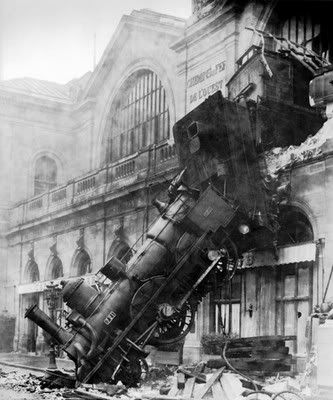
And now, to tie a knot on this synchronistic little post, here is a famous picture of a train crash at the aforementioned Montparnasse train station in Paris in 1895:

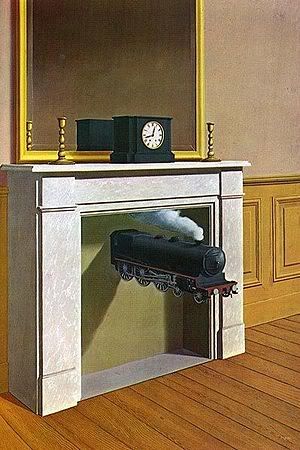
And here is a famous Surrealist painting called Time Transfixed by René Magritte.

Monday, July 25, 2011

Some words for Winehouse

Saturday morning I had to get up very early, around 6 AM, to drive my girlfriend to work. Bursting out of sleep and into consciousness so early brought with it a still-spinning movie reel of vivid dream action. I don't often remember my dreams (although I have tried a few times, including recently, to record them in the morning immediately upon waking up in an effort to tap into that unconscious wellspring) but this time I was still seemingly half asleep. The whole story was fresh and I outlined it to my girlfriend during the short drive over to her job, including my own attempts at interpreting each facet of it.

My memory of the dream began with me checking into a hotel and my credit card being denied. The problem was quickly resolved (although there was intense worry upon my only form of payment being rejected) and I went over to the elevator to head up to my room. It was a crappy, rickety old elevator, probably representing the elevators at the hotel I stayed at recently in Pasadena, those were unusually old and slow as hell.

I went in and hit the button to head up to my floor but then two little children rushed in and started playing a game where they chased each other in and out of the elevator while their mother looked on, unable to control them. I realized the elevator wouldn't be going anywhere so I opted to take the stairs. Walking back into the lobby there was a big beautiful staircase in the middle that led up to a restaurant on the second floor. This lobby, in retrospect, was a dream distortion of the lobby in the hotel I was forced to stay in after I was stranded at LAX last month when the United Airlines computers crashed and passengers had to sit at the ticket lines for over 5 hours.

Walking up the hotel lobby steps I heard a news report blaring out from a television below: a young superstar NHL goaltender had suddenly died in a car accident. This goalie had a name in the dream but it wasn't anybody real, just an unconsciously garbled name but this news hit me hard and I felt terrible for this young man who'd died so suddenly. A very close friend of mine, a hockey goalie who I'd grown up with since the age of 8 or so, died in his sleep two years ago, just two weeks after his 26th birthday and, with the anniversary of his untimely death coming up soon it's likely that the thought of him was present here.

As I continued ascending the stairs onto the second floor, the news report's grim images and descriptions of the young man, normally a spirited and animated presence in hockey games, having his life evaporate from him on a stretcher bubbled up sadness from my heart into my throat and I nearly broke into tears. The stairs led into a restaurant and while walking through the restaurant I spotted a familiar face. It was a distinguished man with glasses and he was carrying on a monologue to a large table of people, I recognized him as an NHL general manager, in fact, the GM of the team who'd just lost their goalie to a sudden death. I went up to him and offered my condolences at this horrible tragedy and he was relieved to see me because he'd been trying to communicate to his dinner guests just how bad this news is. I helped elaborate it for him, noting how this young man was only 25 years old and was at the height of his athletic career, etc, etc.

Shortly after that I woke up. After returning home from dropping my girlfriend off at work it was still super early and I was super tired so I sunk right back into bed and went back to sleep for hours. When I woke up again I was spacey and slow, before I could even get out of bed I languidly checked for new e-mails on my phone and then resorted to Twitter. There I saw the news that Amy Winehouse had just been found dead at the age of 27. It felt like my dream had perhaps tapped into a splash in the collective unconscious.

I never paid that much attention to Amy Winehouse's music over the years but I was certainly blown away by "You Know I'm No Good." The woman clearly had an immense gift for singing, listen to her voice for a few seconds and it will rumble down into the deep recesses of your soul. As powerful as her talent was, her inner demons were just as strong. We all wrestle with our shadows. Nietzsche wrote: "One must have chaos within oneself if one is to be a dancing star." Reading about Ms. Winehouse's harrowing struggles with drug addiction it's clear that her torment ran deeper than we could possibly imagine. She certainly wasn't the first superstar musician to have a drug problem but reading the details of her preferred substances (crack, heroin, ecstasy, cocaine, ketamine, alcohol) makes Ol' Dirty Bastard seem like a choirboy. And her descent played out in plain sight for all to see and judge.

I've been listening to her music a lot these past few days and I'm simply in awe of her voice. Russell Brand wrote a beautiful and personal tribute to her and described this feeling perfectly:
The awe that envelops when witnessing a genius. From her oddly dainty presence that voice, a voice that seemed not to come from her but from somewhere beyond even Billie and Ella, from the font of all greatness. A voice that was filled with such power and pain that it was at once entirely human yet laced with the divine.
I hope her troubled soul can now finally rest in peace.

I also hope that people can come to understand that she doesn't deserve to be tossed into the gutter because of her failure to cope with her problems. Artists are often lightning rods not just for controversy, glamor, and all the other paparazzi bullshit. They are antennas tuned into the aura of their epoch. We live in a chemically consumptive world and this brilliant young woman who couldn't stop gobbling up drugs is representative of our modern mass madness. 

Saturday, May 14, 2011

More Mind Fusion

"De la musique avant toute chose..."
("Music before anything else")
- Paul Verlaine, Art Poétique

I'd like to share a few more examples of the records that appear on Volume 2 of Madlib's Mind Fusion series I talked about in the last post. The essence of this first song embodies, for me, the whole approach of these Madlib mixes and serves as a nice introduction to the catalogue of forgotten beauties that this musical savant seeks to entertain us with.


This next one is an epic 1960s Italian song with great drums.


That song is by the famous Italian composer Ennio Morricone who also produced the legendary soundtrack to the trilogy of Clint Eastwood spaghetti westerns in the 60s. Of all the great musical notes in that classic film series, the one that I've always been most struck by is the poignant little pocket watch tune that plays an important part in the second film of that trilogy, For a Few Dollars More.


And, last but not least, a glorious explosion of drums and piano, again from Mind Fusion Vol. 2:


(I just want to point out that this isn't even the best mix in the 5-part Mind Fusion series. That would be Volume 3 which contains about 70 minutes of nothing but gems. Unfortunately, there is no extant tracklist for Volume 3 and I've only been able to identify one song, though it's a beauty.)

The Flight of the Oriole


For the last 2 or 3 weeks I've found myself listening almost exclusively to Madlib's Mind Fusion series, a pretty rare set of cds featuring a vast display of old soul-jazz-funk-psychedelic-global-whatever records (there are 5 albums/mixtapes in the series, 2 of them feature Madlib-produced hip hop remixes, 3 of them are diverse DJ mixes from Mind Altering Demented Lessons In Beats' famous 5-ton collection of vinyl and those mixes are superb).

The song above is from Volume 2 of the series (you can see the full tracklist here) and this tune has captivated me from the first time it hit my ears. It's jazz/soul with an old nightclub feel (the singer, Lorez Alexandria, had performed in Chicago nightclubs in the 1950s but this song is from her 1978 album How Will I Remember You?). I'm entranced by the blend of fast-tapping drums, deep bass strumming slowly, and the singer's strong voice and delivery. Her voice darts and floats like a bird as she sings the seductive story of a ladybird, a Baltimore Oriole, using avian archetypes ("no time for a lady to be dragging her feathers around in the snow"). A bird's eye view of the track reveals the full synthesis of meaning, content, and flavorful delivery---her French-sounding pronunciation of the "r" in Oriole even brings to mind the French word orielle which means "ear" and it's as though the temptress described in the song is also tempting the musical ear of the listener (the oriole is, after all, a songbird). It becomes clear that this was all purposely done by this very talented musician, her bio states that her "clearly enunciated delivery...was always highly sensitive to the import of the lyric she was singing" and the info shown at the bottom of the YouTube clip describes her as "superior at interpreting lyrics."

*   *   *


The Baltimore Oriole first received its name because the bird's orange-and-black feathers resembled the coat of arms of Lord Baltimore, a British coloniser in the 1600s who was the first proprietor of the colony of Maryland in North America. The Baltimore Oriole is (surprise!) the state bird of Maryland and, following the pastoral tradition of naming baseball teams after state birds, Baltimore ballclubs have used the symbol of the Oriole for almost 130 years now.

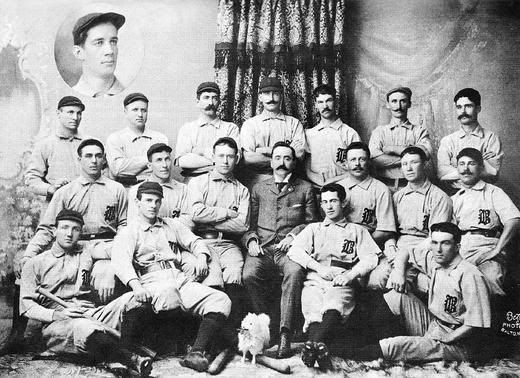
The Baltimore Nine in the 1890s
The original Baltimore Orioles baseball franchise was founded way back in 1882 (the year James Joyce was born). They were a charter member of the American Association, an old professional league that lasted for ten years. When that league folded in 1892, the Orioles joined the National League (yep, the same National League that the Mets and everyone else play in today) and became a powerhouse, winning three consecutive pennants.

The National League during the 1890s was a scary place, the games often filled with violent, dirty play, the umpires were often spat on, punched, or shoved and the fans involved themselves in the game's quarrels to a degree unlike anything we could imagine nowadays. In their tame moments, they were known to hurl rotten eggs or beer bottles at the on-field arbiters. As Bill James wrote in the Historical Baseball Abstract,
 "the fans never actually killed an umpire. They tried. Umpires required police protection countless times, and there was an incident in Minnesota in 1906 in which a crowd got hold of an umpire with apparent intent to do bodily harm, but was dissuaded by a local athlete. A good many umpires have been killed in on-field accidents, some of them in the minors. But if they didn't kill one (deliberately) in the 1890s, then it just wasn't destined to happen, because they sure tried." (pg 53)
During this violent era, the Orioles were known as the absolute dirtiest team of them all. In 1894, the Orioles started a fight on the field in Boston that got so ugly it ended up with the the fans rioting and starting a fire that destroyed the ballpark and 170 surrounding buildings. Led by third baseman John McGraw, who would eventually go on to become one of the greatest managers of all time for the New York Giants, they played rough and they succeeded with it.

But just as the 20th century dawned, the National League decide to get rid of four teams including the Orioles. Members of the defunct team went to the brand spankin' new American League and made their own Baltimore Orioles team though they'd only last a couple of years before moving to New York and becoming the Highlanders (eventually changing their name to the Yankees).

The Orioles of today that we know and love were originally the St. Louis Browns, another team in the early American League, until the franchise transferred to Baltimore in 1954 and took on the name of the famous old B-more ballclubs. The newly minted Orioles stunk during their early years in the American League but they would eventually build up a pretty spectacular team that managed to stay in contention virtually every year from 1960 to 1983, winning three World Series titles along the way.

Those Orioles teams pulled off the exalted feat of playing in the Fall Classic for three consecutive years from 1969 to 1971, though they only won once during that span (in 1970). In 1969, the highly-favored, powerhouse O's went up against the scrappy New York Mets. The Amazin' and lovable Mets pulled off the upset, defeating Baltimore in 5 games, winning their first ever World Championship in a series that featured a handful of legendary moments. Here's the Mets segment from Ken Burns' wonderful baseball documentary:


*   *   *

Having departed San Diego and lost the luxury of rooting for and seeing a nearby baseball team (the Padres) on the regular, I've found thus far this season that I'm clutching to my Mets fanhood as tightly as ever. I'm now deep in the heart of Texas, the state's two pro ball teams are each at least three hours away from me and I've got absolutely no interest in either of them anyway. I don't have cable, so I can't pick up their games on TV and while I do watch baseball on MLB.tv, I'm blacked out from watching any games involving a Texas team. So, early on in the season while league storylines are still developing, I've latched onto my ol' Mets.

This year's team got off to a terrible start but they've looked pretty respectable lately as their deep offense has awoken from its offseason hibernation. As I mentioned recently, I've been particularly glad to see Carlos Beltran back in the lineup and mashing the ball like he used to. As I cooked dinner the other night, I watched and cheered loudly as Beltran launched three homeruns against Colorado.

This weekend, the Metropolitans make their only trip to the city of Houston (though they do return to Texas to face the Rangers in June) and I've been trying to figure out a way to head over there to see a game but my schedule doesn't allow it and it's a three hour drive each way. I can't help but be annoyed by this, though, because my favorite baseball team is playing within driving distance from here and I'm unable to go see them.

I didn't even get to watch last night's game live as it was blacked out. The Mets went about their business anyway and blasted three monstrous homeruns in a nice comeback win against the Astros. For tomorrow afternoon's tilt, featuring the knuckleball-flinging sensation that is R.A. Dickey taking the hill for the Mets, I'll probably resort to tuning into the game's radio broadcast to keep up with the happenings of the National League New York Nine.

*   *   *

The inimitable Joe Posnanski wrote a nice blog post that briefly examines the reborn Carlos Beltran (leading the NL in extra base hits at the moment) and compares him to Derek Jeter while also painting a humorously accurate and well-written portrayal of New York City and her relationship with her baseball teams. As anyone who's spent time in Manhattan knows, the best way to get a glimpse of what's going on with the local teams is to drop a quarter and pick up the often absurd New York Post tabloid. Sayeth Joe:
"I look to the Post front page for overreaction, for gut punches, for the very thing that New York cops, construction workers, store owners and waitresses and anyone else you might run into would say."