Showing posts with label the universe. Show all posts
Showing posts with label the universe. Show all posts
Saturday, November 3, 2012
The Known Universe
Pretty sure I've posted this before in the past, but certainly well worth a re-posting. It's a video showing the entirety of the universe as we comprehend it, set to the music of composer Hans Zimmer (actually, a funky remix of Zimmer).


Saturday, October 13, 2012
This is Where We Live

Hard to believe this is even a real photo (click to enlarge).
From NASA's essential Astronomy Picture of the Day page.
Saturday, September 8, 2012
Glowing Infinite Cosmos Picture of the Day

Courtesy of one of my favorite sites on the internet, Astronomy Picture of the Day. Would love it if I could have their posts show up on my blog everyday but I don't think they'd like that.
With all the phony political presidential bullshit going on right now, I imagine myself as presidential candidate simply saying to people "Look at a picture of the cosmos. Zoom in close as you can and look how many galaxies and stars are in one little pixel. Now, enough of all this meaningless minuscule bullshit. Let's just stop murdering people in the name of senseless wars and figure out how to unite as a planet and start exploring the vast mysterious infinitudes of the universe together."
Sunday, May 27, 2012
Parallax, Cosmic Dimensions and Their Measurements
Via Brain Pickings here is an exceptionally awesome little video explaining graphically how we, as humans on the surface of a relatively minuscule celestial body in a practically infinite cosmic ocean, are able to accurately observe the stars and judge their distances.
It's worth watching more than once. You'll likely be too bedazzled by the scope of it all on first viewing, but the explanations undoubtedly become more digestible with each viewing.
It's worth watching more than once. You'll likely be too bedazzled by the scope of it all on first viewing, but the explanations undoubtedly become more digestible with each viewing.
Friday, March 2, 2012
Supernova 1987A
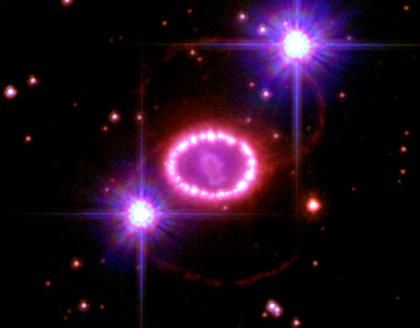
Spotted this beauty on NASA's Astronomy Picture of the Day website. The ring in the center is Supernova 1987A which, as you may have guessed, is a supernova witnessed by astronomers in the year 1987. There are numerous theories for why it appears this way with two hoops surrounding it, but "their origin is still largely unknown."
Supernova 1987A remains one of the brightest stellar explosions we've witnessed since the birth of the telescope 400 years ago. These gigantic explosions occur as the final event in a massive (larger than our dwarf Sun) star's life. For an unfathomable length of time, a massive star maintains a delicate equilibrium between the strength of its outward-pushing nuclear explosions and inward-pulling gravitational force. At the end of its life, a star stops producing the nuclear energy at its core and the entire thing compresses in on itself through the violent process of gravitational collapse. As all of the matter and energy collapses into a tiny dense sphere, it suddenly bounces back outward and creates an incredibly luminous explosion. They are often so powerful as to outshine an entire galaxy (which is approximately 100 billion times larger).
I don't quite understand this stuff thoroughly enough to explain much more than that but I do want to mention neutron stars which are one possible final scenario after a supernova event.
A neutron star is an extremely condensed little star that, as its Wikipedia page attests to, squeezes 500,000 times the mass of the earth into a sphere smaller than Manhattan. These sci-fi-sounding spheres are scattered throughout the universe.
For more incredible astronomical stuff to look at and ponder, go check out THIS page with a time-lapse image of Supernova 1987A's shockwaves smashing into surrounding debris.
Tuesday, January 3, 2012
Where We're At (The Center of the Universe)
 |
| The Railway Station at Perpignan (1965) - Salvador Dali |

Subscribe to:
Posts (Atom)