Sunday, July 24, 2011

"Thought Through My Eyes": Epilogue, Part 3 (Expansive Bibliography)

To finally close out this treatise, I would like to share thoughts on some of the books used in the research process.


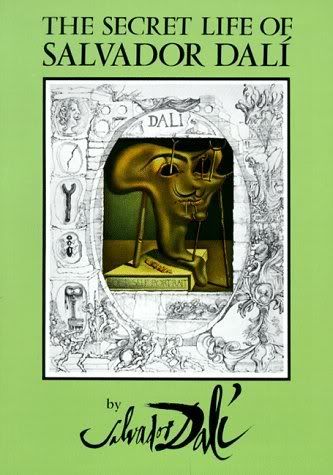
Published in 1942, this is really the definitive text to read for those interested in Dali. His writing style is superb though often flashy and exuberant as he tells the story of his life starting with intrauterine memories (seriously). The intrauterine stuff was actually very interesting, especially as compared to Stanislav Grof's research on the subject (which came decades later). As often seems to be the case, Dali's artistic intuition is so precise that it matches perfectly with later scientific findings.

Next to A Portrait of the Artist as a Young Man, this was one of the main texts for my paper and (as the point is belabored in the paper) its style of "autobiographical mythology" certainly makes for an interesting comparison with Joyce's autobiographical novel. One of the differences between them though is that Dali's book is filled with beautiful hand-drawn illustrations depicting symbols, scenes, characters, etc drawn from the story.

Diary of a Genius by Salvador Dali
Although the opening pages, detailing his disputes with the Surrealists and André Breton, make for interesting reading, I didn't find this book to be all that good. Sure, Dali's writing style is always entertaining but this book is literally a diary, a daily account of a few years in Dali's life and we get to read how many times he crapped that day, what he ate, etc. It's not all boring, but I wouldn't read it again.


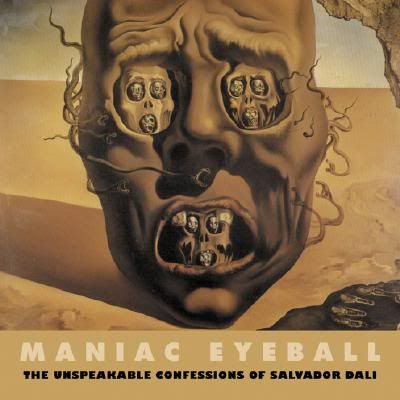
The Unspeakable Confessions of Salvador Dali (as told to André Parinaud)
This book is a written account of Dali dictating his life, his work, and his theories to Parinaud and it makes for a great read. It was composed in the 1970s when Dali had been a famous artist for about five decades so there's plenty to talk about and in the 300 pages there's tons of great material. There are illustrations (and photos) in here as well, hand-drawn in an interesting charcoal style. Plenty of great material on the paranoiac method in here, it's also got the only mention of Joyce by Dali that I've been able to track down. Very briefly, he shares Helena Rubinstein's account of the great writer: "nearsighted and smelling bad."


Salvador Dali by Robert Descharnes
Descharnes is Dali's main biographer and this big coffee table art book has an engaging account of the artist's life and career while also displaying big, beautiful color images of many of his paintings. This is the first Dali book I read and it remains a great one.


Dali: The Impresario of Surrealism by Jean‐Louis Gaillemin
When I visited London back on Thanksgiving 2008, there was an art museum right on the Thames River that had a big Dali exhibit. Of course I checked it out and it was great (they had some of his illustrations of The Divine Comedy which I loved). Afterwards I was in the gift shop trying to avoid getting anything (so as to conserve my meager funds), but this little book caught my attention and I couldn't resist picking it up. I devoured it on the return flight and still pick it up every now and then. It's another book about his life and career but it goes a little bit deeper into certain things like frequent motifs or his interactions with people like Jacques Lacan. In fact, it was reading this book that first put me on to the role Lacan plays in this whole thing. This is a great introductory primer to Dali and his work, I highly recommend it. It's also a very tiny book that could fit in your back pocket.


James Joyce: Portraits of the Artist in Exile edited by Willard Potts
When I was at the Joyce conference last month I often brought this book up in conversation and it seemed nobody had heard of it. I can't recommend this book highly enough. It's a collection of recollections of Joyce by a number of writers, artists, scholars, etc. that encountered him at various points in his life all throughout Europe. It's a highly entertaining book of anecdotes and there's tons of material in it that I've never read anyplace else. This might be meaningless to most people, but it reminds me of the great baseball book The Glory of Their Times.  

James Joyce and the Politics of Egoism by Jean-Michele Rabaté
I've always thought this title sounds boring and overly academic but it's a great read. Rabaté is one of the best of the current Joyce scholars and he writes very well.

A Reader's Guide to James Joyce by William York Tindall
This book really came in handy when I first read A Portrait of the Artist as a Young Man. Tindall writes in a very clear and engaging style and he weaves through the mass of Joycean symbols and motifs very smoothly. My understanding of the symbols in Portrait really owes a lot to Tindall. (This is also a good book to have when reading Ulysses as he gives clear and brief breakdowns of each chapter.)

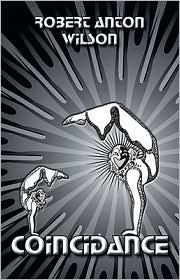
Coincidance by Robert Anton Wilson
I picked up this book very late in the research process and so I didn't include it in the actual bibliography but it certainly helped me put everything together. I've been admiring RAW for a while but this is the first book of his that I actually read and it was spectacular. It is a collection of essays dealing for the most part with instances of synchronicity all over the place in art, science, and history (there are also many essays about things that have nothing to do with synchronicity at all). He has three pieces on Finnegans Wake that are as interesting as anything I've come across yet on the Wake and which might convince you that Joyce was really working on some sort of unknown cosmic level. In one essay he details how the characters (and sigla) of the Wake coincide perfectly with the trigrams of the I-Ching and effectively ties both of those in with the composition of DNA. Really, really delicious food-for-thought. (There is also a footnote in which he claims certain parts of the Wake are influenced by Dali but I didn't find his argument convincing at all.)

Jacques Lacan by Elizabeth Roudinesco
For someone who lived such a wild, "rock-and-roll" lifestyle, I thought Roudinesco's account of Lacan was pretty boring. Her writing style was very dry and bland. Somebody at the conference asked me what's the best book on Lacan's life and, as far as I know, this is the only one and I wasn't too impressed with it.


How James Joyce Made His Name: A Reading of the Final Lacan by Roberto Harrari

Out of all the books I read for my study, this was the most difficult. The "final Lacan" is Lacan's 1975-76 seminar on le sinthome or "the symptom" and it's the one where he focuses entirely on Joyce who, he was convinced, was schizophrenic but was able to channel his madness through his art and thus remain on the safe side of sanity (although his daughter inherited the sickness and perished). That sounds easy enough to understand but Lacan illustrated his theories using the Borromean knot and twisted and tied everything in all different ways because he was at that time hanging out with a lot of mathematicians. In this book, Harrari tries to explain all of Lacan's darting thoughts but I found it impossible to follow. If you flip around the book using the index, though, it's easier to glean what info you need.

Thursday, July 21, 2011

The McLuhan Centennial


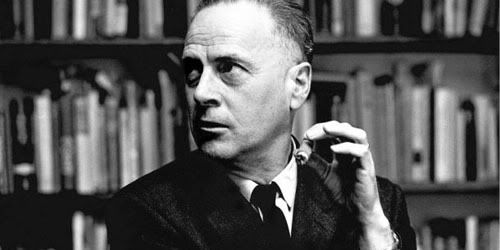
Today is the 100th birthday of the great influential thinker Marshall McLuhan. McLuhan died back in 1980 but his influence has exploded over the last decade or so as most of what he used to talk about in the 1960s has come to fruition lately. I spoke about this in two recent posts reviewing Douglas Coupland's excellent new biography of McLuhan.

Ever since reading that book, I've been devouring all the McLuhan material I can find albeit without picking up any of his books yet (I'm already far behind on a bunch of other books). I can't quite pinpoint what it is exactly that so fascinates me about McLuhan but his intense erudition and his nonchalant, almost humorous way of presenting it certainly appeals to me. He was also a devout student of Joyce, especially Finnegans Wake and he often brings up the Wake in his writings, lectures, interviews, etc. He was also a sort of modern public mystic, one with the physical appearance of a 50-something-year-old English professor (which is exactly what he was). For someone who was technically a literary scholar writing books about the future of technology, he was also very much a poet, an artist.

There is an audio clip of an interview with Robert Anton Wilson that I often listen to where he discusses Finnegans Wake at length and in the opening he describes James Joyce as "one of the greatest archeologists who ever lived." The more I look into McLuhan, the more that quote resonates in my mind and I've been starting to see McLuhan as a sort of successor to Joyce in that respect, a perfect connecting link between Joyce (who flourished in the first three decades of the 20th century) and the current times.

I need not try to expand on all of that here as the 100th anniversary of his birth (his birthday is actually just three days after mine, I turned 26 on Monday) has brought about a whole slew of interesting pieces and profiles all over the interwebs.

A couple weeks back, this big article appeared in Toronto Life completed with photos and an engaging write-up of his rise to fame. Here's a quote from it:
McLuhan didn’t really care if he was right. Right or wrong and good or bad had nothing to do with it. He was, he often claimed, not a moralist but an observer. An explorer, not an explainer. He was too fond of the paradox and the pun, always more of an imagistic and satiric poet. He was not a sociologist, nor was he, strictly speaking, a futurist. “If you really are curious about the future,” he said on CBC’s Ideas, “just study the present.”
That last part brings to mind a quote from Wyndham Lewis that I recently came across (no surprise since McLuhan was buddies with Lewis for a while): "The artist is always engaged in writing a detailed history of the future because he is the only person aware of the nature of the present."

The Toronto Star also has a couple of pieces about him. 

Douglas Coupland, author of the aforementioned book You Know Nothing of My Work!, wrote a piece on MM in the Guardian.
 
The American Spectator has an interesting piece talking about McLuhan and Mark Zuckerberg.

And, of all the McLuhan pieces I've read today, the best one is this blog post by Nicholas Carr.

A few more McLuhan links I'd like to share:

Friend of this blog Bobby Campbell created an illustrated article on McLuhan a few years back called "The State of the Art." (Hat tip to the Maybe Logic blog.)

I think I've already linked to this before but here is a great article about McLuhan and Giordano Bruno.

And here is a really good interview McLuhan did back in 1971 (I actually burned this on CD and have listened to it during my daily commute---McLuhan starts off slow but then takes off). This is Part 1 of 6:

Thursday, July 14, 2011

"Thought Through My Eyes": Epilogue, Part 2

"If you like the epilogue look long on it"
- Ulysses, pg 213

One of the important facets of my paper that I really didn't get to delve into as much as I would've liked is Dali's paranoiac-critical method. This is also probably the most complex part of the whole paper and the part I found most difficult to write (and talk) about. Here I would like to expand on Dali's philosophies and percepts with regard to paranoia and also delve into how this relates to the title for my essay.

In Part 2 of my paper, the paranoiac-critical method is first described in what I think is the simplest and most understandable manner: looking at a cloud and clearly observing a rabbit. We do this kind of thing all the time. Recently, I was sitting outside having lunch with my lady at one of Austin's many great food trucks, and we were looking at an enormous conglomeration of what turned out to be thunderhead clouds. They were in motion, morphing into different shapes so that first we could clearly see a wolf, then a woman's face, and so on. One of us would perceive something and point out each little wrinkle to the other and they would see the same image too.

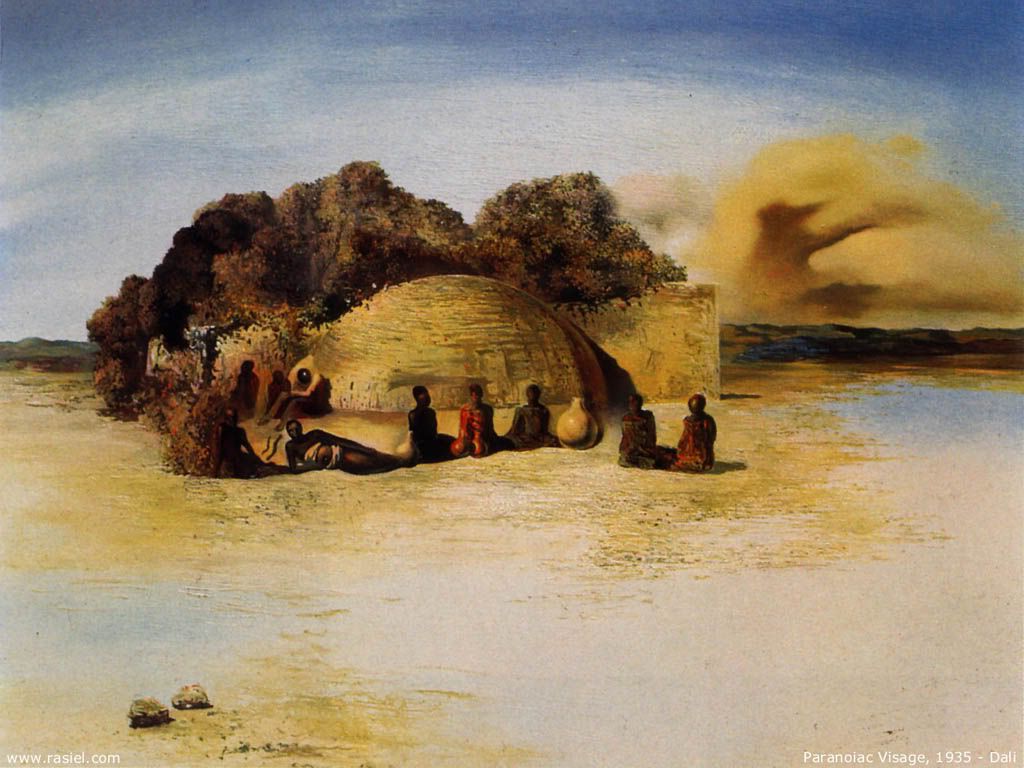
The Paranoiac Visage (1935)
In 1929, when he was about my age (25), Dali started to realize something special about this phenomenon of perception. He became aware of an exceptional ability to look at an arrangement and perceive something altogether different. His mind could look at objects and create its own interpretation. He once looked down at a pile of envelopes and papers on a desk and saw a perfect reproduction of one of Picasso's faces. Turns out it was just a photograph angled a certain way. He later painted this same scene in The Paranoiac Visage. As he delved deeper into this process of perceptive organization, it became clear to him that this was a crack on the supposedly smooth surface of objective reality. If one can systematically and thoroughly outline one's own unique subjective obsessions or unconscious material onto the outside world, then the concept of an objective reality starts to melt down (this image of soft, melting, or amorphous objects is probably Dali's most well-known motif). During this time he published his first essay on the subject of paranoia entitled The Rotten Donkey and laid out the basics of this his theory (which, he would later admit, he still was only beginning to comprehend himself): 
As far removed as possible from the sensory phenomena that can be thought of as more or less connected to hallucination, paranoid activity always makes use of verifiable, recognizable materials. It is enough for someone in the grip of an interpretive delirium to link the meanings of heterogeneous paintings that happen to hang on the same wall for the real existence of such a link to become undeniable. Paranoia uses the external world to validate an obsessive idea, with the troubling result of validating its reality to others. The reality of the external world serves as illustration and proof of the paranoid idea and is subservient to the reality in our minds.(emphasis mine)
Before quantum physics asserted to us that nothing really "exists" without an observer, here is Dali hinting at the fact that the external world is "subservient to the reality in our minds."  What we are getting at here is a realization that what we see before us and perceive as reality is actually an ambiguous, amorphous flux upon which we project our own being, our own inner symbols and organizing principles.* Under normal conscious circumstances, this fact is suppressed and denied as irrational. But, in a state of delirium when irrational phenomena dominates one's view of everything, suddenly the whole outside world can be seen to mesh with one's own subjective thoughts (i.e., paranoia). What Dali was trying to show is that the irrational perspective presents a more accurate picture of reality and this became a conquest for him, "The Conquest of the Irrational," an attempt to discredit ordinary reality and free humanity from its collective madness, declared "in the service of Revolution" in The Rotten Donkey essay.

*As described by Stephen in the Proteus chapter, "veil of space with coloured emblems hatched on its field." (Ulysses pg 48)

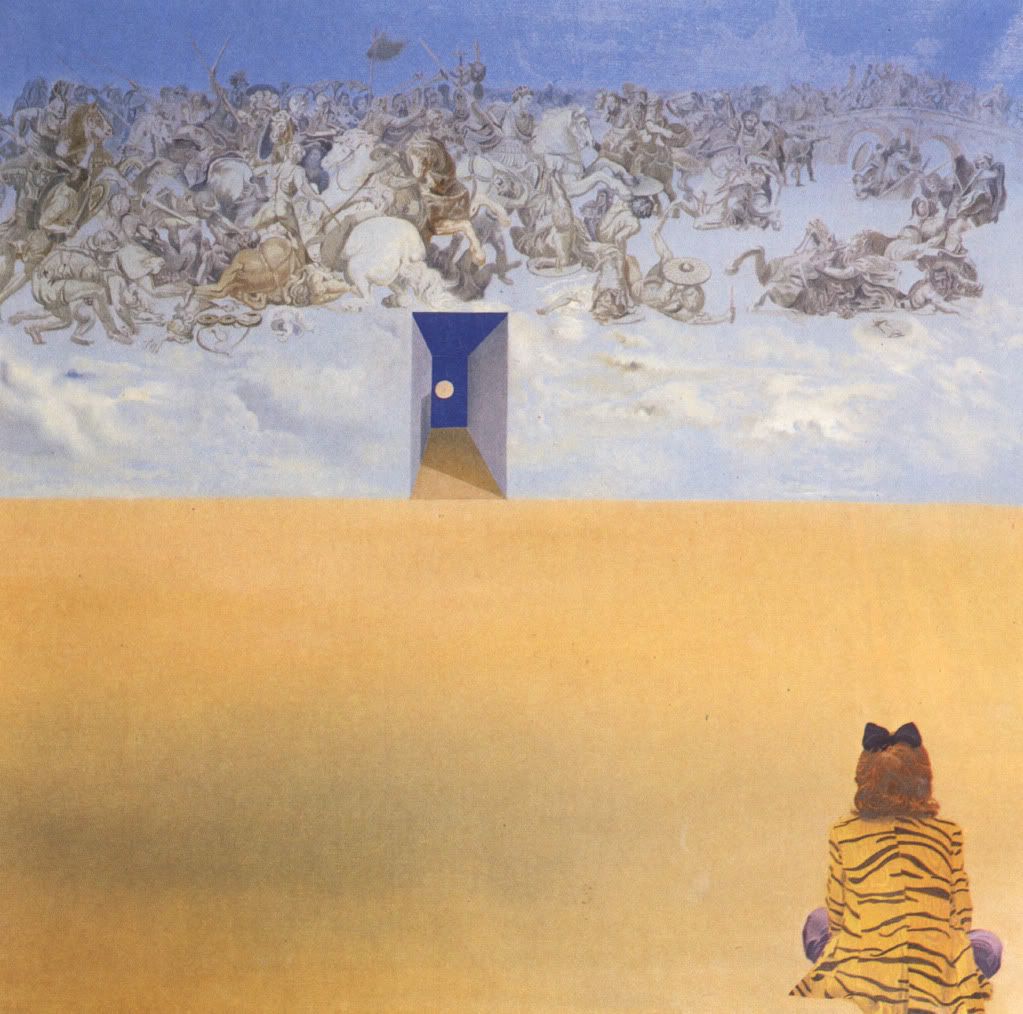
Battle in the Clouds (1974)
Returning to the example of clouds, the cloud is a big puffy, soft, shapeless form as in a thought cloud, the image most often used in comic books to denote the workings of a character's mind. When staring at a cloud, this fluffy ambiguous form can be organized by our minds into a familiar shape, symbol, signifier. Dali explains: "Paranoiac systematization influences the real and orients it, predisposes it, and implies lines of force that coincide with the most exact of truths." We can see Dali's fascination with the anamorphic softness of clouds in many of his paintings including those which I posted in Part 1 of this epilogue. Morphing clouds are essentially the most eye-grabbing and important aspect of The Temptation of St. Anthony, the painting analyzed in the original essay.

The Temptation of St. Anthony (1946)

We see the scene from the perspective of St. Anthony, the ascetic who's been fasting in the desert and now perceives the clouds morphing into enormous and nightmarish temptations (notice how closely the horse's chest resembles the clouds on the right). In Flaubert's novel The Temptation of St. Anthony, the scenes Anthony sees often involved people from his life. This image is thus an exemplary scene of paranoia because this is all emanating from the character's own mind. We will come back to this shortly.

*   *   *

"He seeks fluid, wavelike forms that will express
immutable laws through infinite mutations,
the clarity of eternal forms through their
opaque but ineluctable modalities."

- J. Mitchell Morse discussing
the Proteus episode in
James Joyce's Ulysses: Critical Essays, pg. 31

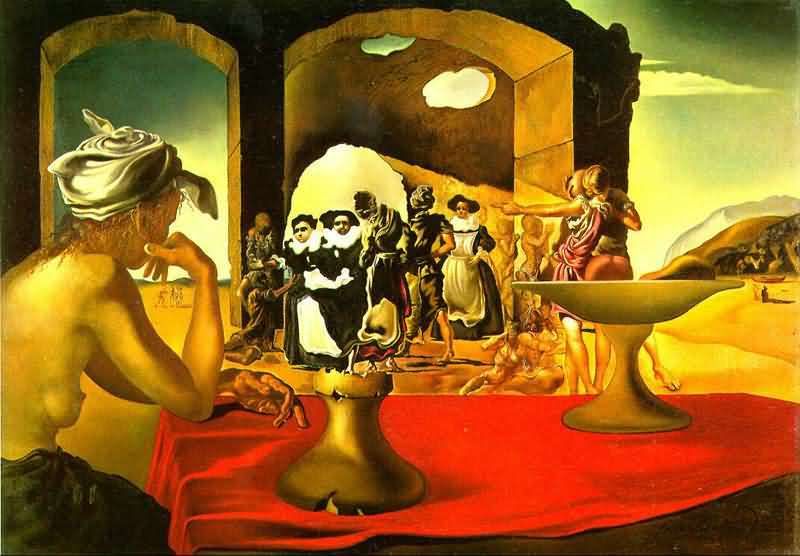
If you take a look at most books of Dali's paintings (and there are tons of them), they usually bring up Dali's paranoiac theory in reference to some of his works that feature visual tricks or trompe l'oeil ("trick the eye" in French) techniques. During the decades of his deepest paranoiac explorations (1930s-40s) Dali produced about thirty sketches and paintings that invoke this technique, here is one of the most famous examples:
Slave Market with the Disappearing Bust of Voltaire (1940)
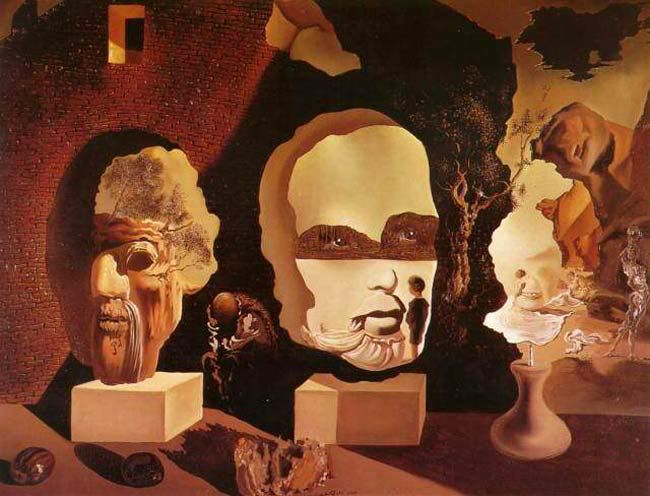
There are many more images like this from Dali including this one which is one of my favorites:
The Three Ages (1940)
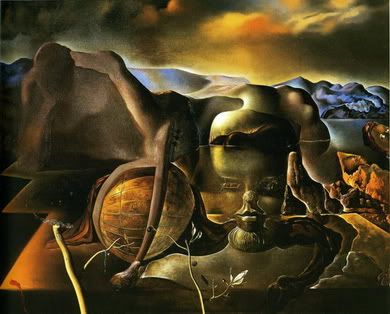
The culmination of this trick-of-the-eye technique is probably The Endless Enigma, in which the image can take on any number of forms depending on the observer.
The Endless Enigma (1938)
This multiple-image effect, which Dali calls "anamorphic hysteria," is just one example of the paranoiac method. Dali's inquiry into paranoia certainly goes much deeper than this. As he discusses in the book The Unspeakable Confessions of Salvador Dali (pg. 140-144), the word "paranoia" is defined not in the way we commonly think of the word now---fear that the universe is plotting against you--- but in a much broader and more scientific sense as "the phenomenon of delirium manifested in a series of systematic interpretive associations." The "critical" part of paranoiac-critical is, as he says, for the artist to "play the part of a photographic developer" and Dali would self-induce a hallucinatory paranoid state (without drugs, "I don't take drugs, I am drugs" as Dali used to say) and spontaneously record the delirious associations, witnessing the "clash of systematization with the real" and the inevitable "evolution and production" that occurs in the exchange between subjective and objective. There is supposed to be a veil or a wall between these two (subjective and objective, psychological and physical, etc) but they are actually shaping each other. As Eugene de Klerk puts it in his excellent essay on this subject, "If one is able to remain critically aware while inducing paranoia, one can open up the play of representations which shape perceptual reality."

We start to see the importance of this tool for Dali; he's not simply trying to play visual tricks on you, he's going toe to toe with the accepted principles of our very existence. "It is time for us, in the history of thought, to see that the real as given to us by rational science is not all of the real," he states.
The world of logical and allegedly experimental reason, as nineteenth-century science bequeathed it to us, is in immense disrepute. The very method of knowledge is suspect...In the end, it will finally be officially recognized that reality as we have baptized it is a greater illusion than the dream world. Following through on my thought, I would say that the dream we speak of exists as such only because our minds are in suspended animation; the real is an epiphenomenon of thought, a result of non-thought, a phenomenon of amnesia.
Whoa!
The true real is within us and we project it when we systematically exploit our paranoia, which is a response and action due to the pressure---or depression---of cosmic void.
The same paranoiac phenomenon that systematically organizes ambiguous images into meaningful associations through our eyes is also the way we create our subjective individual selves, seemingly separate from all that we see. The space that we see and occupy is also being unconsciously created in this same manner. As Joyce writes: "We walk through ourselves, meeting robbers, ghosts, giants, old men, young men, wives, widows, brothers-in-love. But always meeting ourselves." I was recently listening to an old interview with Marshall McLuhan who touched on this as well, he said that primitive non-literate man doesn't think of the eye as a receptor but as a creator; it is creating that which it sees. The same idea comes from the observations of modern physics, which state that a particle is in a state of unsure probabilistic flux until it is observed and then takes on a certain form.

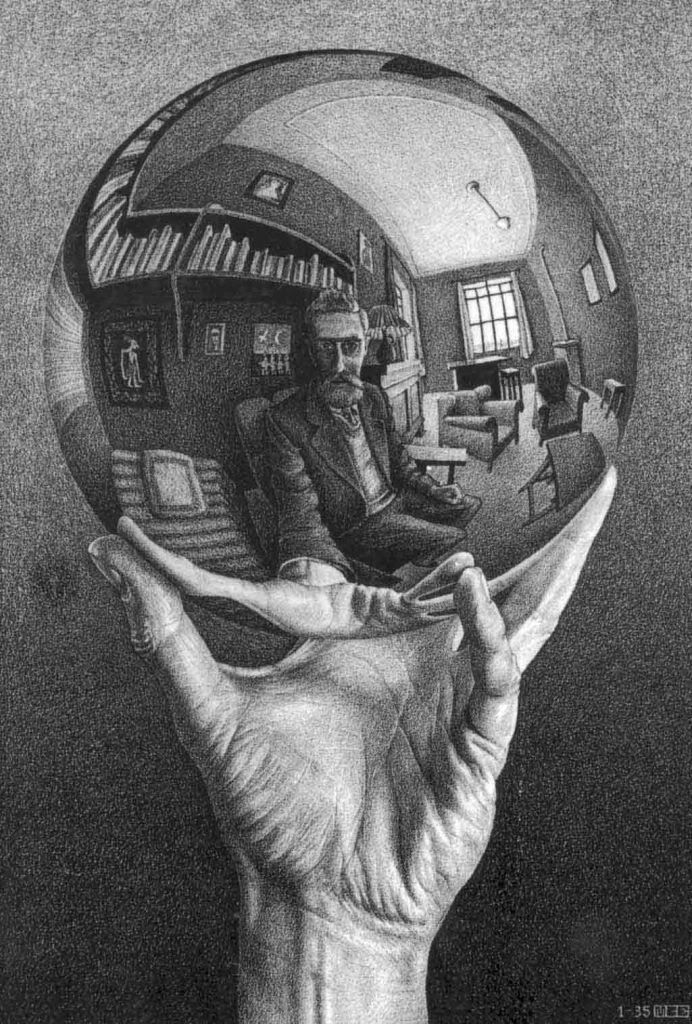
Reflecting Glass Sphere (1935) by M.C. Escher
It occurred to me during my studies on this stuff that another image I have hanging on my wall is actually a perfect representation of this idea. If reality itself is a sort of fluid, morphing substance emanating and reflecting our own selves, then M.C. Escher's glass sphere can be seen as a proverbial droplet of this substance, reflecting and staring right back at us.
 
It is through all these considerations that I came to think about "Proteus," the third episode of Ulysses. It's the episode where readers usually gives up on the book because we get a firsthand look at Stephen's inner attempt to transcend the "limits of the diaphane," the veil of existence. This is perhaps my favorite episode in the book and one of my favorite pieces from Joyce. It is from the opening sentence that my title is derived:

Ineluctable modality of the visible: at least that if no more, thought through my eyes.

By the very act of perception we are stuck in this modality of visible space, inescapable or "ineluctable" as it is (the word "ineluctable" derives from Latin and literally means "not to struggle against"). The "ineluctable modality of the ineluctable visuality" he says later on. On page 48 he ruminates, "I throw this ended shadow from me, manshape ineluctable, call it back. Endless, would it be mine, form of my form?"

Reality or "space: what you damn well have to see" (Ulysses pg 186) is created by our looking at it through those bulbous organs of ours, eyes, which Dali eloquently considers:
What is the eye? A glob of humors, a knot of muscles, a film of flesh and nerves irrigated by a flow of acid? Beneath that appearance lurk galaxies of microscopic electrons, agitated by an impalpable wave, itself the fluid of a quasi-immaterial energy. At what level then, the real? The truth to me, to Dali, is in the magnifying-glass I aim at the world, called my eye, through which there takes place an exchange that for that moment is known as real. (pg. 144 Unspeakable Confessions)
This whole emphasis on the eye and visual perception is interesting also because Joyce actually suffered from terrible eye problems throughout his adult life. As his friend Louis Gillet gruesomely described it in an obituarial essay:
For twenty years, the great poet was half-blind; the left eye was lost and in the other remained only a flap of retina. Reading and writing was torture. The wretched man retained a gleam of light thanks only to twenty operations---each time a very cruel martyrdom. I still see him, in order to decipher a text, placing the paper sideways and bringing it into the narrow angle where a ray of his ruined sight still subsisted. (Portraits of the Artist in Exile, pg. 168)
*   *   *

"guide them through the labyrinth of 
their samilikes and the alteregoases
of their pseudoselves...
from loss of bearings deliver them"
- Finnegans Wake, pg. 576

Going back to that first line of Proteus again, the "ineluctable modality" also feels to me like a good description of a labyrinth as well and, of course, Joyce bestowed the name Dedalus upon his hero so as to invoke the symbolism of the architect Daedalus who, himself, built the labyrinth on the island of Crete and was also trapped in it because of its complexity. In A Portrait of the Artist as a Young Man, the metaphor has to do with Stephen Dedalus trying to escape the oppressive atmosphere of Ireland to fly to mainland Europe just as Daedalus seeks to fly from the island of Crete to mainland Greece. Here in Proteus, this most metaphysical of chapters in the sequel to Portrait, Stephen is trying to escape the very labyrinth of space and existence.

This ties back to Dali again as he composed a number of essays on paranoia (including a piece alongside Jacques Lacan) in the surrealist art review called Minotaure, a title that conjures the beastly creature that was housed inside the labyrinth on Crete to keep people from escaping. He did clearly think of this paranoiac creation of existence in the sense of a labyrinth we've created and trapped ourselves in, indeed, he states in the aforementioned Unspeakable Confessions book: "We are at the heart of a labyrinth and can find our way while becoming labyrinths ourselves." Like many of Dali's profundities, that sounds like nonsense, but what he is referring to (intuitively, I assume) is that our souls are labyrinths. We exist in a labyrinth and we ourselves are also labyrinthine, this latter fact has been explored for centuries in the symbolic usage of mandalas to represent the soul and this symbol is still used in many modern psychotherapeutic practices to help people bring their psyches into balance. The labyrinth is essentially a mandala and vice-versa.

Now, to finally get us out of this labyrinth of an essay, let us conclude by once again considering the original point of the entire paper (if you haven't read it yet, contact me and I will send you a copy). What got this all started was a rather peculiar interpretation I made of Dali's painting The Temptation of St. Anthony in which I systematically compared it to the material in Joyce's Portrait of the Artist. The paper has elicited a positive reaction from those that have encountered it and on a few occasions folks have commented to me that it would really solidify the whole thing if I could identify a "smoking gun" that proves once and for all that Dali painted St. Anthony with Joyce on his mind. I would argue that such a thing isn't necessary. The piece-by-piece interpretation of connections/resonances with Portrait is interesting in its own right because it was initially a natural, organic, unwitting example of the paranoiac-critical method in action. 

Not in the sense of a simple trick of the eye, no, I didn't stare at the painting and realize it formed a picture of Joyce's face or anything like that (though the Martello Tower does appear to be there in the background). Instead, under a spell of thoughts and speculations on the symbols and motifs of Joyce's work, I suddenly was able to look at the painting of a tempted desert monk and associate all of the characters and objects with the object of my obsession at that moment. The resonances and connections I made can, I believe, probably stand up on their own but even beyond that, the paranoiac analysis led to two new ideas on the painting: that it is largely autobiographical in scope, and that it exemplifies the artist's famous paranoiac-critical method.
Saturday, July 2, 2011

Flickerings of Film

Adrien Brody as Salvador Dali
Went to see Midnight in Paris last night and enjoyed it very much. I had heard a lot of good things about it from people and it certainly lived up to expectations. Getting to see some of the past greats like Ernest Hemingway, F. Scott Fitzgerald, Pablo Picasso, T.S. Eliot and everyone else in a modern film was certainly a treat. I was especially impressed with Adrien Brody's portrayal of Salvador Dali. As you can tell if you've read this blog much at all (or even looked at my previous post), I've been involved in closely studying Dali's life and work for a little while and so I was glad to see him get such a nice portrayal in the film, especially from a big actor like Brody. In all honesty, I can be a harsh critic with this kind of stuff, especially when it deals with something I've spent so much time being involved with, and I genuinely really enjoyed Brody as Dali. In fact, he may have been the best character in the entire movie (though Ernest Hemingway was certainly really good and the laughs in the theater certainly attested to that).

The one thing that bothered me, of course, was the absence of James Joyce. His name was mentioned in an anecdote very early in the film but through all the adventures the main character had with the big figures of 1920s Paris, we never got to meet Joyce. This was really disappointing because I know his character would've stolen the show, just as the real Joyce did within that rich artistic environment. The Joyce of the 20s was also perhaps the one best suited for big screen portrayal; he had the eye patch at that time, the great fame from having just published Ulysses, and was in the midst of his greatest (and most baffling) work of all, Finnegans Wake. And the biographical books are certainly filled with his wild carousing with the likes of Hemingway who had a relatively huge role in the movie. I wonder if there were Joyce scenes that were cut out that might be included in a future DVD set. I'm really interested to find out because I thought Woody Allen handled all these old famous figures extremely well.

While my girlfriend and I were getting ready to go see the movie, I reflected on how for decades and decades couples were in that same spot, getting dressed for a night at the movies to see "a Woody Allen film." It struck me for a reason I can't quite elucidate (eternal recurrence through the ages, perhaps). I've never had any real interest in Allen's films before and, really, I can't name a film of his that I particularly enjoyed. I know of Annie Hall but haven't seen it, and the last time I started to watch a Woody Allen movie I found the whiny arguments so grating I had to turn it off (admittedly, Whatever Works starring Larry David was not bad). This movie was completely different and, really, there wasn't much indication that it was a "Woody Allen" film. The director managed to stay out of his work, as in Joyce's description of the dramatic art form: "The artist, like the God of the creation, remains within or behind or beyond or above his handiwork, invisible, refined out of existence, indifferent, paring his fingernails."

*   *   *

Speaking of directors, God, and creation, I have to say a few things about Terrence Malick's Tree of Life. As I wrote a few months back, the trailer for this movie captivated me and the scope seemed to perfectly fit my current mindstate. I dragged my uninterested girlfriend to a packed theater on the first night it was playing here in Austin and after nearly three hours of completely unconventional cinema, I was left in a daze. She absolutely hated the film and it doesn't surprise me that it has evoked similarly strong reactions from the public on each side of the pole.

To put it bluntly, the style of the film does not make for a palatable cinematic experience. One has essentially no idea what they are watching from beginning to end. The dialogue is minimal and most of the talking we hear is in hushed whispers. What we encounter is a collage of memories, moments, seemingly personal explorations of the unconscious. Whose unconscious it is, we're never really sure, but it seems to be that of Sean Penn's character as he goes about his work day and experiences a sort of crisis within himself.

The style was unlike anything I've experienced from a movie, it was perhaps a bit more like a (lame) amusement park ride. There is a constant pattering upon the senses of a variety of sounds, gleams of sunlight, and, if it were somehow possible, smells. (A recent piece in Salon magazine likened it to Joyce's A Portrait of the Artist as Young Man where we also experience the character's developing senses.) I think it is a film that speaks very clearly to our unconscious but is quite difficult for our conscious minds to ascertain. From the trailer, I expected it to be a monumental epic that would hit my emotions and provide that feeling of aesthetic arrest but it was only during one brief scene that I could feel the depths of my own memories get a bit rattled. It was a simple scene within the family kitchen on a bright afternoon and it unearthed a dusty old cave somewhere in my mind that brought about visions of my upbringing and made me a little nostalgic for Staten Island (or, at least, the innocent Staten Island of my childhood).*

I had expected the scenes showing the Big Bang and the creation of the universe to be special and indeed they were. My problem with it is that they seemed to leave something out, as we didn't get any kind of transition from all of that to the small-town Texas family. It was just a bunch of cosmic creation, formation of planets, life, etc and then a cut back to the family scene. While the point ("we are walking manifestations of the history of the universe") seems clear enough, I don't think the delivery of it was well executed. Nevertheless, an extremely admirable and ambitious idea.

I don't want to offer a firm judgment on the overall quality of the movie because I've only seen the film once and really didn't connect with it the way I expected to. That doesn't mean I think it sucked, it certainly left me in a blank daze for a while afterwards, but that may have just been due to the aforementioned tender onslaught of sights and sounds which can be hypnotizing in a way. I think I'd like to give it a look one more time and then decide how I feel about it. It's certainly sending some of our cinema scribes into a state of spiritual serenity.

*Interestingly enough, the final scene (trust me, this won't ruin it for you) is a view of Staten Island from across the Verrazano Bridge in Brooklyn. In the context of the film, I don't have the slightest clue why this appeared but it certainly hit me personally as that bridge holds an important place in my heart for many reasons (one of which is that it allowed my parents, from Brooklyn and Staten Island respectively, to join together.)

*   *   *

Lately, I've come to think that the movie trailer is, itself, a new medium. I can think of many examples of films that had awesome trailers while the actual film was disappointing (my favorite example is probably Revolutionary Road which had a stirring Nina Simone song). The crafting of movie trailers has gotten so good that we often relish the opportunity to watch previews just as much as the actual movie itself when we go to the theater. I certainly do, at least, and I'm always open for that next big potentiality to light up my eyes and expectations. Well, a new one of those hit me yesterday and it's called Take Shelter. Here's the trailer:


With my recent studies on paranoia (and my own occasional feelings of impending doom within this crumbling American Empire) this one seems right up my alley. Plus those are some pretty strong endorsements included within the trailer.

Wednesday, June 29, 2011

"Thought Through My Eyes": Epilogue, Part 1


"Everything that terrifies others delights me, the fears and phantasms that others commonly carefully repress are to me so many fresh sources for my critical intelligence, but one would have to be far more foolish than I to try to analyze the complexity of my intentions and motivations. I who live them am far from understanding all about them! Fortunately, there are still my works which, subjected to the most objective examination, allow some of the truths I have been dredging up from the depths to come through."
-Salvador Dali (The Unspeakable Confessions of Salvador Dali, p. 141)
At the top of this post is the cover for the presentation/paper I delivered at the James Joyce Conference two weeks ago. The drawing is from Salvador Dali's book The Secret Life of Salvador Dali (which features prominently in my study) and it was put together by my girlfriend's dad, Luther, a highly talented graphic designer. The talk that I gave in Pasadena was just a very basic overview of the material in the paper. The full version is available in a 17-page booklet format with color images so if you'd like one of those just let me know and I can mail you one.

The essence of my paper is an analysis of Salvador Dali's The Temptation of St. Anthony showing that the material in the painting bears a striking resemblance to the symbols and structure of Joyce's first novel A Portrait of the Artist as a Young Man. Then I go on to explore whether Dali ever explicitly acknowledged any Joyce influence (or vice versa) and what this interpretation of the painting means, concluding with a look at Jacques Lacan's role as "shoelace" tying together Joyce, Dali, and my new interpretation of the painting.

What I'd like to do here is present some of the left-over material that didn't make it into the final version of the paper and also (in Part 2) discuss the meaning of the title which, unfortunately, I didn't really get to touch on at all in the paper. In the interest of graciously acknowledging all of my sources, I will also go through most of the books and scholarly stuff I used in my research (this will be Part 3) and point out some of the material one should seek to study if they have any further interest in this stuff.

Image drawn at the top of a chapter in Dali's book The Secret Life.
So, in analyzing the painting, the first thing I looked at is that tiny image in the very center amid the elephant legs showing what appears to be a parent with child and, as I tried to show, this is Dali himself as a young child, an image of his earliest memories and experiences. What I didn't get to mention is that this is a frequent motif in Dali's paintings from around this era (1930s-40s), as you can see from these examples.

Atavistic Ruins After the Rain (1934)
And (as in the St. Anthony painting) much smaller, barely visible here:
Geological Development (1933)
The Ambivalent Image (1933)

Here are a couple more instances of this motif appearing, this time in two of Dali's works that incorporate the elements from Jean-Francois Millet's Angelus which Dali became obsessed with.
Archaeological Reminscence of Millet's Angelus (1935)
The Architectonic Angelus of Millet (1933)
The Angelus
As a child going to school, there was an image of Millet's The Angelus hanging on the wall just outside the classroom door and young Salvador would stare at it until it was branded on his brain. As you can see, he was prone to incorporate this image or its likeness into his work. In the 1930s, when penning numerous articles and essays on his developing paranoiac-critical method (one of which I've published on this blog before) he composed a paranoiac study of The Angelus in which he asserted a whole new and different meaning behind the painting. One of his assertions was that the man and woman in the scene (to the right) are standing over the buried body of their child. In 1963, the laboratory at the Louvre actually x-rayed the original painting and saw that there was originally what looks like a casket at the mother's feet but it had been painted over by Millet.

Unfortunately, there's no way to x-ray The Temptation of St. Anthony to see if my interpretation of it is accurate but I did confirm that the meanings I perceived within the painting were apprehended, witnessed, or "thought through my eyes" in a process exactly like Dali's paranoiac-critical method. I did manage to magnify and zoom into some of the smaller elements in the painting and the autobiographic aspect of my interpretation is, as I've showed, justified by just taking a look at the images in Dali's wonderful and illustrated autobiography entitled The Secret Life of Salvador Dali.
To be continued...

Tuesday, June 28, 2011

Hot as a Texas Summer

With a few lengthy but unfinished posts clogging up the pipeline, I might as well take a break and talk a little bit about the Mets and my first live baseball experience of 2011.

I went to sleep last Friday night undecided on whether or not it would be worth driving a total of 7 hours by myself back and forth to Arlington to watch the visiting New York Mets play the Texas Rangers on Saturday. When I awoke Saturday morning I couldn't recall my dreams but there were baseball images, players, scenes, thoughts left over in my mind and I realized my unconscious mind had made the decision for me.

I quickly prepared some long-drive materials (music, snacks, directions, places to eat on the way) and hit the road. After over 3 hours of driving through a boring flat landscape, I got closer to Arlington and was driving on single-lane roads through farms with haystacks, horses, and cows. Finally I saw the huge ballpark's castle-like outer walls. As I approached, I was confronted by an imposing, enormous bulb that looked exactly like a spaceship had landed and settled in the grass. I later realized it was the gaudy new Dallas Cowboys stadium.

I entered the Ballpark in Arlington through its centerfield gate and the place was packed though surprisingly pretty easy to maneuver around. I picked up a scorecard and searched in vain for a pen to use. In the process, I didn't come away with a pen but did encounter the strongest Texas accents I've ever heard.  The game had already begun and when I peeked out at the bright emerald expanse there was Carlos Beltran standing at third and the Mets had already tacked on 2 runs before recording an out (Beltran had brought in both runs with a triple). It seemed my long drive would be rewarded with, at the very least, a competitive effort from the New York nine.

When I reached my seat in the middle of the right field grandstand, it was already 3-0 Mets and the sweaty crowd around me was getting annoyed. In a row of 16 seats I had to maneuver past everybody to sit in the 8th seat and I sat next to a lovely woman who was at the game with her family, she even let me borrow her pen (a pink "girly pen" she warned) to keep score for the whole game and we chatted it up through the ebbs and flows of the game.

Here's the view I had:


The Mets went down quickly in the 2nd inning but then knocked in another 3 runs in the third to take a commanding 6-0 lead. I was jubilant after my team's aggressive start but I was also by this point soaking in (literally, it was around 100 degrees) my surroundings and having old memories of admiring this park on television over the years. It was infamous for "it ain't over til it's over" kind of games because the sweltering Texas air allows the ball to fly out of the park easily. Sure enough, Mets starter Jonathsn Niese gave up back-to-back homers the next inning and the big lead was cut to 6-2. Then came the 6th inning.

I've been going to Mets games for about 10 years now and there were a few years in NY when I managed to get to about 10 games a year. I can't remember ever witnessing as unrelenting an offensive onslaught as they executed in that 6th inning. The first 8 batters of the inning reached base before an out was recorded. By the end of the inning they had blown the game open with 8 more runs, making the score 14-2! I literally could not have imagined a more satisfying performance from my favorite team.

With the game essentially out of hand, I decided to get up out of my seat and walk around the premises a bit. I ended up sitting at the very top of the stadium, up in the last row deep in left field. I could see off in the distant horizon the cluster of towers that make up the city of Dallas and, to the west, a smaller cluster making up Fort Worth. Beyond the ballpark walls I could see the domed top of the Cowboys stadium gleaming. To my right, a cowboy with sunglasses was guzzling a Coors Light with crushed cans of the same scattered around him. Way down below, the Mets closed out a big victory and I sat for a moment pondering the vastness of Texas. The ride home was unbearably bland and filled with lonely farmland as I stared in stupefied surprise at some of the rural flat emptiness in the vicinity of one of the planet's largest and most expensive super stadiums.

*   *   *

Over the years, when I would play baseball video games and watch nationally televised ballgames, I had always looked upon the Ballpark in Arlington as one of those really cool stadiums with its own unique characteristics and game-altering aura but I could never picture it as an actual destination for viewing a game. I could never picture myself ending up in the heart of Texas watching a baseball game (where the crowd actually sung "Deep in the Heart of Texas"!). Now, here I am and there I was.

Having ticked another ballpark off my list, I've been considering other parks that I may or may not end up attending in the future. I find it hard to envision a scenario where I would end up seeing a game in Detroit's Comerica Park. I have never been to the city of Detroit and don't foresee myself going there in the near future although, with it's rich musical history (and my current favorite musicians present there), there's always a possibility I'll stop by.

After laying two consecutive whoopings on the Rangers, the Mets now find themselves in Motown facing another first place American League team, the Tigers. With my personal favorite AL team, the Oakland A's, tanking yet again this year I'd been searching for another junior circuit squad to root for and I've developed an interest in this Tigers team. As I discussed in my team previews, they are built to be a very top heavy team but so far this year their lineup has gotten strong contributions from hitters not named Miguel Cabrera. I loved the Victor Martinez signing and V-Mart is hitting as well as ever (.336/.385/.498 AVG/OBP/SLG) but they've also seen catcher Alex Avila come into his own as a major league hitter this year (at the age of 24) putting up perhaps the best offensive season by a catcher in all of baseball. The other surprises are Brennan Boesch (136 OPS+) who most analysts expected to collapse after his sudden ascent last year and the former failed prospect Jhonny Peralta who's having a career year (.311/.360/.531) at the age of 29. Their only problem is that, other than those five guys, nobody else has hit even close to the league average. (It also bothers me to see manager Jim Leyland continue to pencil in three of his worst hitters atop the batting order while putting all five of his legit sluggers further down.)

Peralta, who'd always been considered a poor shortstop for a lack of range (he was even moved over to third base while still with his original team, the Cleveland Indians), seems to be holding his own out on defense and speedy sophomore centerfielder Austin Jackson is covering the vast Detroit middle pastures more than adequately as well so their defense remains reliably solid.

In the rotation, Justin Verlander has been one of the best pitchers in baseball and the Mets will have to face him on Thursday, but the rest of the staff hasn't been all that good. I expected young righty Max Scherzer to take a big step forward this year but he's kind of been treading water thus far.  The bullpen has some good arms on the back end (including one of my favorite new ballplayer names, Al Albuquerque) but they've also got some ridiculously bad walk rates on that staff. The closer Jose Valverde walks nearly five men per 9 innings and there are two other relievers (Albuquerque and Daniel Schlereth) walking over six batters per 9. 

As I type this, the Mets are in the middle of yet another offensive outburst with two grand slams against the Tigers already and 13 runs total. I imagine they'll probably continue the streak of making pitchers cry tomorrow when they face lefty Phil Coke who, despite having a birthday within one day of my own, kinda sucks. I'd be surprised and delighted if the runs continue to pour in against Verlander, though.

Monday, June 20, 2011

Retrospective Arrangement of Thoughts

Dali's "architecture of eternity" sketching
It's about time I resuscitate this blog after nearly a month of silence. My absence was due, as I've frequently mentioned, to the completion of my paper on James Joyce and Salvador Dali as well as the visual presentation material that I delivered to a group of about 25 people this past Thursday morning at the California Institute of Technology in Pasadena. My paper, entitled "Thought Through My Eyes: A Portrait of the Artist as a Dali Painting" was well-received; everybody seemed to enjoy it and I got plenty of positive feedback from folks. Having not endured public speaking for nearly four years, I somehow managed to avoid spontaneously combusting. In fact, I think I did pretty well.

The Joyce Conference overall was fun, though a bit mentally taxing (which is to be expected). Everybody I met was very nice to me and the whole group of Joyceans were very welcoming and appreciative that a young, non-academic like me was there to present my work. I did feel a little bit out of place at times, especially since most people would ask "so where are you from?" upon introduction, expecting to hear what university I teach (or go to grad school) at but not only am I independent of any university, I've also bounced around three time zones the last three and a half years. So, my answer was always complicated. Nevertheless, I made some friends and had a good time with everyone, getting to hang out with folks from all over the globe (Denmark, Australia, UK, Canada, Japan, to name a few).

One of the more interesting individuals there was an Australian named Jaya Savige who, as I realized earlier today from Googling him, is an award-winning poet attending Cambridge University on a full scholarship. One night, while gripping a glass of some sort of hard liquor, he told a memorable story about confronting Bill Gates on capitalism to the point where the bajillionaire Microsoft man accused him of being a "Stalinist." The story becomes all the more comical when you read that Savige is in fact a Gates Scholar, receiving the rare $100K scholarship grant to attend Cambridge for free.

Throughout the four day conference, the most captivating things I witnessed were:

1. Adam Harvey's mind-blowing performance of the Mookse and the Gripes story from Finnegans Wake, reciting with great dramatic emphasis the entire 15-page selection from memory. As far as I know, it was the only thing in the conference that achieved a standing ovation.

2. Actress Fionnula Flanagan's recitation of the short story "Counterparts" as well as the discussion afterwards. The Dubliners story, about a man who slips out of work for a quick beer, gets berated by his boss, gets drunk after work, loses a barroom arm-wrestling match and then beats up his son, was emotionally striking and she performed it extremely well. Afterwards, the white-haired (but beautiful) Irish woman discussed how important the story is to her because of the realness of it, mentioning "the sickness of my nation: alcoholism," and reflecting on why she feels it's the greatest short story ever written.

3. The closing ceremony, an outdoor dinner in the middle of a beautiful old Spanish-style villa on the campus of Caltech (right underneath the windows of a room where Albert Einstein lived for a while) in which two old songs that appear in Portrait and Ulysses were sung. I had never really thought I would enjoy hearing these old songs but the magical alchemy of the evening managed to lift me off the earth momentarily. Particularly, the song sung acapella (and with no microphone) by Patrick Reilly of the CUNY Graduate Center entered me into a trance, the undulating tones of human chords making me feel as though my beating heart were a uvula dangling alone in the universe amidst the entire vibrating energy of existence. Yup, it was that good. (The song is an old ballad called "Love is Pleasin', Love is Teasin'.")

4. Some of the academic papers I enjoyed were: Jeffrey Drouin's talk on Joyce as "The Einstein of English Fiction"; Benjamin Boysen's takedown of Jacques Lacan entitled "When the Psychiatrist Needs a Psychiatrist"; Tim Martin talking about Ulysses as an elegy; Mark Osteen on the "Handiwork of Portrait"; and Sheldon Brivic's paper on "Ulysses and Badiou" even though I didn't know who Badiou was and still don't (Brivic was just really interesting to listen to).

It is often sporting events that mark historical points in the constellations of my life experiences, time markers, helping me reach back and remember the specifics of past autobiographical events. This wonderful return trip to Cali certainly had that: I watched the Mavericks capture the NBA Finals inside the hotel bar drinking a brew with a new pal from the University of Alberta, and then sat next to a table full of black-and-yellow-clad cheering Bruins fans in a restaurant when they won Game 7 of the Stanley Cup Finals.

Certainly a memorable time. I'll probably have much more to say about it soon and I'm working on some more posts about my Joyce-Dali paper (which I printed in a monograph booklet, contact me and I'll send you one) as well as a bunch of other writings to come.

Sunday, May 29, 2011

A Cacophony of Shouts

Inside the Sagrada Familia
For over a week, I have devoted the bulk of my free time to completing my essay on James Joyce and Salvador Dali (which I will be presenting at the North American James Joyce Conference in Pasadena on June 16th). After finishing it the other day, I've been immersed in some further residual readings related to my study of these two 20th Century master craftsmen. One book in particular has really been sparking my interest, the extravagantly titled Unspeakable Confessions of Salvador Dali as told to André Parinaud. It's from the early 1970s so Dali, who had been a famous artist for about 5 decades already, has plenty of interesting things to say. I've been most fascinated by his discussion of the paranoiac (a main aspect of my paper) but I will get into it all of that here later on, I'm planning on writing a big post detailing all of the books used for my essay.

So I was reading it today and Dali was speaking very favorably about an architect, Antoni Gaudi, who hails from Catalonia, Dali's hometown in Spain. I had never heard of Gaudi or his works before and so I had to look him up after reading such laudatory praise as this:
The Sagrada Familia in Barcelona

What I love about Gaudi is his vitality. His brain is at the tips of his fingers... I remember Lorca [Garcia Lorca, the Spanish poet, a friend of Dali's] in front of the admirable facade of the Sagrada Familia claiming to hear a griterio---a cacophony of shouts---that rose stridently to the top of the cathedral, creating such tension in him that it became unbearable. There is the proof of Gaudi's genius. He appeals to all of our senses and creates the imagination of the senses. Gaudi researched this deeply by studying applications of acoustics. He turned bells into organ pipes....
Everything in his work, light as well as silence, "transports us elsewhere," and none was more adept than he at using bad taste to throw us, decondition us, tear us away from the sterility of good taste. He provokes us down to our innermost depths. Through him, everything is metamorphosis, nothing is taboo nor set any longer, the Gothic rejoins the Hellenic, which in turn merges into Far Eastern forms....The Sagrada Familia is a magnetic tuning-fork whose waves spread ceaselessly and penetrate all minds receptive to the irrational that often practice and live art nouvea unwittingly. (pg 146-147)

Needless to say, I'm in awe.

Saturday, May 14, 2011

More Mind Fusion

"De la musique avant toute chose..."
("Music before anything else")
- Paul Verlaine, Art Poétique

I'd like to share a few more examples of the records that appear on Volume 2 of Madlib's Mind Fusion series I talked about in the last post. The essence of this first song embodies, for me, the whole approach of these Madlib mixes and serves as a nice introduction to the catalogue of forgotten beauties that this musical savant seeks to entertain us with.


This next one is an epic 1960s Italian song with great drums.


That song is by the famous Italian composer Ennio Morricone who also produced the legendary soundtrack to the trilogy of Clint Eastwood spaghetti westerns in the 60s. Of all the great musical notes in that classic film series, the one that I've always been most struck by is the poignant little pocket watch tune that plays an important part in the second film of that trilogy, For a Few Dollars More.


And, last but not least, a glorious explosion of drums and piano, again from Mind Fusion Vol. 2:


(I just want to point out that this isn't even the best mix in the 5-part Mind Fusion series. That would be Volume 3 which contains about 70 minutes of nothing but gems. Unfortunately, there is no extant tracklist for Volume 3 and I've only been able to identify one song, though it's a beauty.)

The Flight of the Oriole


For the last 2 or 3 weeks I've found myself listening almost exclusively to Madlib's Mind Fusion series, a pretty rare set of cds featuring a vast display of old soul-jazz-funk-psychedelic-global-whatever records (there are 5 albums/mixtapes in the series, 2 of them feature Madlib-produced hip hop remixes, 3 of them are diverse DJ mixes from Mind Altering Demented Lessons In Beats' famous 5-ton collection of vinyl and those mixes are superb).

The song above is from Volume 2 of the series (you can see the full tracklist here) and this tune has captivated me from the first time it hit my ears. It's jazz/soul with an old nightclub feel (the singer, Lorez Alexandria, had performed in Chicago nightclubs in the 1950s but this song is from her 1978 album How Will I Remember You?). I'm entranced by the blend of fast-tapping drums, deep bass strumming slowly, and the singer's strong voice and delivery. Her voice darts and floats like a bird as she sings the seductive story of a ladybird, a Baltimore Oriole, using avian archetypes ("no time for a lady to be dragging her feathers around in the snow"). A bird's eye view of the track reveals the full synthesis of meaning, content, and flavorful delivery---her French-sounding pronunciation of the "r" in Oriole even brings to mind the French word orielle which means "ear" and it's as though the temptress described in the song is also tempting the musical ear of the listener (the oriole is, after all, a songbird). It becomes clear that this was all purposely done by this very talented musician, her bio states that her "clearly enunciated delivery...was always highly sensitive to the import of the lyric she was singing" and the info shown at the bottom of the YouTube clip describes her as "superior at interpreting lyrics."

*   *   *


The Baltimore Oriole first received its name because the bird's orange-and-black feathers resembled the coat of arms of Lord Baltimore, a British coloniser in the 1600s who was the first proprietor of the colony of Maryland in North America. The Baltimore Oriole is (surprise!) the state bird of Maryland and, following the pastoral tradition of naming baseball teams after state birds, Baltimore ballclubs have used the symbol of the Oriole for almost 130 years now.

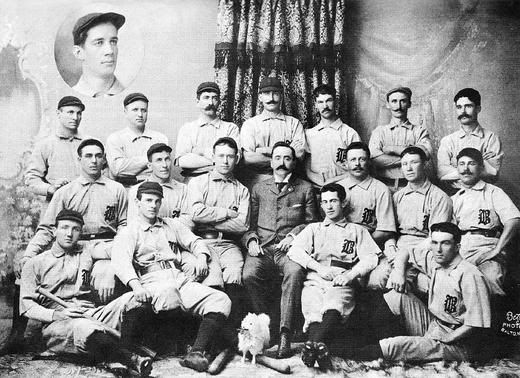
The Baltimore Nine in the 1890s
The original Baltimore Orioles baseball franchise was founded way back in 1882 (the year James Joyce was born). They were a charter member of the American Association, an old professional league that lasted for ten years. When that league folded in 1892, the Orioles joined the National League (yep, the same National League that the Mets and everyone else play in today) and became a powerhouse, winning three consecutive pennants.

The National League during the 1890s was a scary place, the games often filled with violent, dirty play, the umpires were often spat on, punched, or shoved and the fans involved themselves in the game's quarrels to a degree unlike anything we could imagine nowadays. In their tame moments, they were known to hurl rotten eggs or beer bottles at the on-field arbiters. As Bill James wrote in the Historical Baseball Abstract,
 "the fans never actually killed an umpire. They tried. Umpires required police protection countless times, and there was an incident in Minnesota in 1906 in which a crowd got hold of an umpire with apparent intent to do bodily harm, but was dissuaded by a local athlete. A good many umpires have been killed in on-field accidents, some of them in the minors. But if they didn't kill one (deliberately) in the 1890s, then it just wasn't destined to happen, because they sure tried." (pg 53)
During this violent era, the Orioles were known as the absolute dirtiest team of them all. In 1894, the Orioles started a fight on the field in Boston that got so ugly it ended up with the the fans rioting and starting a fire that destroyed the ballpark and 170 surrounding buildings. Led by third baseman John McGraw, who would eventually go on to become one of the greatest managers of all time for the New York Giants, they played rough and they succeeded with it.

But just as the 20th century dawned, the National League decide to get rid of four teams including the Orioles. Members of the defunct team went to the brand spankin' new American League and made their own Baltimore Orioles team though they'd only last a couple of years before moving to New York and becoming the Highlanders (eventually changing their name to the Yankees).

The Orioles of today that we know and love were originally the St. Louis Browns, another team in the early American League, until the franchise transferred to Baltimore in 1954 and took on the name of the famous old B-more ballclubs. The newly minted Orioles stunk during their early years in the American League but they would eventually build up a pretty spectacular team that managed to stay in contention virtually every year from 1960 to 1983, winning three World Series titles along the way.

Those Orioles teams pulled off the exalted feat of playing in the Fall Classic for three consecutive years from 1969 to 1971, though they only won once during that span (in 1970). In 1969, the highly-favored, powerhouse O's went up against the scrappy New York Mets. The Amazin' and lovable Mets pulled off the upset, defeating Baltimore in 5 games, winning their first ever World Championship in a series that featured a handful of legendary moments. Here's the Mets segment from Ken Burns' wonderful baseball documentary:


*   *   *

Having departed San Diego and lost the luxury of rooting for and seeing a nearby baseball team (the Padres) on the regular, I've found thus far this season that I'm clutching to my Mets fanhood as tightly as ever. I'm now deep in the heart of Texas, the state's two pro ball teams are each at least three hours away from me and I've got absolutely no interest in either of them anyway. I don't have cable, so I can't pick up their games on TV and while I do watch baseball on MLB.tv, I'm blacked out from watching any games involving a Texas team. So, early on in the season while league storylines are still developing, I've latched onto my ol' Mets.

This year's team got off to a terrible start but they've looked pretty respectable lately as their deep offense has awoken from its offseason hibernation. As I mentioned recently, I've been particularly glad to see Carlos Beltran back in the lineup and mashing the ball like he used to. As I cooked dinner the other night, I watched and cheered loudly as Beltran launched three homeruns against Colorado.

This weekend, the Metropolitans make their only trip to the city of Houston (though they do return to Texas to face the Rangers in June) and I've been trying to figure out a way to head over there to see a game but my schedule doesn't allow it and it's a three hour drive each way. I can't help but be annoyed by this, though, because my favorite baseball team is playing within driving distance from here and I'm unable to go see them.

I didn't even get to watch last night's game live as it was blacked out. The Mets went about their business anyway and blasted three monstrous homeruns in a nice comeback win against the Astros. For tomorrow afternoon's tilt, featuring the knuckleball-flinging sensation that is R.A. Dickey taking the hill for the Mets, I'll probably resort to tuning into the game's radio broadcast to keep up with the happenings of the National League New York Nine.

*   *   *

The inimitable Joe Posnanski wrote a nice blog post that briefly examines the reborn Carlos Beltran (leading the NL in extra base hits at the moment) and compares him to Derek Jeter while also painting a humorously accurate and well-written portrayal of New York City and her relationship with her baseball teams. As anyone who's spent time in Manhattan knows, the best way to get a glimpse of what's going on with the local teams is to drop a quarter and pick up the often absurd New York Post tabloid. Sayeth Joe:
"I look to the Post front page for overreaction, for gut punches, for the very thing that New York cops, construction workers, store owners and waitresses and anyone else you might run into would say."

Sunday, May 8, 2011

Three Baseball Book Reviews

Reviewing the three baseball books that have occupied my mind the last couple months.

Baseball Prospectus 2011

I never really thought about this until now, but it's incredible to realize that every year (for 8 years and counting) I devour the entirety of a book that is literally the size of a phonebook. Usually, I will gradually cruise through the Baseball Prospectus annual throughout the summer until I've finished it. This year, I surprised myself by zipping through the whole thing in less than two months.

The arrival of the new BPro publication is a yearly ritual for me as I'm sure it is for many other devout baseball fans. In the foreword to this year's edition, Joe Posnanski gives a rundown of the exact manner in which he approaches the great tome every year. For me, I spend a few days just flipping through it, reading bits and pieces and soaking up the feeling that a new baseball season is upon us. Then I start reading through the essays of each team (starting with the crappy ones, saving the best teams for last) along with the capsules for their key players. One of the many beautiful things about this book is that after reading the whole thing, it then becomes an essential reference book; a perfect, handy (though heavy) guide to flip through whenever watching a ballgame.

Now, as an annual devourer of these books, I find myself scrutinizing the mistakes and typos (there are plenty, as usual) and holding it up to a very high standard. I expect a lot from this book and it's something I look forward to reading every year, not just because of the sharp and thorough baseball analysis, but because the quality of the writing is usually excellent. The Prospectus think-tank has seen a lot of turnaround among its ranks these last few years, though, and the quality does occasionally reflect that. Some of the writing is very bland and doesn't offer anything new or special in the way of baseball analysis---I was particularly unimpressed with the team essays for the White Sox, Rangers, Giants, and especially the Mets. It also becomes very obvious when you read through the player essays that the writer isn't looking at the same stats that the reader is being shown. In that respect, they actually got a bit sloppy this year.

That's not to say that there weren't big improvements in this year's book. The format and design of the player capsules (of which there are over 1,600 making up the bulk of the book) received a major overhaul from past editions. The capsules were cleaned up, some staple stat categories removed and the info condensed to conserve space. It was a visual shock at first, but my eyes quickly got used to it and I actually think the presentation is much smoother than its ever been. A pet peeve of mine with these books, though, is a complete lack of any creativity at all in the appearance. The look of the text is as cold and bland as an instruction manual. And yet the wit and spirit of the written content is lively, occasionally causing me to burst into laughter. (I also get a lot of enjoyment out of the lists of player comps which sometimes bring up amazing old baseball names like Puddin Head Jones and Vinegar Bend Mizell.)

It seems like the best chapters were those for the lesser teams. I loved the Orioles team essay which put into perspective the nearly unprecedented turnaround the team had last year; the Nationals got one of the best essays in the book, one which compares them to Dave Dombrowski's successful Tigers teams and even speaks of a growing Nats bandwagon; the Astros, perhaps the shittiest and most boring franchise in baseball right now, received an insightful and humorous assessment, same with the Indians. As for the good teams, they certainly present a great case for why the Reds will be a competitive force for the upcoming future (a great defensive team with tons of young talent) and pick apart the always interesting Colorado Rockies.

On my eighth or ninth edition of this book, it's pretty clear they have developed a formula for the writing style which always features lots of snark and cultural references to bring much needed levity to a scientific, numbers-heavy content. They can tend to pile it on a bit thick, though, and the same jokes (this year it's obesity humor) repeated over and over fall badly flat. Despite its flaws, this vast text is still a delicious treat that doesn't lose its flavor even months after you've completed it. A worthy addition to the annals of Prospectus annuals.

The Extra 2%

This book felt very much like an unofficial sequel to Moneyball or, perhaps, a nephew to Michael Lewis' famous book. The author certainly doesn't hide that, often referencing the book that told the story of the shrewd Oakland A's front office. Just like Moneyball, this book has a great story. The worst-to-first scenario played out so ideally for the Rays that, honestly, it's a meatball pitch for any astute baseball writer to hit out the park and Jonah Keri does just that.

He's certainly got a gift for storytelling and juggling different scenes in a narrative, often jumping nimbly between decades or individual seasons while following a general chronology of the Tampa Bay Rays' history. After its inception in the late 90s, the organization was so unbelievably pathetic in every possible way that it's often comical. The team president was a world-class schmuck who wouldn't even let the employees use e-mail, considering it to be just a fad. His business manners pissed off everyone: the employees, the fan base, local businesses, even the city itself.

Three Wall Street honchos eventually took over the reins and completely changed everything about the organization, from the team name (exorcising the "Devil" out of "Devil Rays") on down to the allowance of outside food to be brought into the ballpark and free parking. They needed to revamp the team's image and they not only accomplished that, but they built a powerhouse that managed to win the AL East two out of three years with a minuscule payroll.

I particularly enjoyed the chapter on the team's manager, Joe Maddon, covering his background and ascent to the role of major league manager. Maddon is a highly interesting character; a baseball lifer with broad intellectual interests who frequently goes against the grain and the accepted baseball wisdom in his machinations. The chapter entitled "Mystery Men" was also great, describing the Rays' manner of seeking out bright sabermetricians to build a powerful braintrust of brilliant baseball minds on the cheap. The whole Rays story is a great one, enough to make me a fan of theirs, but what makes this book special is that it's written in an extremely readable, smooth manner.


The Hardball Times Baseball Annual 2011

At the inception of my deep intellectual interest in baseball, one of my must-read websites was the upstart Hardball Times. The staff has changed a lot over the years as many of their original writers have gone on to bigger gigs, but they still produce plenty of great (and free), cutting edge baseball content. I was one of the few people that bought their first venture into book publishing and I've been getting their Annuals every year since.

The timing of the book's release is a bit awkward, though. First, they were releasing the book at the conclusion of each season to examine what had happened that year. And now this last iteration was released so soon after the season that its content doesn't cover the playoffs or World Series. Repeating the same exact cover art for a few years in a row doesn't look great either. Nevertheless, this an awesome book.

It is split into halves: a collection of essays and studies on various aspects of the game in front and full thorough stats for every team in the back. This year had a bunch of excellent essays including a really long one (15 pages) by legendary analyst Craig Wright on the proper way to get the most of a pitcher. That's really the must-read essay in the book that's worth the purchase price on its own. But I also loved Steve Treder's piece on the reasons for last year's low scoring levels (an interesting relationship between pitcher, batter, and umpire is apparently behind it); Jeremy Greenhouse used the data goldmine of Pitch f/x to identify the pitchers in the game with the best "stuff" (hardest throwers/best movement) and location yielding fascinating results in a well-written piece; Sean Smith examined the oft-asked question of whether or not catchers have a real impact on the performance of their pitcher and the results were groundbreaking (backstops do have a noticeable effect). There's also an intricate though highly readable breakdown of Barry Zito's fall from grace and return to respectability as well as an eye-opening little piece by Tom Tango that might make you see the game a bit differently (with regards to balls in play, at least).

The cover boasts "timeless commentary" and, in fact, I do find myself digging out last year's edition of the same book to read some of the essays because, for the most part, they don't lose their luster. And this current edition is already about 6 months old but I've been reading it constantly. Great, informative, worthwhile reading for a baseball nut.