Saturday, April 29, 2017
Madlib Interview NYC 2016 (Video) & More
Posting this not because it's a fantastic interview or anything, but a new(ish) appearance of an interview with Madlib in that type of setting is worth celebrating and paying attention to. The interview technically isn't even anything special, mainly because Madlib is such a notoriously quiet character. But for me, as a huge Madlib fan, his elusive nature and bizarre personality---buried as it is within a thick turtle shell whose surface is decorated with jewels and whose cavernous depths echo exotic clanky music---is fascinating in and of itself. It's amusing watching Madlib here squirm away from straightforward answers, or use humor and sarcasm as subterfuge.
More importantly, Otis Jackson Jr. aka Madlib is widely considered (by those who know who he is) to be one of the great musical geniuses of our time. When he speaks (whether in a rare interview or through music), you listen. A multi-instrumentalist who transcends mediums and genres, his trippy crate-digging mixes of Brazilian jazz or African rock or other miscellaneous gems are just as interesting as his one-man band jazz releases or his legendary beat tapes. He's always been one of my favorite artists to write about and a constant presence in my daily playlists. I'm thrilled to see the mind of Madlib open up here even just a little bit to share his wisdom. Plus, above all else, the common thread of intrigue about his sound is his style, and the man's unique style certainly comes across in this interview. So do check it out.
After that, you can listen to this Madlib mix of Brazilian records from the crates, entitled Speto Da Rua.
(If you dig that, then also check out his newer mix, Mind Fusion: African Ear Wax.)
Lately, I've been immersed in the instrumentals he produced for Strong Arm Steady's 2010 album In Search of Stoney Jackson. I could listen to this for days:
And, lastly, one can't talk about Madlib without lamenting the absurdly long wait for the new Madvillain album with Doom. Here's Madlib's remix of a track from another long-awaited collabo, Doom and Ghostface:


Tuesday, April 25, 2017
Monday, April 3, 2017
MLB 2017 Season Predictions

In the aftermath of the Cubs winning the World Series in 2016, it feels weird we're even still having baseball. It feels way too soon for a new baseball season to begin. We still need more time to recover and contemplate that Game 7. The fucking Cubs won the World Series! We're in a post-Cubs-shattering-their-108-year-drought period now, a whole new cosmic epoch. Oh, and in other news we've got a new president, the first one in more than 100 years to decline to throw out the season's first pitch.
So here we are, a new season begins already. I don't quite feel ready for it and actually feel less enthused about baseball than I have in forever. This explains why last year I read a dozen baseball books and this year I've barely read one. It's why after writing up a set of predictions for all 30 baseball teams before opening day in each of the last seven years, I've neglected to do so until now, with games already underway.
Other factors contributing to my relative unpreparedness for baseball season: I bought a house, have been renovating it for a month, and am packing to move next week. It's been one of the busiest and most stressful periods of my life. So during any slivers of free time I've had lately I've tried to engage in marathon writing, both to maintain sanity and assure continued writing progress in this chaotic time.
So here, as quickly as I can prepare them, are my predictions for each MLB division and team. (Presented in the usual format of choosing Over/Under for the team's 2017 win projection from Baseball Prospectus' PECOTA as of March 31, 2017.)
Friday, March 31, 2017
To Witness the NBA Renaissance
 |
| (Credit: Getty Images) |
It was the best of times, it was the worst of times.
Amid the backdrop of a crumbling country, the NBA has been experiencing a new golden age.
And while the league reaches new heights, its storied New York Knicks franchise achieves ever deepening levels of rock bottom.
The frantic artistry and entertainment of last year's seven-game NBA Finals between the Warriors and Cavaliers sparked a surge in my basketball interest. When the 2016-17 season began, I was latched on to my favorite team, the increasingly frustrating and weird New York Knicks, keeping up with basketball mostly through them while they showed plenty of early promise. They were 14-10 at one point, creating the early illusion of a shot at playoff contention. During that first month of the season, when family members asked what they could get me for Christmas I figured some new Knicks gear might be a good idea.
Sunday, February 19, 2017
The Sudden Relevance of Children of Men
 |
| Poster by Mondo. |
One day last year, I sat down and wracked my brain to come up with a ranking of my favorite films of all time. After much deliberation, I determined my top film ever is Children of Men, the dystopic masterpiece from director Alfonso Cuarón, released on Christmas Day 2005.
I can remember seeing it for the first time. I was in San Diego visiting my brother and his wife. We all went to see it together. When it was over, I felt stuck to the chair, unable to move. The emotional impact of the film felt like a spear had impaled me, pierced my chest and nailed me to the theater seat in wide-eyed shock. It was an experience I'll never forget.
Despite the premise being a distant future---the year 2027 in which humans have lost the ability to reproduce leading to anarchy and rampant terrorism all around the world---everything about the film felt relevant to the current moment. I can remember being viscerally stunned at the force of the filmmaker's message, it felt like a desperate plea, trying to re-awaken our sense of humanity through art. Now, a little more than 10 years later, this sci-fi dystopian display of theatrical imagination feels more realistic than ever, loaded with xenophobic nationalistic politics conveyed through news media, ever present armored police militants, and extreme anti-immigrant, anti-refugee policies leading to frequent terrorist attacks.
Lately Children of Men, which was a box office flop when first released, has been gaining more and more attention due to its sudden allegorical relevance in our alarming contemporary situation. Abraham Reisman of Vulture recently summoned director Alfonso Cuarón to discuss the film as framed in the context of Brexit, the Trumpacolypse, etc, leading to an in-depth feature piece entitled "Future Shock" positing that Children of Men "might be the most relevant film of 2016."
In the feature, Cuarón describes the conception and execution of the film's most famous cinematic feats, its long uncut shots with the masterful cinematographer, Emmanuel Lubezski. I enjoyed this bit about working with him:
And Cuarón expresses his view of our current wayward moment in history:He recruited his longtime friend and frequent partner Emmanuel “Chivo” Lubezki to be his cinematographer. Together, they hit on the idea of loading up the background with information — graffiti, placards, newscasts — and thus limiting the kind of expository dialogue that often plagues dystopian stories. Cuarón recalls Lubezki declaring, “We cannot allow one single frame of this film to go without a comment on the state of things."
The gap between our world and that of Children of Men is closing rapidly, but he refuses to give up his faith in our wayward species. There are dark days ahead, to be sure, but perhaps they will also be days of transformation. “Look, I’m absolutely pessimistic about the present,” Cuarón says. “But I’m very optimistic about the future.”
Following the feature, Vulture also published an expanded interview with Cuarón where they go into more detailed depth on the making of the film, what he felt it was really about ("it was more about spiritual infertility"), and the filmmaker's enduring hope for the future.
On the same note, YouTube film analyst Nerdwriter created this fantastic, enlightening glimpse of the symbology within the film's loaded frames, "Do Not Ignore the Background":
^
To the excellent observation that the shot of pregnant Kee in the barn echoes the posture of Botticelli's Venus, I want to add that the scene is also literally overflowing with symbols. Kee, the key symbol of the film, the future of the human race in the form of a young pregnant mother from Africa, stands surrounded by cattle, symbols of fertility from time immemorial, with their mother's milk being extracted. Fertility, fecundity, pregnancy are the story's most important symbols. Note the year is 2027, and it's been 18 years since the last child birth. 27 and 18 are both divisible by 9, the number of gestation. I could go on forever about this movie.
Here's hoping we as humanity get through our current bleakness and continue to produce beautiful art like Children of Men.
Sunday, February 12, 2017
Street Lamps: Hip Hop in the Dark Ages
 |
| Mural by Retna. |
The Trumpacolyptic Revelations of Amerikkka
Since the Trumpocalypse began, most of the world has been mired in despair, confusion, and uncertainty. The highest office in the land, the most powerful position atop the most powerful country in the world, has been handed over to a capricious billionaire whose most ardent supporters include the Ku Klux Klan and neo-Nazis. To make matters worse, he quickly loaded up his cabinet with all manner of ghoulish racists, white nationalists, and billionaire bankers. The last few months have felt like the scene in Ghostbusters where the prick from the city inspector's office pries open the containment unit opening the floodgates for an overwhelming stream of ghosts and demons. Somehow this is reality.
During this period of darkness, I've found there are very few indulgences that make sense within this context, few things that really feel right. Thomas Pynchon makes sense. So I read Vineland, the paranoid novel inspired by the fearful proto-fascism of Nixon and Reagan. Philip K. Dick makes sense. So I've checked out the new series The Man In the High Castle based on his novel, a bizarre scenario envisioning America if the Nazis and Japan had won World War II.
And, above all: Hip Hop makes sense. Hip Hop feels right during these times.
Not unlike the oddly reassuring Dave Chapelle appearance on SNL immediately after the election, where the message was basically that this latest travesty of hatred and racism is nothing new, I've found myself retreating into Hip Hop (real Hip Hop, not the fake shit) where the message has always been that the system is corrupt, racist, deceitful, and predatory. From the early days of Public Enemy, KRS-One, and Ice Cube on through Wu-Tang, Immortal Technique, Dead Prez, and Mos Def, the message has remained the same. Things didn't change with Obama in office. The drug war persists, the prison industrial complex grows, police brutality worsens, poverty lingers, and black disenfranchisement continues.
Back in 2011, as demonstrations were erupting around the world leading to what became the Arab Spring and Occupy Wall Street, I wrote a review of the debut album from the late Kevlaar 7, Who Got the Camera?, a scathing sociopolitical wake-up call. I opened by quoting Ezra Pound who said "The artist is the antenna of the race, the barometer and voltmeter" and Marshall McLuhan who saw art "at its most significant, as a DEW line, a Distant Early Warning system that can always be relied on to tell the old culture what is beginning to happen to it.” In Trumpocalyptic America, many are wondering who could've seen this coming, how could we have let this happen, how can America (or Amerikkka) really be this racist. Well, the answer is that true artists, in America's case, Hip Hop artists who have their antennas up, have been warning us of this for many years.
Sunday, January 29, 2017
Secret Retributions
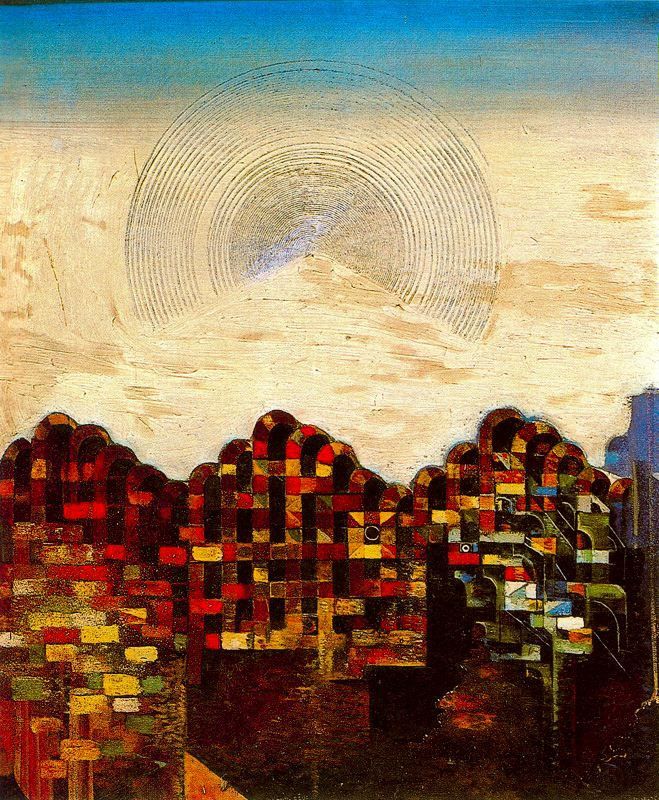
Secret retributions are always restoring the level, when disturbed, of the divine justice. It is impossible to tilt the beam. All the tyrants and proprietors and monopolists of the world in vain set their shoulders to heave the bar. Settles forever more the ponderous equator to its line, and man and mote, and star and sun, must range to it, or be pulverized by the recoil.
- Ralph Waldo Emerson
(quoted in Vineland by Thomas Pynchon, p. 369, where a character has memorized the passage after discovering it quoted "in a jailhouse copy of The Varieties of Religious Experience by William James." Artwork: Paris Dream by Max Ernst.)
Tuesday, January 3, 2017
Some Things I Wrote, Read, and Experienced in 2016
2016 was, at the very least, a great year to get lost in the things you love and indulge in healthy distractions from all the darkness and bullshit.
In that respect, it was a great year for me. Pursued my passions as much as ever, achieved some success, met some incredible people, went to cool places. Here's a summary of the things I wrote, read, and experienced in 2016.
Some Things I Wrote in 2016 On Literature/Art:
 Detailing a fascinating theory put forth by Roy Benjamin positing that the structure of Finnegans Wake involves the precession of the equinoxes, the earth's wobble on its axis that leads to the pole star changing over millennia, a glacially slow sequence whose accounting is at the heart of most of the world's mythologies, symbolizing renewing cosmic aeons. This is the piece from 2016 I am most proud of and while I finished it in January, the ideas from here have been on my mind all year.

A close exegetical reading of the opening pages of Book IV in Finnegans Wake, focusing on the archaic prayers to the rising sun which have elements of Hinduism, Celtic paganism, and a snoozing sleeper's overheard radio advertisements, among many other things. In the Finnegans Wake Reading Group of Austin, we spent much of the year unpacking the rich pages of Book IV and I was inspired to fully interpret its especially astonishing opening pages, 593-594. The latter was especially fun to examine.

A book review of the latest work by John Higgs, one of my favorite reads from 2015, highlighting five of the most bizarre facts/stories from his astute overview of our previous century. Here's a snippet:
A short piece describing a connecting thread of thoughts I had about two phenomenal 20th century painters, Ivan Albright and Pavel Tchelitchew, as well as two literary critics whose work I fell in love with in 2016, Guy Davenport and William Gass. Go for the images of stunning, surreal art, stay for the quotes connecting the symbols from same.
In that respect, it was a great year for me. Pursued my passions as much as ever, achieved some success, met some incredible people, went to cool places. Here's a summary of the things I wrote, read, and experienced in 2016.
Some Things I Wrote in 2016 On Literature/Art:
Rise and Shine: The Dawn Prayers of Book IV
[of Finnegans Wake]
&
A close exegetical reading of the opening pages of Book IV in Finnegans Wake, focusing on the archaic prayers to the rising sun which have elements of Hinduism, Celtic paganism, and a snoozing sleeper's overheard radio advertisements, among many other things. In the Finnegans Wake Reading Group of Austin, we spent much of the year unpacking the rich pages of Book IV and I was inspired to fully interpret its especially astonishing opening pages, 593-594. The latter was especially fun to examine.

A book review of the latest work by John Higgs, one of my favorite reads from 2015, highlighting five of the most bizarre facts/stories from his astute overview of our previous century. Here's a snippet:
On the cusp of Einstein's relativity, and before Hubble's discovery that the universe is expanding, astronomer Simon Newcomb said in 1888 that we were "probably nearing the limit of all we can know about astronomy." Ha!
Max Planck, before he became one of the most important physicists in history with his development of quantum theory, was told by his teacher Philipp von Jolly not to pursue physics because "almost everything is already discovered, and all that remains is to fill a few unimportant holes."
Similarly, scientists thought it was virtually impossible that rockets would lead to space flight a mere few decades before it was achieved. Higgs notes that a 1931 textbook declared there was "no hope" for such developments, and that "only those who are unfamiliar with the physical factors involved believe that such adventures will ever pass beyond the realm of fancy." Within 30 years humans had launched the first satellite and sent a human in orbit around the Earth.
The recurrence of such foolhardy assuredness from scientists should serve as an important lesson for the present. Soon as you think you have it all figured out, the world flips upside down.
 |
| "Hide-and-Seek" by Pavel Tchelitchew |
A short piece describing a connecting thread of thoughts I had about two phenomenal 20th century painters, Ivan Albright and Pavel Tchelitchew, as well as two literary critics whose work I fell in love with in 2016, Guy Davenport and William Gass. Go for the images of stunning, surreal art, stay for the quotes connecting the symbols from same.
Sunday, October 30, 2016
Some Thoughts on Chess and Artists Who Love Chess
 |
| Portrait of Chess Players - Marcel Duchamp (1911) |
Recently, a new employee started working at my job, a Turkish guy, and in his introductory email he noted that he plays chess competitively. As someone who's long been fascinated by chess, played sporadically for many years, and desires to improve, I of course sought him out to play some games during lunch breaks and try to learn something from him.
The Turkish chess master has now beaten me 21 straight times.
While I have a great interest for the game, I'm a subpar player prone to boneheaded mistakes. He's a pro who plays in tournaments for financial prizes. Once he told me that his chess teacher can play something like 50 games on different boards simultaneously while blindfolded, and win most of them. He confidently asserts that he can beat me blindfolded. I don't doubt it.
Playing chess, talking chess, and getting my butt whooped in chess has rekindled my passion for the game and I've played at least a game or two each day since. Occasionally I'll watch some chess instructional videos or do tactics puzzles. One day I hung around after work and the Turkish chess master (whose first name, Baris, recalls another Turk from an earlier chapter in my life, the manager of a restaurant I worked at in lower Manhattan---we shared a birthday, yet always clashed) provided me a couple hours worth of lessons. My rating skyrocketed from there and I've been playing much better ever since. For some reason I'd always had trouble staying above the 900 level consistently; since that one lesson I've been around 1300. It's much more fun to play when you don't suck.
* * *
What I do remember is playing chess games at Zuccotti Park in downtown Manhattan (the very same spot where the Occupy Wall Street movement would later spring up) during lunch breaks when I was 14, working my first summer job in '99 as a messenger in that area, under the shadow of the World Trade Center. There'd be folding tables set up and games going on there a couple days a week. The park players were aggressive, talked plenty of smack, and required anyone who sits down to play to put up money. Serious players only. Many of these dudes were impoverished, homeless, likely just hustling chess games in the park all day for cash. I used to get my ass whooped, often in front of crowds of lunching onlookers (and, this being New York, commentators). Didn't care. I love those Manhattan park chess players. That whole scene, with crowds gathering around active tables of chess games in city parks, feels like a relic. A civil gathering of scores of diverse people to compete and match wits.
After 9/11, Zuccotti was pretty banged up, then used as storage for years before eventually being rebuilt and reopened. By the time the new and improved Zuccotti Park was unveiled I was a senior in college at Pace University nearby, disappointed that I'd soon be done with school, finally done with downtown Manhattan, and wouldn't get to enjoy the fresh new version of Zuccotti which now had marble slab tables with chess boards built into them.
Nevertheless, I don't think they play a whole lot of chess over there. It's a relatively tiny park, occupying essentially one city block. Washington Square Park, by comparison, is huge. That's where the real New York City park chess scene takes place. My sister lives down the street from there now. Last Christmas I was staying at her place, snapped a pic of some chess players in the park one afternoon while walking through.

* * *
As with other elements of my life, my chess interest originally sprang from my love of the Wu-Tang Clan, particularly the group's most devoted chess players, RZA, GZA, and Masta Killa. They've talked about the game often, rhymed about it frequently, filmed chess-inspired music videos, the cover of the Liquid Swords LP is a bloody Marvel comic scene of a chess board battle, GZA did a whole chess-themed record with DJ Muggs called Grandmasters. Chess even gets its own chapter/chamber in RZA's Wu-Tang Manual---suffice to say, it's an integral part of the Wu-Tang mythology. So as a dedicated Wu head from Staten Island, I felt as a kid that I must learn the game. The more I got into it, I realized being in the habit of playing chess, thinking about chess moves, enhanced my focus in life and helped with decision-making. It's a mindfulness practice. My mind felt better organized during periods when I was playing chess. Not unlike listening to heavily lyrical hip hop, it's a type of mental exercise. And it's addictive.
RZA has been an outspoken advocate of chess for years and even created a Hip Hop Chess Federation to educate children. Their slogan is: "Fusing logic and the arts to unite minds and hearts."
That fusion of logic and arts that chess embodies is what has fascinated me most about it recently.
So many prominent artists were also chess enthusiasts.
Among these, the most notable must be legendary 20th century artist Marcel Duchamp, who was such a chess junkie that at one point during the height of his career he basically gave up on creating art to pursue playing chess full time. I've written once before about this, he eventually slowed down his obsessive chess playing and returned to the arts, but maintained his interest by becoming a chess journalist and blessing us with some insightful, eloquent commentary on the game.
"I have come to the conclusion that while all artists are not chess players,
all chess players are artists." - Duchamp
And here is a famous photograph of Marcel Duchamp playing chess against a nude Eve Babitz [oh and NSFW? but it's art goddammit!].

Behind them lies Duchamp's masterpiece, the extraordinary glass pane entitled The Bride Stripped Bare By Her Bachelors, Even. (You can read the full story behind that photo in this detailed Vanity Fair piece.)
The combination of chess and lust invoked by the image reminds me of a memorable scene in an old Seinfeld episode. Jerry is dating a woman who disgusts and irritates him but she's irresistibly attractive physically, likening his conundrum to a chess game between his brain and his penis.
* * *
As I mentioned, RZA has long been a proselytizer of chess and there's a slew of random RZA chess videos around the internet to prove it. He plays against a New York Times chess editor, he plays against a young grandmaster, he freestyles in a cypher after a chess tournament, lectures at a chess symposium, there's even footage of a live concert that begins with RZA and Yoko Ono playing chess on stage:
You can imagine what a thrill it was for me when I explained to the Turkish chess master coworker that my chess interest stems from the influence of The RZA and Wu-Tang and he responded that he'd actually played a couple games against RZA once when The Abbott had visited his chess club in Los Angeles years back. He showed me a pic. So the guy I've been playing chess with has actually played against the artist who sparked my interest in the game in the first place. I find that incredible.
* * *
During this recent period where my interest in chess has fired up again, I've simultaneously developed a new interest in the life and work of author Vladimir Nabokov. I'd been stumbling upon Nabokov biographies in bookstores, thumbing through them and learning more about him, developing a fascination for this esteemed and controversial scribe. Picked up a thick collection of his short stories and have found them to be about as pleasurable to read as any stories I've ever encountered. They're exquisite.
Nabokov was an interesting dude, extremely prolific, a writer so productive he puts most others to shame. He wrote tons of short stories, dozens of novels, books of poetry, books of literary criticism, and somehow was also a respected lepidopterist who published scientific articles on the study of butterflies. He did all this while trying to survive on income from, variously, working as a tennis instructor, boxing instructor, language teacher, and eventually literature professor at Cornell. With all that going on, he was also an ardent chess enthusiast.
He wrote a chess novel called The Defense and spent ample time composing chess problems about which he wrote: "The strain on the mind is formidable; the element of time drops out of one's consciousness." He felt that chess problems "demand from the composer the same virtues that characterize all worthwhile art: originality, invention, conciseness, harmony, complexity and splendid insincerity."
Nabokov had a very involved, collaborative relationship with his wife, Vera. He read every story and novel to her as he was writing them, then she'd type them all out for him. She was also an avid chess player and they played each other every day. There are some charming photos of the Nabokovs playing chess together like this one.
 |
| The Nabokovs enjoying a game of chess. |
* * *
Since Nabokov wrote the screenplay for Kubrick's Lolita film, I wonder if the two geniuses ever actually sat down for a chess game... I can't find any documentation of it, but surely they must have. What a fascinating battle of the minds that would've been.
To conclude, here is an awesome video essay on "What Chess Taught Kubrick About Filmmaking" that goes into much further detail about Kubrick's love of chess and how it factors into his films:
Saturday, October 29, 2016
Bill Murray Providing Color Commentary for an Entire Cubs Game in '87
Funniest thing I've seen in a while.
39 minutes of Bill Murray broadcasting a 1987 afternoon Cubs-Expos ballgame alongside Steve Stone. Murray midway between Ghostbusters Part I and II at this point in his career. Unrelentingly hilarious here.
Game is preceded by Bill Murray's commentary of Bill Murray's misadventures taking rips during batting practice.
Wish every baseball game could be like this.
Go Cubbies!!!
39 minutes of Bill Murray broadcasting a 1987 afternoon Cubs-Expos ballgame alongside Steve Stone. Murray midway between Ghostbusters Part I and II at this point in his career. Unrelentingly hilarious here.
Game is preceded by Bill Murray's commentary of Bill Murray's misadventures taking rips during batting practice.
Wish every baseball game could be like this.
Go Cubbies!!!
Sunday, October 16, 2016
Why I Hopped Onto the Chicago Cubbies' Bandwagon

To the general baseball enthusiast or fans of teams outside of Illinois, the Chicago Cubs have been pretty harmless for a while. They haven't won anything in pretty much forever and when they've come close to winning anything recently they've tended to trip over their own feet. Besides the notorious Steve Bartman game in 2003, they've also had some pretty hapless and forgettable postseason departures in '07 (swept in first round), '08 (swept in first round), and most recently 2015 against my New York Mets (swept in second round). As everyone knows, they haven't won a championship since 1908. Haven't even been to the World Series since 1945. With a reputation and tradition for being lovable losers that's as rich as any organization in professional sports, it's been hard for anyone to really dislike the Cubs. I certainly've never had anything against them.
This year things were different. A lot different. After a few seasons of intensive rebuilding at the hands of Theo Epstein & Friends, the fully matured Chicago Cubs of 2016 were the best team in Major League Baseball and nobody else was even close. The Cubs won 103 games in a year when nobody else won more than 95. They allowed the fewest runs in baseball by a wide margin thanks to some shutdown arms and the best fielding ballclub in the game. And their lineup boasts two of baseball's best hitters (Kris Bryant and Anthony Rizzo) surrounded by a versatile and talented cast of young sluggers and a few seasoned vets sprinkled in. Helming this imposing group is the man widely considered the smartest and most open-minded manager in the sport, Joe Maddon.
Going into their Division Series with the San Francisco Giants, I found myself actually rooting for the Giants. The Cubs just appeared to be too good, too much of a dominant powerhouse for me to root for them. They've also got some players I just can't stand like John Lackey and Miguel Montero. Flame-throwing relief dragon Aroldis Chapman, for as entertaining as he is to watch, also ain't the most likable character. And the Giants, while coming off a defeat of my beloved Mets, entered the series as the clear underdogs, an 87-win team with glaring flaws up against a 103-win behemoth with no discernible weakness. So I was rooting for the underdog.
At some point during the Division Series, my outlook changed, as I had a pretty incredible encounter with someone who is truly a part of Cubs lore.
Subscribe to:
Posts (Atom)