Monday, January 27, 2014

Brain Pickings spotlights an Alan Watts classic

I could probably piggyback a Brain Pickings post at least once a week or so. It's surely one of the finest blogs on the internet and a must-read if you aren't already into it.

Today there is a nice lengthy post on one of my favorite books, Alan Watts' classic The Book: On the Taboo Against Knowing Who You Are. There haven't been many books in my life that I've found to be so consistently rich and rewarding that I've been compelled to actually carry them around on my person for weeks at a time. I can think of just two: Watts' The Book and Ralph Waldo Emerson's Nature and Selected Essays. (Any reader of this blog knows how much I love Ulysses and Finnegans Wake but both are weighty, encyclopedic tomes dense with obscurity. Not ideal for carrying around in your pocket.)

Watts is undoubtedly one of the all-time great Western scholars on Eastern philosophy and this brilliant little book is essentially a philosophical lecture on the Hindu Vedanta perspective of the universe and man's place in it, explained in the most basic terms that a child could understand. It also serves as a nice summation of Watts' work as whole. There is a great collection of over thirty Alan Watts audio lectures on iTunes that I purchased a while back and I find myself coming back to these lectures over and over again for their soothing eloquence, humor, and Watts' unique combination of scholarship and wisdom. It's safe to say The Book is a distillation of his philosophy into a very compact, accessible format.

Definitely go check out the Brain Pickings breakdown and here's a snippet from Watts:

We suffer from a hallucination, from a false and distorted sensation of our own existence as living organisms. Most of us have the sensation that “I myself” is a separate center of feeling and action, living inside and bounded by the physical body — a center which “confronts” an “external” world of people and things, making contact through the senses with a universe both alien and strange. Everyday figures of speech reflect this illusion. “I came into this world.” “You must face reality.” “The conquest of nature.”
 
This feeling of being lonely and very temporary visitors in the universe is in flat contradiction to everything known about man (and all other living organisms) in the sciences. We do not “come into” this world; we come out of it, as leaves from a tree. As the ocean “waves,” the universe “peoples.” Every individual is an expression of the whole realm of nature, a unique action of the total universe. This fact is rarely, if ever, experienced by most individuals. Even those who know it to be true in theory do not sense or feel it, but continue to be aware of themselves as isolated “egos” inside bags of skin.

Thursday, January 23, 2014

Falling Down the Kubrick Rabbit Hole


Since first hearing about the documentary Room 237 about a year and a half ago, I've become increasingly interested in the artform of Stanley Kubrick and the internet's rich array of exploration into his work. At this point, it's become a minor obsession of mine.

Much like James Joyce, Kubrick was an artist capable of building layer upon layer of meaning and reference into his work. His movies amount to moving-picture puzzles that invite the viewer to dive into them and try to uncode their messages according to their own perspective. When asked to explain the meaning of any of his movies, Kubrick was always deceptively vague and wouldn't offer much, preferring to let the films stand for themselves as works of art to be interpreted. Asked about the symbolic meanings contained in 2001: A Space Odyssey, Kubrick once said:
"They are the areas I prefer not to discuss because they are highly subjective and will differ from viewer to viewer. In this sense, the film becomes anything the viewer sees in it. If the film stirs the emotions and penetrates the subconscious of the viewer, if it stimulates, however inchoately, his mythological and religious yearnings and impulses, then it has succeeded."
Personally, I haven't really gotten much enjoyment out of any of Kubrick's movies, haven't even seen any of them more than once. They strike me as too dark. Although I do recall that upon seeing A Clockwork Orange for the first time, knowing virtually nothing about it or its director, I declared to my friends that whoever made this movie is an absolute genius.

But it's the world of Kubrick analysis and interpretation I've found to be endlessly fascinating, much the way my fascination with Joyce's work began long before I'd read any of his books. The medium of film seems much more ripe for such deep analysis, though. Great as Finnegans Wake or Ulysses are, there's only so much you can squeeze into a sentence or paragraph, whereas a master filmmaker can insert a staggering amount of material into one shot and this is exactly what Kubrick---a true visual artist who was a renowned photographer prior to getting into film---specializes in.

Wednesday, January 15, 2014

The Indigenous Arts of Moondog


I don't know how it took me all this time before I finally discovered Moondog. But, thanks to the glory of the internet, once I tasted a few drops of his music it wasn't long before the floodgates opened.

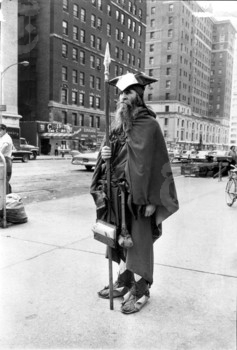
Moondog was a blind composer, street musician, and poet who spent decades plying his craft on the streets of New York City in the mid-20th century, busking and selling his music and poetry. Known as "The Viking of 6th Avenue", the eccentric blind bearded artist always wore full Viking regalia
New York Times image
(clothes which he made himself), spear included.

The blind man's sound is spellbinding, intoxicating, invigorating, enchanting---often a Native American-influenced thumping drum pattern forms the spine of his symphonic melodies with their whistling flutes, moaning horns, or lilting violins. Together with the indigenous tribal thump, his music is known for incorporating the sounds of the world, whether it's animals (frogs croaking, birds squawking), the crashing ocean waves, a boat's foghorn, or the grumbling of car engines. It's all combined together into a unique jazz-classical hybrid occasionally punctuated by readings of his short, playful poetry.

Mostly self-trained as a musician, he was adept with many instruments and even invented a few of his own. During his years busking in New York he eventually connected with some major composers of the era who helped get him to record studio albums and even conduct major orchestras. Despite reaching the heights of conducting symphonies in Carnegie Hall he remained devoted to the streets, regularly donning his hand-made Viking garb, rain or shine, to stand out and play for pedestrians.

Surely the most fascinating character I've come across in a while, his story sounds mythical and his sound is mystical. He even has a timeless look to him, his face could be the face of Da Vinci or Aristotle.

Thankfully there appears to be a documentary about him slated to be released this year.

A few of my favorite Moondog sound clips will follow. The first one should be strikingly familiar.


Monday, January 6, 2014

Catching Up and Looking Forward

Happy New Year!

I must apologize for yet another extended absence (more than 2 months without any posts here) as my life continues to undergo major changes. It's been nearly six months since I met my girlfriend (under highly serendipitous circumstances) and things continue to grow more exciting as we get to know each other more. I also recently gave in and decided to convert from part-time to full-time work after almost 3 years of working about 20 hours per week, during which time I was content to be just barely making it financially.

I was juggling two different part-time jobs for a while with the workload inching ever closer toward full-time so it finally made sense to ditch the sillyness of having two part-time positions and stick with one full-time job. The transition has gone pretty smoothly thus far but it will definitely be a challenge to keep up with all the reading and writing I plan to do while staying physically and socially active with half of my week's waking hours devoted to an office job. I'm taking solace and inspiration in the fact that there are writers out there who not only have full-time jobs and write prolifically on the side but who also have families to take care of, too. For now, I've got just one mouth to feed and should have plenty of mental energy to devote to my intellectual pursuits each week.

On that note, another reason for the slim presence on my two blogs lately is that I've spent an absurd amount of time working on one very large piece. I've wanted to write a very thorough summary review of Joyce's Book of the Dark by John Bishop for many years now because it is without a doubt the largest and most enlightening study of Finnegans Wake there is and I've always been disappointed at how little discussion there is about it on the internet. Bishop's book unpacks so many interesting ideas in such a thorough manner, you'd have thought someplace out in the far reaches of the interweb universe there'd be some intensive talk about it. But I haven't found much at all. Even the book's Amazon page only has 6 reviews, one of them a misguided and confused 1-star.


It was actually from Bishop's book that I got the title for my blog devoted to Finnegans Wake (pg. 169: "Finnegans, wake!, you have nothing to lose but your chains"), highlighting the imperative angle of Joyce's title, urging all the sleeping Finnegans to wake up! and take off their shackles of mental and spiritual slumber. A main part of my intention with starting that blog was to write reviews for the many fascinating studies of the Wake that are out there and certainly none come close to matching the originality and depth of Bishop's book.

So as soon as I finished up with reading the Wake last December, I jumped right into Bishop's book for the first time and devoured it within a few weeks. Then I started composing a review and realized... I needed to read it again. This second reading took many months as I was thoroughly parsing this heavy scholarly (yet entertaining and readable) text to take notes and distill its vastness into a sharp summary.

Almost a year later, I'm still not quite finished with the process but I've completed enough of it to start putting up the Bishop review/summary in pieces. PART 1 is up at my other blog now, I hope you'll go read it. [Just posted PART 2, two more to come soon.]

In the meantime, I'll be chipping away at the remainder of the review and trying to build up some writing momentum so as to keep both blogs alive and healthy throughout 2014.

Wednesday, October 30, 2013

Short Reviews for Books Read in 2013

In loosely chronological order...

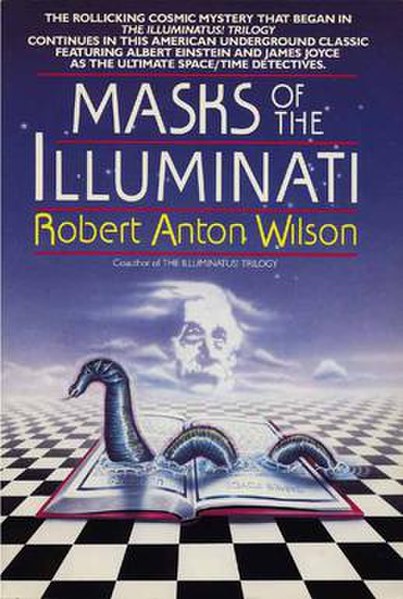
1. Masks of the Illuminati by Robert Anton Wilson
This was my first experience of RAW's fictional work and I enjoyed it thoroughly. A very entertaining, smooth read, this story takes place in the early 20th century and stars none other than James Joyce and Albert Einstein teaming up to help a distressed man who fears he's been the victim of a conspiracy perpetrated by Aleister Crowley. It reads like a detective novel, the clues generated through flashbacks and chewed on by our sleuths, two of the greatest geniuses of their generation, drawing the reader into its mystery until a somewhat ridiculous, confounding (though humorous) conclusion. The novel's shifting writing style often mimics the various styles employed by Joyce in Ulysses and there's even a subplot here of the young Joyce, thanks to his conversations with Einstein on relativity, fully conceiving his grand idea for a new book that would become Ulysses. Joyce describes his idea for "A multi-dimensional, multi-level, multi-meaningful book. A puzzle-book, one might say---and what could be more appropriate to our times, when all the best minds recognize increasingly that our existence is a profound puzzle?" (I read this book along with Tom Jackson's reading group over at his site RAWillumination.net. Go here to see more about the reading group.)


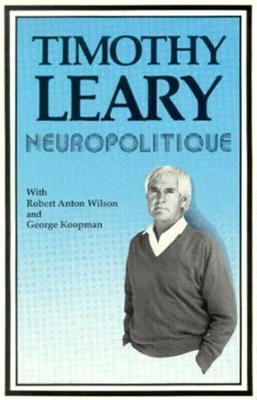
2. Neuropolitique by Timothy Leary and Robert Anton Wilson
A collection of essays from Leary mainly from the early-1970s, this features a wide array of pieces mostly written while in prison. I most enjoyed his overview of what occurred during the 1960s and early 70s which morphs into an incisive (and humorous) condemnation of the system of glorifying crime and punishment in the US, eventually covering his arrival and assimilation into maximum security prison culture, being in a cell next to Charles Manson, and working a deal with law enforcement to shorten his sentence. There are also essays on the 8-circuit model of consciousness (including one written by RAW) and space migration. My favorite aspect of Leary's spiel tends to be his view of DNA and evolution and I love the way he ties space migration into this. He likens space migration to "the movement from marine to amphibian life or from reptile to mammalian." Why don't people say this kind of stuff anymore? The quality of the pieces definitely seems to tail off towards the end but this book is worth reading for the first half. (This also seems to be the only Leary book without his enduring wide grin on the cover. He means business here.)

3. Info-Psychology: A Manual for the Use of the Human Nervous System by Timothy Leary
Continuing my foray into the life and work of Leary (temporarily put on hold at the moment as I work on some big writing projects), this was the book that always seemed most appealing to me since it's Leary's own introduction to the 8-circuit model of consciousness, which RAW so perfectly examined in his book Prometheus Rising. While it has its bright spots, I found this book lacking in many respects (including its physical appearance, the New Falcon re-issue feeling cheap with rigid, stiff paper). While it gave me a better understanding of the overall picture, especially the higher four circuits, the book doesn't make the ideas seem very intriguing at all and even frequently refers to other books of his for further elaboration (whereas I thought this was the key text). At the same time, its subtitle claims it to be a manual but there really isn't anything interactive here, unlike Prometheus Rising which is a book that can literally change your life. You also get a clear sense that Leary was still hammering out some of the details of his model while writing this book, the re-issue even has an awkward set of footnotes at the end suggesting alternatives or retractions for the preceding material. This is another book that Leary wrote while in prison and, while the ideas and insights are staggering at times, it all seems a little disorganized. I don't blame him.

4. Quantum Psychology by Robert Anton Wilson
This is essentially the sequel to his classic Prometheus Rising. Here RAW makes use of the worldview(s) suggested by discoveries in quantum physics and attempts to work these into our experience of everyday life, with lots of interactive exercises that would work best in a group setting. (Once again, Tom Jackson's RAW-focused website had an online reading group for this one.) While there's certainly plenty of fascinating and important stuff here with RAW's usual combo of Zen parables, historical anecdotes, and hard science examining things like psychosomatics, relativity and the 8-circuit model of consciousness, I managed to breeze right through this book without too much of it really sticking in my head. Maybe I'll need to read it again with a more focused attitude and willingness to try all the exercises.

5. The Book of the Breast by Robert Anton Wilson
I picked up the original version, a hardcover edition with pictures, published by Playboy Press (it was later revised and reissued by New Falcon under the title Ishtar Rising). It's one of RAW's earlier works and provides an interesting glimpse at the period when he worked as an editor with Playboy. The subject matter is anthropological and very sophisticated for a book published by Playboy, it reminds me Joseph Campbell's books with its insights developed by a combination of psychology, history, poetry, art, myth, and sociology. At the same time, any regular reader of RAW's works will notice his prose feels a little bit different. Probably due to some combination of the intended audience, the era, the publisher, and the stage of his craft, the writing occasionally tries too hard to come across as hip and cool, man. Ya dig?

6. Baseball Prospectus 2013
This annual stalwart took a major dive by changing its structure, junking its unique, creative essays for a boring, uniform style. Wrote a full review here. Thankfully, they've considered the harsh feedback and are going back to the fun style.

7. Operating Manual for Spaceship Earth by Buckminster Fuller
A very short book but not a very quick read. The eminent architect-engineer-poet Bucky Fuller conveys his thoughts in a dense manner, heavy on metaphors. Great insights, though, and certainly a book that arouses one's optimism as he asserts the essential truth about our global problems---that they are entirely solvable if we restructure our attitudes.

8. Slaughterhouse-Five by Kurt Vonnegut
Somehow I'd never before read this classic, so a friend insisted I borrow it. What a beautiful prose stylist, this Vonnegut guy. I zoomed straight through this excellent and hilarious story of the misadventures of some American POWs in the German city of Dresden toward the end of World War II. A quirky, spectacularly awkward soldier/time-traveler/dentist named Billy Pilgrim is the star of the show and Vonnegut has fun with his pathetic hero. The prose is very simple, poignant, plain, practical. Repeated motifs like the simple phrase "So it goes" give the novel a vital continuity. With the firebombing of Dresden at its epicenter (in which an entire city was reduced to ashes, killing more people than the bombing of Hiroshima), the depiction of the horrors of war is piercing and unsettling but not overly teary or sentimental. Vonnegut's curt prose lets the reader fill in the blanks. Definitely a book to be read multiple times through one's life.

9. Manage Your Day-to-Day: Build your routine, find your focus & sharpen your creative mind by the team at 99u
This little book speaks perfectly to my struggles as an aspiring writer---it's a collection of essays on how to remain focused and manifest your creativity in an era of technology and distractions galore. What it all seems to boil down to is showing up every day, never waiting for inspiration, instead getting your ass to the desk and working. The name for their website comes from the Thomas Edison quote, "Genius is is one percent inspiration, ninety-nine percent perspiration." Basically, put your nose to the grind and work. Highly recommended book for all creative people out there.

10. Joyce's Book of the Dark by John Bishop
I'm almost done with my second reading of this book. Began it last December upon completing Finnegans Wake and, when my attempts to write a summarizing review failed, I had to jump back in and read it again for a better understanding. It's a vast and rich study, a dizzying deconstruction of that most obscure of books, Finnegans Wake, and it may actually be one of the all-time great works of art criticism. In an attempt to explain just what the hell Finnegans Wake is, Bishop begins with Joyce's own frequent hints that it is a book of the night, of the sleeping state, and then proceeds to wrap an astounding array of material from the Wake around his argument through increasingly fascinating chapters, hammering home his points thoroughly and highlighting the deep mysteries of our nightly descent into unconsciousness. His analysis includes large etymological flowcharts, illustrations and diagrams, and even giant maps representing the domain of a sleeping body ("Nocturnal Geography" he calls it). It's definitely not an easy read, but it's arguably the best book ever written about Finnegans Wake and contains some of the most unique and well-argued takeaways from Joyce's puzzling masterpiece I've thus far encountered. Look out for my full review coming soon at my other blog Finnegans, Wake!

Honorable Mention:
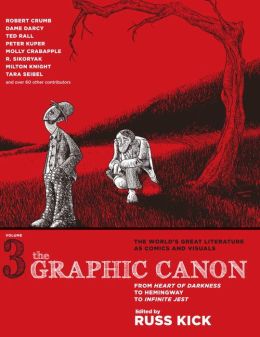
The Graphic Canon Vol. 3: From Heart of Darkness to Hemingway to Infinite Jest

Putting it down here because I haven't read this one in its entirety. Not even close. It's an enormous
book, sort of like an illustrated almanac of 20th century literature featuring a wide array of artistic styles. This serves as both a grab bag of visual candy and a nice primer to the best literature of the last 100 years. It's got just about everything from Joyce and Yeats to Pynchon and Wallace, Aldous Huxley and Hemingway, Kafka, Faulkner, Eliot. You name it, it's here. More importantly, the artwork is awesome. Sometimes it's in graphic novel form, other times weird, trippy, psychedelic paintings, or sharp colorful computer-generated graphics. It's a perfect book to leave out on a coffee table and flip through randomly. So much good stuff here, you'd probably never get through it all.

Monday, October 21, 2013

Indian Well with Escher-esque Stairs


Via New Scientist:
Between AD 600 and 1850, more than 3000 step wells were dug, by hand, in the Indian provinces of Gujarat and Rajasthan. Many of them had intricate staircase designs, peppered with shrines and balconies on which to linger in the afternoon heat. They reach deep underground and provided insurance against the region's fluctuating water supply.
The stairs guided local people – women, mostly – down to the water that seeps in from nearby aquifers. During the rainy season, the wells fill up, but in the dry season, you would have to lug containers up and down the entire well. This particular well, Panna Meena ka Kund near Amber Fort in Rajasthan, has eight storeys. According to local tradition, you must use different sets of stairs to climb down and climb out. The photograph was taken by Edward Burtynsky for his latest exhibition, Water, which opens at Flowers Gallery in London on 16 October.
You can find some other jaw-dropping photos from Burtynsky's Water project at his website. Here's another one I really like (of a Colorado River delta in Baja, Mexico):


(Photo Credit: Edward Burtynsky)

Thursday, September 26, 2013

Finding Glimmers of Hope in Another Lost NY Mets Season

All hail Lagares, the biggest bright spot on another losing team.
Another New York Mets season is about to be put in the books and with it a few negative streaks are extended. It's the team's seventh straight season missing the playoffs, their fifth straight season with a losing record, and the third consecutive losing finish under the promising, stats-savvy front office led by general manager Sandy Alderson.
While it's become an overdone cliché to mock the misery of the Mets franchise, this hapless 70-something win season offered glimpses of realistic hope for the near future and was actually quite entertaining to follow throughout the year as a devoted fan. I watched nearly every game of theirs throughout the spring and summer, only losing touch with the team as they fell into a late summer funk which coincided with an injury to the team's best hitter, David Wright.

Eclipsing any other story about this year's team was the ascent of Matt Harvey to superstardom. The 24-year-old starter spent a large chunk of the season pitching as well as anyone in baseball and even got to start the All Star Game in Queens but succumbed to an elbow injury in late August, sending Mets fans into a deep depression.

Beyond Harvey's five-month flirtation with the Cy Young award, there are still reasons to see this Mets season as a step forward for the franchise.

Wednesday, September 11, 2013

Picasso's Guernica


I recently re-watched one of my favorite films of all time, Children of Men, and the appearance of Picasso's Guernica caught my eye. (In the film we see the original 20 ft x 10 ft masterpiece serving as a mural in a character's dining room.) I've since been reading up on this painting a bit and watching documentaries about it.

Inspired by the despicable bombing of a civilian Spanish village by German and Italian planes in 1937, the shattered, sharp, and screeching imagery gives a unique, haunting depiction of the horrors of war. With the recent stream of bullshit pouring out of American media and government concerning the desire of the United States to drop bombs on Syria (drop bombs on who?), I've thought about this painting a lot.

A tapestry of Guernica hangs inside the United Nations building and in 2003, while Colin Powell and American military officials gave a press conference detailing the urgent need to invade Iraq (in the name of "freedom" and "peace" of course), the tapestry was covered up by a large blue curtain so as not to appear in the background. Don't want to give people mixed signals, I guess.

From Wikipedia:
Guernica has become a universal and powerful symbol warning humanity against the suffering and devastation of war. Moreover, the fact that there are no obvious references to the specific attack has contributed to making its message universal and timeless.

Tuesday, August 13, 2013

Saturn Returns


There have been a few periods of long neglect in this blog's three-plus years of existence, but none which have coincided with as much prosperous real life activity as this past month. And in the midst of not getting anything posted here, lots of ideas have piled up so I'm now hoping to get back to writing here, getting some posts churned out.

First, a bit of catching up.

I completed my 28th journey around the sun recently and had a pretty relaxed, subtle, though lengthy and memorable birthday celebration. Most importantly, I had quite a miraculous and mind-blowing synchronicity/serendipity occur.

On the eve of my birthday, during a rare rainy night in Austin, I ventured over to one of my favorite sources of sustenance, a cafeteria-style eatery called Casa de Luz. Casa de Luz is a special place, essentially a restaurant in the middle of a holistic integral health center. Always seemingly buzzing with a positive spiritual vibe. Of course, the food is very healthy---all macrobiotic. And one always tends to meet interesting people there. Whenever I go there by myself, I seek to sit next to a stranger and engage them in conversation. Twice this has resulted in meeting people who were essentially exactly who I needed to meet at that moment (one a prize-winning poet who strongly encouraged my writing and another a master physical therapist who eventually gave me much-needed gratis treatment on my bum knee).

This time, as soon as I walked in I spotted a gorgeous young woman sitting alone at a big table and immediately decided I had to join her. I asked if I could sit with her and she said yes, we got to talking, and it turns out she was originally from Staten Island, less than 3 miles away from where I grew up. As soon as she mentioned where she was from, my head virtually exploded and pretty much everything since that moment has felt like a dream. Still, almost four weeks later, I'm trying to assimilate how all of it can be real.

In all my travels and with all the people I've met since leaving home five years ago, I don't recall ever meeting anyone else who actually grew up in Staten Island (though I do have a friend in Austin who lived there for four years), so the fact that a beautiful woman who I'd---admittedly somewhat courageously---approached on the eve of my birthday happened to be from there struck me powerfully. Like I said, Casa de Luz is a special place.

We hit it off immediately, conversing for almost 2 hours (she's not only beautiful, but intelligent, funny, artistic) and then exchanged contact info before leaving. The next day was my birthday but since it was a Thursday, I'd held off on making any major plans until Friday night. Seeking to reenact the great vibes I'd felt with her the night before, I contacted the gorgeous Staten girl to see if she'd like to have dinner again that night. Alas, she had plans but quickly arranged for us to go out on a specified night soon afterward.

So I spent the day of my 28th birthday floating along the river on a paddle board, swimming, and then later went to an art museum with a friend. After the museum we went to get some dinner and, sure enough, there was the same Staten girl sitting in the restaurant with her friend. We were actually born in the same hospital, played basketball for the same church as kids, and have many other hometown connections, but for the first 28 years of my life we never met. Then we met twice in the span of 24 hours surrounding my birthday, deep in the heart of Texas.

We've gone out many times since, each date better than the last.

*   *   *

Adding intrigue to the powerful events that occurred around my 28th birthday is the idea of Saturn's Return which I was just recently informed about. The planet takes approximately 28 years to revolve around the sun so around the time of one's 28th birthday, the planet returns to the spot where it was at the time of their birth. This is said to be associated with major transitions and important changes in one's life. I think I can vouch for that.

*   *   *

The birthday celebration lasted for about five days, all told. Nothing wild, just spending time with friends, hanging out and doing Austin things. During the weekend, I got to go see one of my all-time favorite baseball players, Manny Ramirez, ply his trade for the local minor league team.

Now 41-years-old and somewhat desperately hoping to make it back to the major leagues after being essentially blacklisted for a while (and finding brief success and renewed stardom in Taiwan), the
slightly heavy-set Manny drew lots of excitement from the crowd, most of whom seemed there to see him play. Batting cleanup and serving as the designated hitter, we only got to see him on the field when he came to the plate four times.

Sitting just a few rows behind the home team's dugout, my first glimpse of the notoriously childish Manny was perfect: he stumbled stepping out of the dugout toward the on-deck circle and immediately went to swipe at a teammate who'd tried to trip him. He was like an exaggerated comedic stage actor. Wearing the same number 99 on his back that he'd donned while taking the major leagues by storm in his stint with the LA Dodgers, it was a bit disheartening to see his trademark long dreadlocks completely shaved off. He now sported a shaved head, following closely to the Texas Rangers' organizational policy of looking clean-cut.

Though he only got on base once via a walk, there were some moments of excitement when he'd take a mighty cut and foul a pitch back. This is, after all, a man with 555 career homeruns, certainly one of the greatest right-handed hitters of all-time and here he was playing in a little ballpark against scrubs in Round Rock, Texas. The crowd loved every minute of him being on the field. So did I.

His finest moment came in his first at-bat when he crushed a very loud line drive to deep right-centerfield that would've been a double except for a great running catch by the center fielder. Otherwise, his beautiful swing often seemed a millisecond too slow. Right before we decided to leave, we stood on the concourse watching his final at-bat. Next to us, a Mexican family was screaming encouragement in Spanish at him and the sunset made the sky a gorgeous pinkish orange. The former star swung late on two fastballs which loudly cracked the catcher's mitt and there was a slight tint of worry in the focused crowd. Our hero may really have lost it.

He caught up to the next fastball, but smacked it for a fly ball to center field. An easy out and that was it. Today, the Texas Rangers officially released Manny and it's quite possible we'll never see him play baseball in the United States again. If so, I'm thankful for the birthday gift of getting to see the notorious star from Washington Heights taking one last at-bat as the sun set on his colorful career.


Tuesday, July 16, 2013

Further (Belated) Bloomsday 2013 Thoughts: A Quick Look at the Rumbold Scene


Despite the air of its lofty reputation being one of haughty, high-brow, ivory tower academic density and seriousness, Ulysses is a damn funny book.

I'd like to briefly illustrate its humor by highlighting a favorite selection---a satirical vignette depicting a hanging---from perhaps the funniest chapter, known as the "Cyclops" episode.

Wednesday, July 10, 2013

Discovering New Old Minds: Remedios Varo and others

Personaje Astrale by Remedios Varos (1961)
Somehow I've only just recently heard of this woman. The internet is a glorious place.

Wikipedia:
Remedios Varo Uranga (December 16, 1908 – October 8, 1963) was a Spanish-Mexican, para-surrealist painter and anarchist. She was born María de los Remedios Alicia Rodriga Varo y Uranga in Anglès, a small town in the province of Girona, Spain in 1908. Her birth helped her mother get over the death of another daughter, which is the reason behind the name.
While I only see one mention of Salvador Dali on her wiki page (noting that she attended his alma mater, the San Fernando Fine Arts Academy in Madrid) she was born only 4 years after him, was a fellow Spanish surrealist painter, and her work certainly bears a slight influence of his.

Even better: Dali had the exact same history behind his birth. His parents had a previous child named Salvador Dali who died before the age of two so nine months later they had another baby boy and named him Salvador Dali.

Definitely need to pick up a book on Miss Remedios Varo soon. She's my kind of thinker:
"Varo was influenced by a wide range of mystic and hermetic traditions, both Western and non-Western. She turned with equal interest to the ideas of C. G. Jung as to the theories of G. I. Gurdjieff, P. D. Ouspensky, Helena Blavatsky, Meister Eckhart, and the Sufis, and was as fascinated with the legend of the Holy Grail as with sacred geometry, alchemy and the I-Ching."
*   *   *

Some other new old minds I've recently discovered and taken an interest in...

Benjamin Lee Whorf
Wiki:
Benjamin Lee Whorf (April 24, 1897 – July 26, 1941) was an American linguist and fire prevention engineer. Whorf is widely known as an advocate for the idea that because of linguistic differences in grammar and usage, speakers of different languages conceptualize and experience the world differently. This principle has frequently been called the "Sapir–Whorf hypothesis", after him and his mentor Edward Sapir, but Whorf called it the principle of linguistic relativity, because he saw the idea as having implications similar to Einstein's principle of physical relativity.
Throughout his life Whorf was a chemical engineer by profession, but as a young man he took up an interest in linguistics.
Whorf discovered that the Native American Hopi language seemed to have no concept of time as a series of discreet events, that they were experiencing everything as one event.


Fred Hoyle
20th century English astronomer who coined the phrase "Big Bang" although he strongly rejected the theory. As Wiki explains carefully:
While having no argument with the Lemaître theory (later confirmed by Edwin Hubble's observations) that the universe was expanding, Hoyle disagreed on its interpretation. He found the idea that the universe had a beginning to be pseudoscience, resembling arguments for a creator, "for it's an irrational process, and can't be described in scientific terms" (see Kalam cosmological argument). Instead, Hoyle, along with Thomas Gold and Hermann Bondi (with whom he had worked on radar in World War II), argued for the universe as being in a "steady state". The theory tried to explain how the universe could be eternal and essentially unchanging while still having the galaxies we observe moving away from each other. The theory hinged on the creation of matter between galaxies over time, so that even though galaxies get further apart, new ones that develop between them fill the space they leave. The resulting universe is in a "steady state" in the same manner that a flowing river is - the individual water molecules are moving away but the overall river remains the same.
Hoyle also rejected the theory that life had originated on earth, postulating the idea of panspermia, essentially that small pieces of life are flying around the universe on meteoroids, asteroids, etc. As he said it once:
"If one proceeds directly and straightforwardly in this matter, without being deflected by a fear of incurring the wrath of scientific opinion, one arrives at the conclusion that biomaterials with their amazing measure or order must be the outcome of intelligent design. No other possibility I have been able to think of..." 
Of course, Hoyle was a staunch atheist, a Darwinist, etc. but scientifically the only conclusion he could derive was that an intelligence had purposefully designed DNA and spread it throughout the universe.

Edgar Mitchell
Wiki:
Edgar Dean Mitchell, Sc.D. (born September 17, 1930) is an American pilot, retired Captain in the United States Navy and NASA astronaut. As the lunar module pilot of Apollo 14, he spent nine hours working on the lunar surface in the Fra Mauro Highlands region, making him the sixth person to walk on the Moon.
Okay, so he's an astronaut. Big deal.

From an interview:
SET  In 1971, as you pulled away from the Moon and made your way back to Earth, what did it feel like to be in the space between worlds?

EM  I’ll have to set up the story for you just a little bit. The spacecraft was oriented perpendicular to the plane that contains the Earth, the Moon and the Sun. Not flying perpendicular to that plane – but moving through it back to Earth. The spacecraft was rotating to maintain the thermal balance of the Sun. What that caused to happen was that every two minutes, with every rotation, we saw the Earth, the Moon and the Sun as they passed by the window. The 360-degree panorama of the heavens was awesome and the stars are ten times as bright and, therefore, ten times as numerous than you could ever see on a high mountaintop on a clear night. It was overwhelmingly magnificent.

SET  What were you thinking then?

EM  I realized that the molecules of my body and the molecules of the spacecraft had been manufactured in an ancient generation of stars. It wasn’t just intellectual knowledge – it was a subjective visceral experience accompanied by ecstasy – a transformational experience.

SET  You were raised as a Southern Baptist and studied as a scientist. Then you had this visceral, spiritual experience in space: how did you reconcile this with your upbringing and training?

EM  The experience in space was so powerful that when I got back to Earth I started digging into various literatures to try to understand what had happened. I found nothing in science literature but eventually discovered it in the Sanskrit of ancient India. The descriptions of samadhi, Savikalpa samadhi, were exactly what I felt: it is described as seeing things in their separateness, but experiencing them viscerally as a unity, as oneness, accompanied by ecstasy.

SET  Can you speak to the division that is often drawn between science and spiritual experience, between the material world and consciousness?

EM  The materialist worldview says that everything is due to the bumping together of little atomic structures like billiard balls – and consciousness is an accident of that encounter. The opposite extreme is the idealist interpretation, which has been around since Greek times or earlier. It says that consciousness is the fundamental stuff, and matter is an illusion, a product of consciousness.

Science and religion have lived on opposite sides of the street now for hundreds of years. So here we are, in the twenty-first century, trying to put two faces of reality – the existence face and the intelligence or conscious face – into the same understanding. Body and mind, physicality and consciousness belong to the same side of reality – it’s a dyad, not a dualism.

Okay, one last Mind, whose theories tie together nicely with what Fred Hoyle said above.


You rang?
Wiki:
Konstantin Eduardovich Tsiolkovsky (17 September 1857 – 19 September 1935) was a Russian and Soviet rocket scientist and pioneer of the astronautic theory. Along with his followers, the German Hermann Oberth and the American Robert H. Goddard, he is considered to be one of the founding fathers of rocketry and astronautics. His works later inspired leading Soviet rocket engineers such as Sergey Korolyov and Valentin Glushko and contributed to the success of the Soviet space program.
Tsiolkovsky spent most of his life in a log house on the outskirts of Kaluga, about 200 km (120 mi) southwest of Moscow. A recluse by nature, he appeared strange and bizarre to his fellow townsfolk.
While conjuring up new scientific plans for rocketry, astronautics, and space stations at the turn of the 20th century in his secluded log house, Tsiolkovsky had some other brilliant, profound, unflappably optimistic ideas. He strongly believed the human race would advance toward colonizing the Milky Way. As he wrote in his 1928 book The Will of the Universe. The Unknown Intelligence:
"The finer part of humanity will, in all likelihood, never perish---they will migrate from sun to sun as they go out. And so there is no end to life, to intelligence and to the perfection of humanity. Its progress is everlasting."