Tuesday, July 16, 2013
Further (Belated) Bloomsday 2013 Thoughts: A Quick Look at the Rumbold Scene
Despite the air of its lofty reputation being one of haughty, high-brow, ivory tower academic density and seriousness, Ulysses is a damn funny book.
I'd like to briefly illustrate its humor by highlighting a favorite selection---a satirical vignette depicting a hanging---from perhaps the funniest chapter, known as the "Cyclops" episode.
Wednesday, July 10, 2013
Discovering New Old Minds: Remedios Varo and others
![]() |
| Personaje Astrale by Remedios Varos (1961) |
Wikipedia:
Remedios Varo Uranga (December 16, 1908 – October 8, 1963) was a Spanish-Mexican, para-surrealist painter and anarchist. She was born María de los Remedios Alicia Rodriga Varo y Uranga in Anglès, a small town in the province of Girona, Spain in 1908. Her birth helped her mother get over the death of another daughter, which is the reason behind the name.While I only see one mention of Salvador Dali on her wiki page (noting that she attended his alma mater, the San Fernando Fine Arts Academy in Madrid) she was born only 4 years after him, was a fellow Spanish surrealist painter, and her work certainly bears a slight influence of his.
Even better: Dali had the exact same history behind his birth. His parents had a previous child named Salvador Dali who died before the age of two so nine months later they had another baby boy and named him Salvador Dali.
Definitely need to pick up a book on Miss Remedios Varo soon. She's my kind of thinker:
"Varo was influenced by a wide range of mystic and hermetic traditions, both Western and non-Western. She turned with equal interest to the ideas of C. G. Jung as to the theories of G. I. Gurdjieff, P. D. Ouspensky, Helena Blavatsky, Meister Eckhart, and the Sufis, and was as fascinated with the legend of the Holy Grail as with sacred geometry, alchemy and the I-Ching."
* * *
Some other new old minds I've recently discovered and taken an interest in...
Benjamin Lee Whorf
Wiki:
Benjamin Lee Whorf (April 24, 1897 – July 26, 1941) was an American linguist and fire prevention engineer. Whorf is widely known as an advocate for the idea that because of linguistic differences in grammar and usage, speakers of different languages conceptualize and experience the world differently. This principle has frequently been called the "Sapir–Whorf hypothesis", after him and his mentor Edward Sapir, but Whorf called it the principle of linguistic relativity, because he saw the idea as having implications similar to Einstein's principle of physical relativity.
Throughout his life Whorf was a chemical engineer by profession, but as a young man he took up an interest in linguistics.Whorf discovered that the Native American Hopi language seemed to have no concept of time as a series of discreet events, that they were experiencing everything as one event.
Fred Hoyle
20th century English astronomer who coined the phrase "Big Bang" although he strongly rejected the theory. As Wiki explains carefully:
While having no argument with the Lemaître theory (later confirmed by Edwin Hubble's observations) that the universe was expanding, Hoyle disagreed on its interpretation. He found the idea that the universe had a beginning to be pseudoscience, resembling arguments for a creator, "for it's an irrational process, and can't be described in scientific terms" (see Kalam cosmological argument). Instead, Hoyle, along with Thomas Gold and Hermann Bondi (with whom he had worked on radar in World War II), argued for the universe as being in a "steady state". The theory tried to explain how the universe could be eternal and essentially unchanging while still having the galaxies we observe moving away from each other. The theory hinged on the creation of matter between galaxies over time, so that even though galaxies get further apart, new ones that develop between them fill the space they leave. The resulting universe is in a "steady state" in the same manner that a flowing river is - the individual water molecules are moving away but the overall river remains the same.Hoyle also rejected the theory that life had originated on earth, postulating the idea of panspermia, essentially that small pieces of life are flying around the universe on meteoroids, asteroids, etc. As he said it once:
Of course, Hoyle was a staunch atheist, a Darwinist, etc. but scientifically the only conclusion he could derive was that an intelligence had purposefully designed DNA and spread it throughout the universe."If one proceeds directly and straightforwardly in this matter, without being deflected by a fear of incurring the wrath of scientific opinion, one arrives at the conclusion that biomaterials with their amazing measure or order must be the outcome of intelligent design. No other possibility I have been able to think of..."
Edgar Mitchell
Wiki:
Edgar Dean Mitchell, Sc.D. (born September 17, 1930) is an American pilot, retired Captain in the United States Navy and NASA astronaut. As the lunar module pilot of Apollo 14, he spent nine hours working on the lunar surface in the Fra Mauro Highlands region, making him the sixth person to walk on the Moon.Okay, so he's an astronaut. Big deal.
From an interview:
SET In 1971, as you pulled away from the Moon and made your way back to Earth, what did it feel like to be in the space between worlds?
EM I’ll have to set up the story for you just a little bit. The spacecraft was oriented perpendicular to the plane that contains the Earth, the Moon and the Sun. Not flying perpendicular to that plane – but moving through it back to Earth. The spacecraft was rotating to maintain the thermal balance of the Sun. What that caused to happen was that every two minutes, with every rotation, we saw the Earth, the Moon and the Sun as they passed by the window. The 360-degree panorama of the heavens was awesome and the stars are ten times as bright and, therefore, ten times as numerous than you could ever see on a high mountaintop on a clear night. It was overwhelmingly magnificent.
SET What were you thinking then?
EM I realized that the molecules of my body and the molecules of the spacecraft had been manufactured in an ancient generation of stars. It wasn’t just intellectual knowledge – it was a subjective visceral experience accompanied by ecstasy – a transformational experience.
SET You were raised as a Southern Baptist and studied as a scientist. Then you had this visceral, spiritual experience in space: how did you reconcile this with your upbringing and training?
EM The experience in space was so powerful that when I got back to Earth I started digging into various literatures to try to understand what had happened. I found nothing in science literature but eventually discovered it in the Sanskrit of ancient India. The descriptions of samadhi, Savikalpa samadhi, were exactly what I felt: it is described as seeing things in their separateness, but experiencing them viscerally as a unity, as oneness, accompanied by ecstasy.
SET Can you speak to the division that is often drawn between science and spiritual experience, between the material world and consciousness?
EM The materialist worldview says that everything is due to the bumping together of little atomic structures like billiard balls – and consciousness is an accident of that encounter. The opposite extreme is the idealist interpretation, which has been around since Greek times or earlier. It says that consciousness is the fundamental stuff, and matter is an illusion, a product of consciousness.
Science and religion have lived on opposite sides of the street now for hundreds of years. So here we are, in the twenty-first century, trying to put two faces of reality – the existence face and the intelligence or conscious face – into the same understanding. Body and mind, physicality and consciousness belong to the same side of reality – it’s a dyad, not a dualism.
Okay, one last Mind, whose theories tie together nicely with what Fred Hoyle said above.
![]() |
| You rang? |
Konstantin Eduardovich Tsiolkovsky (17 September 1857 – 19 September 1935) was a Russian and Soviet rocket scientist and pioneer of the astronautic theory. Along with his followers, the German Hermann Oberth and the American Robert H. Goddard, he is considered to be one of the founding fathers of rocketry and astronautics. His works later inspired leading Soviet rocket engineers such as Sergey Korolyov and Valentin Glushko and contributed to the success of the Soviet space program.
Tsiolkovsky spent most of his life in a log house on the outskirts of Kaluga, about 200 km (120 mi) southwest of Moscow. A recluse by nature, he appeared strange and bizarre to his fellow townsfolk.While conjuring up new scientific plans for rocketry, astronautics, and space stations at the turn of the 20th century in his secluded log house, Tsiolkovsky had some other brilliant, profound, unflappably optimistic ideas. He strongly believed the human race would advance toward colonizing the Milky Way. As he wrote in his 1928 book The Will of the Universe. The Unknown Intelligence:
"The finer part of humanity will, in all likelihood, never perish---they will migrate from sun to sun as they go out. And so there is no end to life, to intelligence and to the perfection of humanity. Its progress is everlasting."
Sunday, June 23, 2013
Further Bloomsday 2013 Thoughts, Part One
![]() |
| Marilyn reading the famous final chapter of Ulysses, the Molly Bloom soliloquy. |
Last Wednesday (a few days before Bloomsday), at the invitation of the Austin Film Society, I attended a screening of the documentary "In Bed with Ulysses" which tells the story of James Joyce writing and publishing Ulysses. While it was refreshing and often entertaining to witness the story of Joyce creating his epic and rising to fame (and notoriety) conveyed through cinema, I found the film lacking in many respects.
Labels:
books,
Ezra Pound,
film,
James Joyce,
literature,
ulysses
Saturday, June 22, 2013
Potent Quotables: Woven into Nature
"Our skin shares its chemistry with the maple leaf and moth wing. The currents our bodies regulate share a molecular flow with raw sun. Nerves and flashes of lightning are related events woven into nature at different levels."
- Richard Grossinger, Planet Medicine
"I am part of the sun as my eye is part of me. That I am part of the earth, my feet know perfectly, and my blood is part of the sea. There is nothing of me that is alone and isolate, except my mind, and we shall find that the mind has no existence by itself, but is only the glitter of the sun on the surface of the waters."
- D.H. Lawrence, Apocalypse and the Writings on Revelation
(Taken from Rob Brezsny's excellent book Pronoia is the Antidote for Paranoia.)
Sunday, June 16, 2013
Some Brief Thoughts on Ulysses for Bloomsday
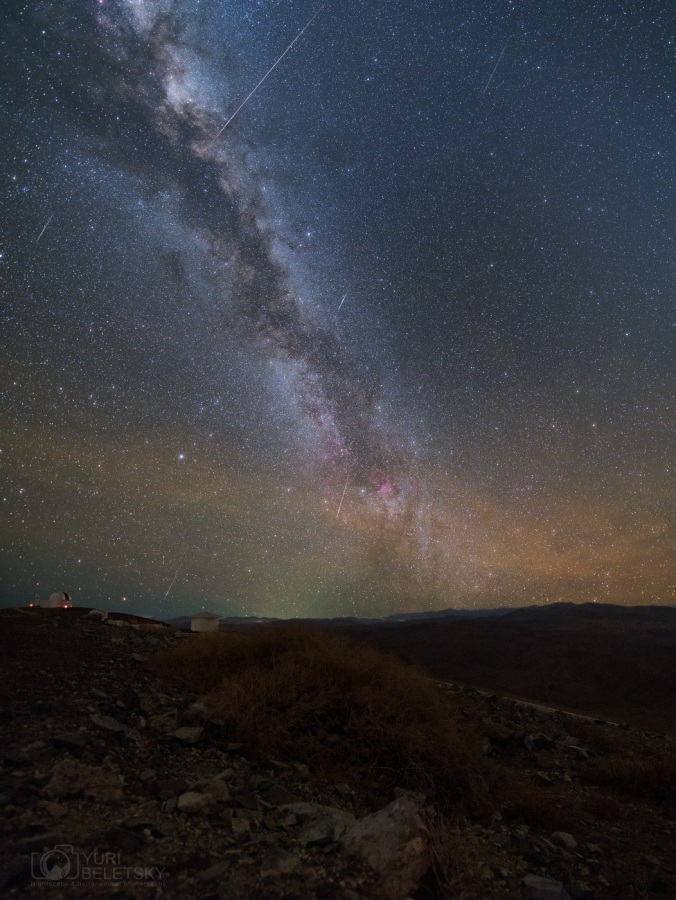
| Image by Yuri Beletsky, from Astronomy Picture of the Day site. |
"The heaventree of stars hung with humid nightblue fruit." - Ulysses
One of my favorite chapters in Ulysses is known as the "Ithaca" episode, the penultimate chapter of the book, where the prose turns into a scientific Q & A catechism featuring lengthy ruminations by the main character Leopold Bloom on things like water and the cosmos. A particularly beautiful passage has Bloom considering the connection between woman and the moon:
What special affinities appeared to him to exist between the moon and woman?
Her antiquity in preceding and surviving successive tellurian generations: her nocturnal predominance: her satellitic dependence: her luminary reflection: her constancy under all her phases, rising and setting by her appointed times, waxing and waning: the forced invariability of her aspect: her indeterminate response to inaffirmative interrogation: her potency over effluent and refluent waters: her power to enamour, to mortify, to invest with beauty, to render insane, to incite to and aid delinquency: the tranquil inscrutability of her visage: the terribility of her isolated dominant implacable resplendent propinquity: her omens of tempest and of calm: the stimulation of her light, her motion and her presence: the admonition of her craters, her arid seas, her silence: her splendour, when visible: her attraction, when invisible.Today is Bloomsday, commemorating the day on which James Joyce's most famous novel takes place. It's also Father's Day which is fitting because, perhaps more than anything else, Ulysses is about the meaning of fatherhood and paternity, the "consubstantiality of the Son with the Father."
The book begins with three chapters focusing on Stephen Dedalus, a 22-year-old intellectual and schoolteacher (representing young Joyce himself) who's still mourning the death of his mother who died months prior and has left the home of his family mainly because of their abusive, alcoholic father. Stephen is kind of a mess; while he's certainly brilliant, he's stuck in a self-destructive binge-drinking, homeless, depressed situation.
The rest of the book introduces us to Leopold Bloom, the novel's great comic hero, a 38-year-old father and husband whose relationship with his wife was scarred when their infant son died shortly after his birth 11 years prior. The couple hasn't had sex since then and they sleep head-to-foot in bed. His wife Molly ostensibly cheats on Bloom when he's not around. On this day, June 16th, he's aware of a tryst that is to occur at his home in the afternoon and purposely procrastinates and stays away from home all day to avoid it, finding himself in an array of urban adventures and confrontations. (Notice the opposition to Homer's Odyssey where Odysseus fights to return home to his chaste wife who's been rejecting suitors.)
Throughout the afternoon, the paths of Bloom and Stephen weave and intersect like a caduceus, each appearing in the background of another's scene until the explosive center of the book where the sympathetic Bloom decides to follow a drunken Stephen toward Dublin's brothel district to try to save him from ensuing danger.
In discussing Ulysses, people often describe it as a normal, mundane day in the life of one Jew in Ireland named Leopold Bloom. I strongly disagree with this description. While, yes, Bloom runs some errands and does everyday things like defecate, urinate, masticate, masturbate, he also attends a funeral (which leads to deep consideration of life and death), suffers the sadness of knowing his wife is cheating on him that very afternoon (haunting his mind all day), visits a woman in the hospital who's been suffering through a terribly painful labor (his appearance coinciding with a successful parturition), and saves a precocious but wayward young man from getting his ass kicked or going to jail or both.
And this son in search of a father figure and father in search of a son theme echoes all throughout the book from the very first chapter onwards.
It is toward the end of the text, in the Ithaca episode, after Bloom has brought Stephen home to help him recover from his intoxicated misadventures with some hot cocoa and philosophical dialogue, where the two characters become, as Joyce described them, "celestial bodies". Astronomical and scientific jargon-laden prose intricately (yet somehow poetically) describes their experience as they stand out in the backyard urinating underneath the stars.
I'll have more to say about Ulysses and Bloomsday later on. For now, I've got to call my dad and then go host a little Bloomsday gathering at a local coffeeshop.
* * *
EDIT: Have to add another favorite passage from Ithaca, from a section of about four pages worth of Bloom (the science enthusiast as opposed to Stephen the poet-artist) ruminating deeply on physics, the cosmos, "the condensation of spiral nebulae into suns," etc. After his thoughts have zoomed out into an increasingly expanded perspective, he then focuses back on the earth and the unfathomable, perhaps bottomless depths of the microcosm:
Were there obverse meditations of involution increasingly less vast?
Of the eons of geological periods recorded in the stratifications of the earth: of the myriad minute entomological organic existences concealed in cavities of the earth, beneath removable stones, in hives and mounds, of microbes, germs, bacteria, bacilli, spermatozoa: of the incalculable trillions of billions of millions of imperceptible molecules contained by cohesion of molecular affinity in a single pinhead: of the universe of human serum constellated with red and white bodies, themselves universes of void space constellated with other bodies, each, in continuity, its universe of divisible component bodies of which each was again divisible in divisions of redivisible component bodies, dividends and divisors ever diminishing without actual division till, if the progress were carried far enough, nought nowhere was never reached.
Labels:
astronomy,
books,
James Joyce,
literature,
science,
ulysses
Monday, June 10, 2013
Five New Hip Hop Albums Reviewed
Reviewing a handful of records from the first five months of 2013 that have occupied my ears...
The Psychic World of Walter Reed - Killah Priest
A 41-track encyclopedic masterwork from arguably the most gifted lyricist under the Wu-Tang umbrella, PWOWR is Priest's tenth album, a double-CD overflowing with a bewildering variety of mystical/cosmic/occult/street poetics. We get the full range of Priest's writing abilities in this massive collection: intricately weaved story tracks, intensely destructive battle raps, acapella spoken-word poetry psychic trips, certified Wu bangers, cinematic tours through dark electro-dystopian futures and uplifting journeys through the interstellar psycho-spiritual domain of the Wu tribe's articulate shaman.
The Psychic World of Walter Reed - Killah Priest
A 41-track encyclopedic masterwork from arguably the most gifted lyricist under the Wu-Tang umbrella, PWOWR is Priest's tenth album, a double-CD overflowing with a bewildering variety of mystical/cosmic/occult/street poetics. We get the full range of Priest's writing abilities in this massive collection: intricately weaved story tracks, intensely destructive battle raps, acapella spoken-word poetry psychic trips, certified Wu bangers, cinematic tours through dark electro-dystopian futures and uplifting journeys through the interstellar psycho-spiritual domain of the Wu tribe's articulate shaman.
Wednesday, June 5, 2013
"Brilliantaire" by Killah Priest
As I'm in the midst of hammering out a piece covering a few of my favorite hip hop albums of the year thus far, here is one of the finest tracks from the album I'm most enamored with, Killah Priest's vast mystical galaxy of lyrics entitled The Psychic World of Walter Reed.
This track represents the album as a whole as it features the oft-repeated imagery of traveling into the cosmic depths of inner space and becoming in tune with ancient spirits while composing his poetry.
"Then I recline so I can see the design
before he said close your eyes cuz what we need is your mind
and the rhyme, like a storm as the currents blew me on
thru gases, I saw places where planets were born
and the voice that spoke to my ghost majestic
let's show you the essence, let's reveal to you the presence"
"With rare paint, beads, water or oil
saint, holy man, beggar or royal
angels, devils, or aliens
which do you believe in more?
do you receive or restore?
do you want peace or war?
do you wish to live free or by law?
it gets deep to the core
we perform prayers, fasting, and charities, go on pilgrimage
but do we know what real healing is?"
Sunday, May 19, 2013
Thursday, May 16, 2013
Retracing Recent Ramifications of Thought, Part 2 (Room 237 and beyond)
"What do we know about what we put into anything? Though people may read more into Ulysses than I ever intended, who is to say that they are wrong? Do any of us know what we are creating?" - James JoyceI've been remiss not to have mentioned Room 237 on this blog yet. I first learned of this film last October when Chuck Klosterman wrote a review for it at Grantland and began: "I just saw a documentary that obliterated my cranium. It's the best nonfiction film I've seen all year." From there I was compelled to read every Room 237 review I could find, then searched desperately for a way to see it (unsuccessfully until just a few weeks ago), and have frequently been bringing up the film as a conversation piece with friends.
Room 237 quickly turned into a mini obsession for me because the premise of the film---creative interpretation of art---aligned exactly with what I've been pursuing for a couple years now. It is a documentary by Rodney Ascher exploring alternate interpretations of Stanley Kubrick's 1980 film The Shining through the voices of five people outlining their own unique theories. Their analysis, through which they verify a specific subjective interpretation by pointing out numerous correspondences throughout The Shining, is exactly what Salvador Dali referred to as "paranoiac critical analysis," a critical approach I've written about here and in my monograph on Dali and James Joyce.
As the ultimate auteur who carefully pieced together every single element that appears on screen, Kubrick's artistic style lends itself perfectly to this type of deep analysis. Microscopic scrutiny of minute elements reveals a wealth of possible meanings. Hence, the cans of Calumet baking powder displayed in some kitchen scenes hints at an underlying theme of Native American genocide, or so argues Bill Blakemore. Frequent occurrences of the number 42 allude to the Jewish Holocaust since Auschwitz opened in 1942 says Geoffrey Cocks, a noted scholar on Nazi Germany who sees the film through those goggles.
Juli Kearns, with a New England accent sounding a lot like Doris Kearns Goodwin (of Ken Burns Baseball documentary fame) graphically outlines inconsistencies in the architectural arrangement of The Shining's Overlook Hotel, indicating a spooky morphology in the building itself. Colorful Kubrick obsessor John Fell Ryan chuckles through his discussion of minor continuity errors which are, he argues, edited that way intentionally to add a further element of eeriness and subtly shock the viewer's unconscious. The most compelling (and initially ridiculous) argument in the film is made by Jay Weidner who posits that The Shining is Kubrick's confession that he helped the American government fake the Apollo 11 moon landing.*
*Though he makes it clear he is not stating the moon landing didn't occur, only that the footage was faked. Here's my take, for what it's worth: I had heard this Kubrick moon landing conspiracy theory prior to seeing the film and brought it up in a late night outdoor discussion under a full moon with some folks. They knew all about it already. A Houston native told me the story of growing up attending high school with the children of NASA employees, they told him the moon landing footage was indeed faked but we absolutely did go to the moon. The real footage was burned up in the Earth's atmosphere upon return, they said. That Kubrick was working closely with NASA on 2001: A Space Odyssey (a film featuring plenty of moon surface scenes) all throughout the 1960s adds to the intrigue of this whacky idea. True or not, it has to be the coolest conspiracy theory I've ever heard.
The entire documentary is presented through a cut-up of scenes from The Shining and various other film clips with voiceovers of the analysts detailing their stories and ideas. We don't see any of the usual documentary-style scenes of sedentary people talking and there's no narration aside from the interviewees telling their stories and theories. This immersion into the worlds of the obsessed observers actually brings the film some humor as the speakers occasionally go off the edge in their theories (most memorably when it is asserted that the face of Kubrick appears airbrushed into the clouds during the opening sequence).
Thursday, April 18, 2013
Wednesday, April 17, 2013
Retracing Recent Ramifications of Thought, Part 1 (VALIS, Duality and Finnegans Wake)
"Each of us has within us a secretly potent pantheon. The unconscious sends all sorts of vapors, odd beings, deluding images up into the mind–whether in dream, broad daylight, or insanity; for the human kingdom, beneath the floor of the comparatively neat little dwelling that we call our consciousness, goes down into unexpected Aladdin caves. There not only jewels but also dangerous jinn abide: the inconvenient or resisted psychological powers that we have not thought or dared to integrate into our lives. And they may remain unsuspected, or, on the other hand, some chance word, the smell of a landscape, the taste of a cup of tea, or the glance of an eye may touch a magic spring, and then dangerous messengers begin to appear in the brain. These are dangerous because they threaten the fabric of the security into which we have built ourselves and our family. But they are fiendishly fascinating too, for they carry keys that open the whole realm of the desired and feared adventure of the discovery of the self. Destruction of the world that we have built and in which we live, and of ourselves within it; but then a wonderful reconstruction, of the bolder, cleaner, more spacious, and fully human life–that is the lure, the promise and the terror, of these disturbing night visitations from the mythological realm that we carry within.”
- Joseph Campbell, The Hero with a Thousand Faces
Subscribe to:
Posts (Atom)