As Robert Anton Wilson liked to point out, reading about or discussing synchronicity usually tends to vastly increase the amount of strange coincidences in one's life. In my experience, whenever I've been engaged in reading Carl Jung, or the I Ching, or Wilson himself, synchronicities do tend to swirl around me.
This same thing especially applies to reading James Joyce. His major works are filled with synchroncities and coincidences. In his book Joyce the Creator, Sheldon Brivic attempts to document all the synchronicities embedded within the single day of Ulysses and he lists over a hundred of them. Robert Anton Wilson's book Coincidance has a few excellent essays about synchronicity in Finnegans Wake. It's safe to say that it's a big part of Joyce's major works (though the word "synchronicity" was coined by Jung more than ten years after Joyce's death).
These past few weeks I've been undertaking the task of thoroughly reading Finnegans Wake, this deep involvement tending to leave me in an unusual mindstate. I find myself thinking about certain words or phrases all throughout the day and often I can't wait to get home and dive back into the strange book. I've read four chapters thus far and I'm really enjoying it. With lots of notes already written about it, I'll have plenty to say about the book in an upcoming post.
For now, I'd like to share three funny coincidences that occurred over three consecutive days right around the time I'd begun reading the Wake.
Tuesday, July 31, 2012


Saturday, July 28, 2012
The Man Who Created the Mask and the Exile Who Dons It

Finally, we've at least got an explanation for his absence.
The metal-masked writer/producer/performer known as MF Doom (aka The Supervillain) was thwarted upon trying to re-enter the United States in 2010 after a European tour and has remained in exile living in London ever since. An article in Q Magazine explained:
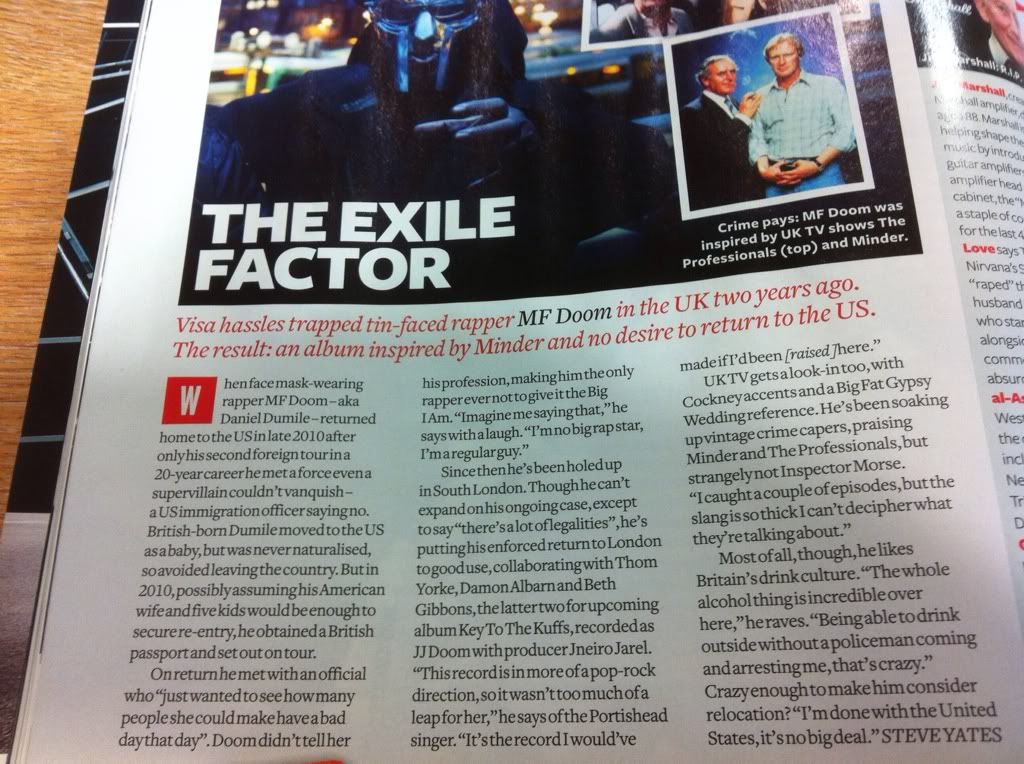
British-born [Daniel] Dumile moved to the US as a baby, but was never naturalised, so avoided leaving the country. But in 2010, possibly assuming his American wife and kids would be enough to secure re-entry, he obtained a British passport and set out on tour.
On return he met with an official who "just wanted to see how many people she could make have a bad day that day." Doom didn't tell her his profession, making him the only rapper ever not to give it the Big I Am. "Imagine me saying that," he says with a laugh. "I'm no big rap star, I'm a regular guy."
Since then he's been holed up in South London.
While stuck over there he has been recording music, though. Suddenly, he's got a new album about to drop, a collabo with producer Jneiro Jarel entitled Keys to the Kuffs, to be released on Stones Throw Records on August 21st.
Here's a new track from the record called "Guv'nor."
In an era ruled by digital music, I still find many releases from Stones Throw to be worthy of physical purchase because of their propensity to craft an all-around artful package. This album features more of the same and they're even including free copies of a 100+ page magazine fully devoted to Doom. Instant purchase for me. More on that here.
As part of the promo push for the magazine, they've put together some colorful YouTube videos including an excellent interview with the artist who originally assembled the Doom mask. Lots of New York City flavor in this one, check it out:
Monday, July 9, 2012
bababadalgharaghtakamminarronnkonnbronntonnerronntuonnthunntrovarrhounawnskawntoohoohoordenenthurnuk!
Stormy weather has finally hit here in the middle of Texas.
As I write this on Monday evening, my roof is being pattered with rain and thunder frequently rumbles. Enormous and dark clouds arrived here yesterday, and last night up in Arlington this happened in the middle of a major league baseball game:
A field full of supposedly tough grown men, professional baseball players, made to cower with fear in a millisecond. Watch as they all sprint off the field even though it isn't raining.
Did I mention I started to read Finnegans Wake in earnest this weekend? The 100-letter word in the title of this post is the voice of God in the Wake, the thunderclap which explodes 10 different times in the book, each time signaling a new cycle in history. Adapted from Giambattista Vico's theory of the repeating cycles of human history, in which thunder scares aristocratic, intelligent, arrogantly advanced humankind into a crippling fear of God and they go back to the first stage, theocracy, the Divine Age.
Vico purported that primitive humans were so terrified of thunder that they fled into caves, just as the ballplayers flee into the dugout.
The thunderword written above is on the first page of the book and contains the word for "thunder" in at least 13 different languages.
A loud crash of thunder ("A black crack of noise in the street") also blasts at the very center of Ulysses, marking the middle break in the book where everything changes, a dry barren wasteland gets nourished and rained on. Stephen (a stand-in for the author himself who had a great fear of thunderstorms) is made to tremble in fear as his boasting to friends is suddenly interrupted when "Loud on left Thor thundered: in anger awful the hammerhurler."
As regards the god of thunder Thor and his hammer, the most notable reaction of the baseball players in the video is Josh Willingham, a muscular slugger known as "The Hammer," falling down on all fours and covering his head.
With MLB.tv's notoriously covetous and absurd blackout rules (put in place to make sure cable companies pocket as much money as possible) I was barred from watching that Texas Rangers game last night despite paying for a baseball media package. I only got to see the great Thunderclap video when I read Grant Brisbee's hilarious coverage of it over at Baseball Nation. I strongly recommend checking that piece out, it made me laugh out loud at least 3 times. This picture that he linked to even made me fall out of my chair in laughter.
As I write this on Monday evening, my roof is being pattered with rain and thunder frequently rumbles. Enormous and dark clouds arrived here yesterday, and last night up in Arlington this happened in the middle of a major league baseball game:
A field full of supposedly tough grown men, professional baseball players, made to cower with fear in a millisecond. Watch as they all sprint off the field even though it isn't raining.
Did I mention I started to read Finnegans Wake in earnest this weekend? The 100-letter word in the title of this post is the voice of God in the Wake, the thunderclap which explodes 10 different times in the book, each time signaling a new cycle in history. Adapted from Giambattista Vico's theory of the repeating cycles of human history, in which thunder scares aristocratic, intelligent, arrogantly advanced humankind into a crippling fear of God and they go back to the first stage, theocracy, the Divine Age.
Vico purported that primitive humans were so terrified of thunder that they fled into caves, just as the ballplayers flee into the dugout.
The thunderword written above is on the first page of the book and contains the word for "thunder" in at least 13 different languages.
A loud crash of thunder ("A black crack of noise in the street") also blasts at the very center of Ulysses, marking the middle break in the book where everything changes, a dry barren wasteland gets nourished and rained on. Stephen (a stand-in for the author himself who had a great fear of thunderstorms) is made to tremble in fear as his boasting to friends is suddenly interrupted when "Loud on left Thor thundered: in anger awful the hammerhurler."
As regards the god of thunder Thor and his hammer, the most notable reaction of the baseball players in the video is Josh Willingham, a muscular slugger known as "The Hammer," falling down on all fours and covering his head.
"his heart shook within the cage of his breast as he tasted the rumour of that storm."
* * *

Sunday, July 1, 2012
Album Review: School for the Blindman by Bronze Nazareth

Specs like Ray Charles seeing from his grave
He said "Bronze, you could hear the color of clouds
and see the sounds of existence like braille printed out"
- Bronze Nazareth
Maybe we could have predicted it, maybe we could've seen him coming. Just as the flourishing basketball culture of the early to mid-90s---with various flavors of expertise on display from Michael Jordan, Magic Johnson, Charles Barkley, Clyde Drexler, Larry Bird, etc---merged with the DNA of a growing young super athlete to eventually become the all-around hoops behemoth that is LeBron James, the apotheosis of hip hop in the 90s was experienced by a growing Motown youth of musical precocity to eventually bring forth Bronze Nazareth, Wu-Tang's #1 draft pick.
Friday, June 29, 2012
Wandering the Storm-tossed Seas
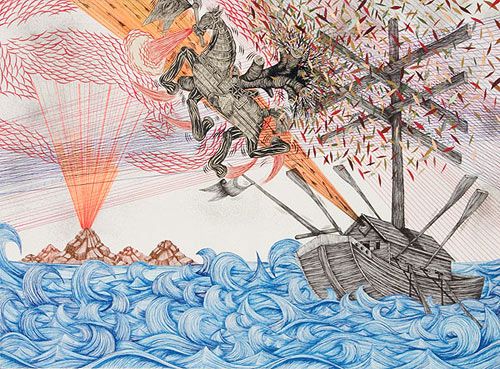
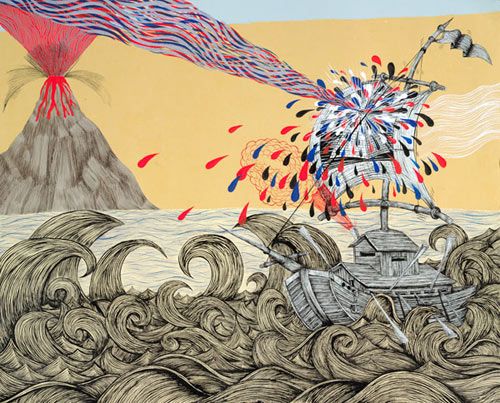
Artwork by Andrew Schoultz from his book Ulysses: Departures, Journeys & Returns.
Potent Quotables: Speaking to the Superconscious Mind
"Stubborn mental or physical diseases always have a deep root in the subconsciousness. Illness may be cured by pulling out its hidden roots. That is why all affirmations of the conscious mind should be impressive enough to permeate the subconsciousness, which in turn automatically influences the conscious mind. Strong conscious affirmations thus react on the mind and body through the medium of the subconscious. Still stronger affirmations reach not only the subconscious, but also the superconscious mind---the magic storehouse of miraculous powers."This quote is exactly what Robert Anton Wilson speaks of in his wonderful book Prometheus Rising, particularly in his discussion of the so-called "fifth circuit" or Holistic Neurosomatic Circuit. Wilson uses the computer-technology language that was popular in the late 70s and 80s but he's talking about the same exact thing (faith healing, miraculous rejuvenation, etc are all discussed).
- Paramahansa Yogananda
In Prometheus Rising (and a few of RAW's other books), there are exercises at the end of each chapter that are very much like the affirmations Yogananda speaks of; statements to speak or focus on that are so powerful they can activate the powerful energies of the unconscious.
Here are some of my favorite exercises from RAW. These are all proposed as ways to reprogram your mind and your way of experiencing the world which eventually results in a revolution of you.
- Believe that you can exceed all your previous ambitions and hopes in all areas of your life.
- James Joyce said he never met a boring human being. Try to explain this. Try to get into the Joycean head space, where everybody is a separate reality-island full of mystery and surprise. In other words, learn to observe.
- If all you can know is your own brain programs operating, the whole universe you experience is inside your head. Try to hold onto that model for at least an hour. Note how often you relapse into feeling the universe as outside you.
- Try living a whole week with the program, "Everybody likes me and tries to help me achieve my goals."
- Try living a day with the program "I am God playing at being a human being. I created every reality I notice."
- Try living forever with the metaprogram, "Everything works out more perfectly than I plan it."
Monday, June 25, 2012
Amen to R.A. and the Redeeming Beauty of Baseball
We're almost midway through the 2012 baseball season and ever so slowly some things are starting to become clear. We know the Yankees are once again a dominant force. The Padres are a complete abject disaster. The AL Central is up for grabs. Rookies Bryce Harper and Mike Trout are really good.
And R.A. Dickey is among the best pitchers in baseball.

That last one is the hardest to believe. For one thing, Dickey got knocked around by the Yankees last night. He's also a 37-year-old knuckeballer, which is something of a sideshow in the game of baseball. And yet earlier this year he became the first National League pitcher since 1944 to throw two consecutive one-hitters. His dominance reached the point of 44 and 2/3 straight innings without giving up an earned run until the Yankees finally got to him last night.
But even after surrendering five runs last night, he's still 7th-best in the league at keeping runs off the board. He leads the NL in shutouts, wins, and his tied for the lead in pitcher's WAR (Wins Above Replacement). Most incredibly, he's got the third most strikeouts of any pitcher in the NL and he's by far the oldest guy in the top 10 of that category.
And R.A. Dickey is among the best pitchers in baseball.

That last one is the hardest to believe. For one thing, Dickey got knocked around by the Yankees last night. He's also a 37-year-old knuckeballer, which is something of a sideshow in the game of baseball. And yet earlier this year he became the first National League pitcher since 1944 to throw two consecutive one-hitters. His dominance reached the point of 44 and 2/3 straight innings without giving up an earned run until the Yankees finally got to him last night.
But even after surrendering five runs last night, he's still 7th-best in the league at keeping runs off the board. He leads the NL in shutouts, wins, and his tied for the lead in pitcher's WAR (Wins Above Replacement). Most incredibly, he's got the third most strikeouts of any pitcher in the NL and he's by far the oldest guy in the top 10 of that category.
Sunday, June 24, 2012
Read Before the Electronic Ink Evaporates: Illustrated Joyce (and some Dali too)
Despite it being far too hot in Austin right now to do anything, including type on a computer, I have a few too many things that have been waiting in the queue and now's the time to share them.
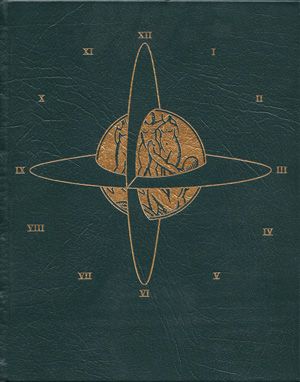
 First up is a post over at the website Brain Pickings that shares images from the special edition of Ulysses for which Henri Matisse provided illustrations in the 1930s. An American publisher had commissioned Matisse to provide some artwork for the text for $5,000 and Matisse came up with 26 full page drawings.
While the combo of Matisse and Joyce certainly sounds intriguing, I'm not particularly enamored of the result and neither was Joyce. The problem is that Matisse didn't bother to read Ulysses and instead drew up scenes from Homer's Odyssey.
I do really like the cover (shown on right) but the rest of it is unexciting.
In the mid-1930s when the Matisse-illustrated edition of the book was being put together, Joyce was hard at work finishing up writing Finnegans Wake which he been laboring on for almost 15 years. Fragments of the Wake (known as Work in Progress at that point since he kept the title secret until completion) had been appearing in magazines and even in individual book form during this time. Joyce encouraged his mentally unstable but artistically brilliant daughter Lucia to take a crack at making her own illustrations for one of the chapters of his enigmatic work and the results were actually quite good. Joyce much preferred her illustrations to the ones by Matisse and you can see why.
While the combo of Matisse and Joyce certainly sounds intriguing, I'm not particularly enamored of the result and neither was Joyce. The problem is that Matisse didn't bother to read Ulysses and instead drew up scenes from Homer's Odyssey.
I do really like the cover (shown on right) but the rest of it is unexciting.
In the mid-1930s when the Matisse-illustrated edition of the book was being put together, Joyce was hard at work finishing up writing Finnegans Wake which he been laboring on for almost 15 years. Fragments of the Wake (known as Work in Progress at that point since he kept the title secret until completion) had been appearing in magazines and even in individual book form during this time. Joyce encouraged his mentally unstable but artistically brilliant daughter Lucia to take a crack at making her own illustrations for one of the chapters of his enigmatic work and the results were actually quite good. Joyce much preferred her illustrations to the ones by Matisse and you can see why.
Saturday, June 16, 2012
16 Reasons Why James Joyce is the Greatest Writer Ever
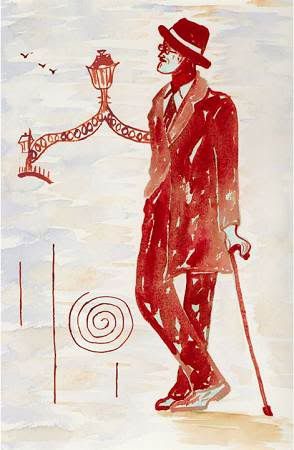
This was originally posted last summer. Today being Bloomsday, I figured it was a good time to post it once more.
1. The simple fact that his writing is beautiful
All good writing strives towards poetry as poetry is the highest form of writing. Joyce started off as a poet and was good enough to receive attention from W.B. Yeats who encouraged Joyce to "turn his mind to unknown arts." This unknown art is a manner of prose in which every word and the flow of the words are considered with precise poetical precision. So Joyce's writing is an original, beautiful gleaming mass that yields gems like this one:
The heaventree of stars hung with humid nightblue fruit.
2. Joyce is to literature what Einstein is to science
In Ulysses Joyce toys with time and space all throughout the book. In the "Proteus" chapter, Stephen Dedalus ruminates and meditates on the nature of Time and Space using Schopenhauer's interesting words Nacheinander (German for "succeeding each other") and Nebeneinander ("beside each other"). The main character Leopold Bloom sells newspaper advertisement space for temporary periods of time. In Richard Ellman's complex exegesis, Ulysses on the Liffey, he argues convincingly that the 18 episodes can be broken into six triads within which the dominant categories of Space, Time, and Space-Time repeat over and over. Relativity (or more specifically what Einstein called "special relativity") also dominates the book, especially in the first six chapters as we follow the movements and thoughts of two different, separate characters at the exact same time of day. Relativity abounds in Bloom's cosmic reflections in the Ithaca episode. Also, Don Gifford's Ulysses Annotated explains how Joyce stretches out time by depicting the events of the day through a "rich mix of clock time, psychological time, and mnemonic time."
We are all aware, for example, that we can think and perceive far more in the course of a few minutes of multi-leveled consciousness than we could spell out in words in as many hours. Joyce variously explores this disparity. (Gifford, pg 3)
Wednesday, June 13, 2012
To Clear the Tension in My Atmosphere, Part 2
Let us come back to our friend, the hairy guy who acts as a flimsy connecting thread in this little story, Mr. Jorn Barger.
 Barger, creator of the term "weblog" and one of the earliest bloggers, as we have seen, maintained a website loaded with material on James Joyce, artificial intelligence, and more. Among his many impressive and worthwhile assemblages of material is a massive collection of quotes about Love gathered from the words of poets, writers, philosophers, musicians, royal figures, and others throughout the history of man.
The collection is entitled Solace: a textbook of romantic psychology and it is organized according to the stages love usually unfolds in, from "Seeking" and "Courting" down to "Trying" and "Fading" until either the love has dried up or one of the lovers passes away.
Having gone through the experience of a long-term relationship suddenly coming to an end, I've found that this collection does indeed provide "Solace" for the reader. As the "textbook of romantic psychology" states in its opening:

The collection is entitled Solace: a textbook of romantic psychology and it is organized according to the stages love usually unfolds in, from "Seeking" and "Courting" down to "Trying" and "Fading" until either the love has dried up or one of the lovers passes away.
Having gone through the experience of a long-term relationship suddenly coming to an end, I've found that this collection does indeed provide "Solace" for the reader. As the "textbook of romantic psychology" states in its opening:
For this will cure him that is sick, and raise him that is in dumps; one that has loved, it will remember of it; one that has not, it will instruct...And so I would like to now, for one last bit of blogspace, gather some quotes from Barger's very useful textbook about the experience of love's fading. This blog was, after all, originally begun out of the insistence of my ex-girlfriend who always acted as a supporter and muse for all of my writing. I feel I must give our relationship a proper sendoff before my heart paves a new road.
Monday, June 4, 2012
To Clear the Tension in My Atmosphere, Part 1

Navigating through the many dead links one might expect to encounter on a site that hasn't been updated since 1999, you'll find a vast amount of material including original (sometimes groundbreaking) analysis and exegesis of virtually all of Joyce's work.
But that's not all Barger ever wrote about and this post is not about James Joyce. This is about life's propensity to ricochet experience into unforeseen directions. See, my girlfriend and I have decided to call it quits after three mostly wonderful years (living together for much of that time) and these last few days have been painful ones for me but the experience of prolonged sadness has led to a number of interesting experiences.
So I'd like to take a Jorn Barger-inspired trek through all of that right now.
Subscribe to:
Posts (Atom)