Wednesday, August 31, 2011
"Keeper of My Soul" by Yesterday's New Quintet
Somebody put together a great video for this track by YNQ (otherwise known as Madlib pretending to be a jazz quintet all by himself). It displays some of the jazz record covers for Madlib's multitude of forays into his father's genre. This is off the first Yesterday's New Quintet album entitled Angles Without Edges. I need to review that one soon. Check out my other Madlib reviews, especially this one about some of his jazz stuff.


Tuesday, August 30, 2011
The Ides of August
 |
| Irene knocks down a tree in Central Park (Mario Tama/Getty Images) |
Reflecting on the calendar's eighth month as it approached this year, I realized that August has been a particularly stormy, eventful, and often painful month in my personal history. Or at least as far back as my journals go (four years).
August 2007 - After graduating from Pace University in May with a business degree I didn't really want, I set out to try and make some money with it for a little while. I needed to save some funds so as to execute a major cross-country move from New York to San Diego in the near future but I had no desire to wear a sycophantic suit and tie and sell my soul to some dull accounting firm. Most of my classmates immediately went into big accounting jobs in Manhattan with high salaries but I not only wanted to get away from New York City, I wanted to avoid the monotony of a regular office job at all costs.
My resistance was relatively futile. My mom brought up doing temp work and got me a brochure about it. Even though the plastic smiles and business attire of the figures on the pamphlet frightened me, I gave it a shot (I was an unemployed college grad and my parents weren't going to be patient with me mooching off their estate). Over the next few months, I worked a couple of relatively harmless and manageable positions. In July, I was doing accounting work at a chemical manufacturing plant in New Jersey working inside of a little cabin. As bad as that may sound, I enjoyed it. It was laid back, I got to eat lunch outside amid grass and trees, the people were nice and really appreciated my work. Best of all, the workload was small and I was actually able to read and write in between tasks.
Then at the end of the month, after having been acquired by a bigger firm, the company started laying people off and suddenly they had to choose between me and a secretary who had been there for 19 years. I endured the awkwardness of training her to do my job for a couple days and then was let go.
The temp agency found me a new position quickly and I was to spend the month of August working at an egg product manufacturing plant in Elizabeth, New Jersey. The job was about as shitty as you would imagine from reading that previous sentence. In fact, it was much worse.
My first day coincided with a Nor'easter storm that found me stuck in traffic on the trip from Staten Island to New Jersey and when I did finally make it over to the hideous industrial grid of Elizabeth, my destination was nowhere to be found. I drove around the supposed address a few times screaming curses and stressing out before parking somewhere and calling the temp agency as the skies poured a steady dump of water on my windshield. Apparently, the business had changed their name but didn't bother to change any of the signs displayed outside.
After parking in the crunchy, muddled mess of a rocky parking lot, I stepped knee-deep into a puddle before failing to locate the door to the warehouse where I was to spend the next four weeks. When I did finally make it inside I was soaking wet and an hour late. The warehouse was dark and stunk like eggs. The office where I would work was situated in a little box within the warehouse. They didn't really care how late I was and immediately put me to work.
The job itself was ridiculously easy, leaving me way too much free time after finishing my workload by late morning. My boss was a bipolar Vietnam vet who would often bounce from jovial laughter to furious screaming within the same breath, something I've never encountered before or since. I worked alongside the warehouse forklift drivers, a couple of ex-convicts who treated me like a new piece of meat in prison and constantly, til the very end, gave me shit because I wasn't doing "real" (i.e., physical) work and got to sit at a desk most of the day.
Without even taking into consideration the terrible commute each day (standstill traffic morning and afternoon every single day as cars squeezed onto the narrow Goethals Bridge), it was an absolute nightmare. I was stuck there for the entire month of August before managing to escape in September to one of the best jobs I've ever worked.
August 2008 - Not nearly as bad as some other Augusts, this one was still memorable.
I had been living in San Diego for two months without having established myself at all aside from moving into a little studio apartment. No job, no friends, no idea what the hell I was doing with my life. When I left New York, I only put thought into the journey (a 10-day road trip across 15 states) and focused on getting myself safely to the other side. The rest would figure itself out.
Well, two months had gone by and nothing was figured out. I was drifting aimlessly in unfamiliar territory. Depression started hitting me and often sabotaged any attempt to do anything productive. One night things got so dire that I resorted to a therapeutic session of writing down all my fears, worries, desires, etc. and seeing what came of it. What came of it was the realization that I had a lot to offer and a general plan (soak up knowledge, write books) but no direction.
The solution proffered itself on my notebook pages: contact some universities that fit my mental framework. I started grabbing my favorite recent books off their shelf and looking for the names of universities that had lit a spark of interest for me in the past. Pacifica Graduate Institute, C.G. Jung Institute, California Institute of Integral Studies. I looked up some of their e-mail addresses and started contacting admissions offices. Plenty of responses came in the ensuing days and suddenly I was flying up north to San Francisco to visit schools.
My first experience of the Bay Area was one of the most interesting and memorable times of my life. Initially, I absolutely hated the place. It was cloudy, freezing, windy, reminiscent of the crisp autumns in New York, except it was the middle of August. I roamed around the city in a state of mild depression, raw cold, and confusion. I visited one school and it was an enchanting experience as I befriended the bookstore clerk and he brought me up on the roof to look out at the Bay Area skyline. We talked books for a while and then he left as I sat amid the roof's Zen garden and tried to reflect on all that was happening. "I'm on a rooftop in San Francisco. In a Zen garden."
The trip ended as quickly as it began and there I was back home in San Diego trying to figure out a way to get myself into the school for free. It never happened and three years later, I still haven't gone to graduate school.
August 2009 - Possibly the worst month of my entire life. Shortly after returning from the Bay Area trip one year prior, I finally found a job in San Diego and stayed there for about nine months. It was a great job in many ways, the people were great, the business was interesting, but the pay absolutely sucked. The salary was better than no salary, but I couldn't keep my head above water when it came to monthly bills. Southern California is a very expensive place to live after all. I sought a better job and found one, a place that offered a much bigger salary but demanded a lot more work and, as I would later find out, feats of emotional strength that I couldn't maintain.
It was an office made up entirely of women, mostly attractive women, though not friendly women. The owner of the business was a genius but a loose cannon. She spoke openly about wanting to retire soon and pass the business on. I should mention that this was a highly successful operation with numerous wealthy clients and the owner had become obscenely wealthy herself. (On the day I was hired, she insisted on showing me pictures of her huge house as well as her summer home, which she offered to let me and my girlfriend stay in.) Her minions were eager to please her and inherit whatever she was about to drop them. Suddenly I stepped into the mix and, while just trying to catch on with the fast and complicated operation, understood everything they taught me a little too quickly.
My first day at the job was Bloomsday, June 16th, and by early July I understood the basic mechanics of how things worked. But it was an extremely complicated enterprise with seemingly infinite variables and understanding the basics only meant that I could now begin to learn how everything else worked. I was given a stack of 75 (!) clients and managed to get through about three of them in the first few weeks before hitting a huge wall of complexity with the other clients. But my training was seemingly over. I was reprimanded for asking questions, given snappy, bitchy responses and chided for not getting it.
In late July, I flew back to New York to participate in a hockey tournament that had been arranged long before I started the job. The owner approved of the trip when I was hired, there was supposedly no problem at all with me missing two days of work to play in the tournament.
It was great to be back in New York and skating on a team with all of my good friends who I'd left over a year prior. Playing five games over three days, I somehow had one of the best hockey performances of my life (probably THE best) and led our team to the tournament championship. We lost because of an insurmountably poor performance by our goaltender.
Our goalie for the tournament was my good friend Mike who I'd known since I was about 8 years old. He was two years older than me and played goalie for the first team my older brother ever played on. Our families always car-pooled to the games and I got to know him very well over the years. In college, I joined an intramural team with him and his brother and we played together for the next six years or so, still driving to the games together because we lived in the same part of Staten Island.
Even though we remained friends when I moved to California (he was one of the few people who would call to check up on me), he had changed a lot in the intervening time---he'd gained weight, started smoking cigarettes again, and didn't look well at all. But he did manage to find a new girlfriend who he spoke about endlessly.
When I returned to New York for the tournament, as always, we drove to the games together. It was great because we got to catch up on things after I'd been across the country for a more than a year. Mike's performance in the tournament was all over the place. He singlehandedly won us a game, then fell apart in the next one. Everything collapsed for him in the tournament final. We battled a team from New Jersey in a back-and-forth affair, scoring 10 goals (I had two and assisted two others) but still we found ourselves tied because Mike wasn't stopping anything. We kept falling behind, fighting back, taking the lead, and then falling behind again before finally losing when Mike let in two easy goals at the very end.
My teammates, who had been playing with Mike regularly for the last few months, were furious and they lambasted him for his poor performance after the game. He had no excuse. It was the worst I had ever seen him play. He looked like he was half asleep. In years past, Mike had always complained to me that he had trouble sleeping. Oftentimes, after our late weekday night games, we would often have to pick up some Tylenol PM for him at a gas station so he could manage to fall asleep when he went home.
I drove him home after the final game and he was distraught. I didn't know how to console him other than to suggest that he quit smoking (something I always got on him about) and start exercising again. He agreed. We didn't get to talk much as his girlfriend called him and they had a long, unpleasant conversation. He argued with her the whole way home. Mike's birthday was coming up and they wanted to go out to have dinner together, but neither of them had a car (a recent accident had wrecked his only means of transportation) and Mike didn't have the money to pay for a cab. Neither did she. It was ugly.
Right before I dropped him off I calmly told him to stop yelling at his girlfriend because it seemed he was taking his hockey frustrations out on her. He hung up and we said our goodbyes as I dropped him off. As he dragged his goalie equipment into his house I looked at him feeling a deep sadness and regret. I couldn't help him. I had tried to help him for years and he wouldn't listen and now I was flying back to California when my friend seemed to need me the most.
Two weeks later, on August 14th, my ringing cell phone woke me up 6 AM. It was Mike's brother. Mike was dead. He went to sleep and didn't wake up. It was two weeks after his 26th birthday.
At this point my job had gotten pretty bad. When I returned from the tournament in New York, everyone seemed mad at me. I heard them talking about me down the hall saying things like "maybe he should work harder or stop missing work for hockey." My days were numbered. The day I learned of Mike's death, I was in shock, didn't cry at all, and went on in to work to endure the bullshit. A day or two later, the owner left to go spend a week at her vacation home and all hell broke loose.
The girls turned a shade of evil that reminded me of the demonic females that flanked Al Pacino in The Devil's Advocate. The main devilwoman, the owner's main lieutenant, warned me that if I didn't step it up at work I would be fired. Yet when I asked her a question about a complex project, she yelled "can't you see I'm busy!" and didn't allow me any of her time again until it was after 5 PM and everyone went home. I had gotten a cold that was becoming increasingly worse with all the stressful drama and as I sat in her office I blew my nose in a handkerchief. She looked up with an annoyed glare and snarled, "Did you just throw your snot in my garbage?"
A day or two later I had descended into a bad fever but couldn't miss work because my job was seemingly hanging by a string. Mike's death had finally sunk in and I was having moments where I'd burst into uncontrolled tears as his voice and image haunted me. The rest of August was spent in a state of physical and emotional decay. Everyday I woke up to liquid snot pouring out of my nose and it lasted throughout the day. Combined with a steady stream of tears in grievance for my lost friend, I was a pretty pathetic sight.
On the final day of August I sent the boss a scathing letter of resignation, detailing the way her sycophantic soldiers had sabotaged my position and never saw any of them again. The whole experience inspired me to turn my journey into an autobiographical novel and soon this blog was born as a means to hone my writing.
August 2010 - Another trip back to New York. This one was so eventful and thought-provoking that I've been meaning to compose a huge essay about it but something keeps holding me back from it. I haven't even managed to write the whole story down in a journal. The whole thing was surreal and, as time passes and I don't transcribe it all, the experience becomes "fabled by the daughters of memory."
Shortly after her birthday (one day after Mike's birthday, actually) my grandmother died. She had just turned 101 years old. The interesting thing about it is that it happened the same day my brother and I were to fly to New York from California for my nephew's baptism. He was to be baptized in a fountain that my devoutly religious grandmother had funded with a big donation to the church.
It was all a pretty magical experience with lots of instances of synchronicity once we got there. Since this post is already exceedingly long, I don't want to go into all the details now except to mention that my nephew was baptized and my grandmother buried on the same day. It was all quite surreal and, as the creative/artistically sensitive person in the family, it really struck me. I wrote my grandmother's eulogy and my sister delivered it.
Just this morning I drove my sister to the airport at 5 AM to conclude her visit here in Austin. She had been at a business conference last week and then stopped over here to pay me a visit since I haven't seen any of my family members since January. Interestingly enough, she avoided all the natural disaster drama in New York.
The last few Augusts have pretty rough on me but this one, despite being busy and leaving me sleep-deprived, has been relatively peaceful. But my hometown was rumbled by an earthquake and then battered by a hurricane. In fact, Staten Island bore the brunt of the storm worse than any other part of New York City. I'm just glad the month is almost over.
Sunday, August 28, 2011
"Teems of times and happy returns"

After finally completing that big list about James Joyce in the last post, I wanted to let it simmer atop the page for a while. I didn't intend to let the blog go dormant for three weeks, though.
Things have gotten a little hectic here lately, my life is becoming more and more like that of a normal young person: very busy. I'm only working 20 hours a week (to avoid succumbing to the soul-killing clutches of a cubicle) but my girlfriend and I are sharing a car and managing to stay occupied from morning until early evening, which doesn't allow me all that much creative/reading/relaxing/baseball-watching time. I'm not stressing about it though, because I know plenty of people my age have it a lot worse than me. Aside from the slow suffocation of my finances (and similar bodily reactions to the intense Texas heat), life here in Austin is pretty damn good. At the moment I'm sitting outside at a coffee shop with wooden decks extending up into the woods. Very cool place.
In the intervening three weeks between blog posts, I did manage to complete two rather large and detailed hip hop album reviews as part of a trio. I'm in the midst of writing the third review and once they're all finished I will share them here. I've got a bunch of posts coming up soon (if I can find the time) including a big one covering all the new Wu-Tang-related music that's springing up right now.
For the moment, I want to share a few (mostly) Joyce-related links that have interested me lately:
- friend of this blog Bobby Campbell is a very talented artist and graphic designer and he recently produced a smooth, peripatetic illustration of the scene in chapter 3 of Ulysses where Stephen is "walking into eternity along Sandymount strand" that is definitely worth checking out. This represents one of my favorite sections from Joyce, as I wrote about last month.
- More great stuff from BC, he created some spectacular looking artwork (including the piece atop this blogpost) demonstrating Vico's four cycles of history which Joyce used as the structure of Finnegans Wake. Go check it out at the Maybe Logic Academy blog, it is part of a nice essay entitled "Falling on Deaf Ears" elaborating on Vico's philosophy, the Wake, Marshall McLuhan, and more.
- The past couple weeks I've been reading an extremely fascinating essay on Finnegans Wake by Dan Weiss that was posted on the The Brazen Head blog. It is written in an easy-to-read style of short sections and it serves as both an introduction to the complexities of the Wake and an exploration of how Joyce tried to construct it so as to encompass the entire universe, thus creating something that closely resembles modern hyptertext and the internet. The essay is lengthy but well-written and worth the read. Another piece covering Joyce in a similar vein (internet, universe, hypertextuality) made my brain cells swell recently; it explores Joyce, Jorge Luis Borges, and Thomas Pynchon and their attempts at creating a "cosmic web" through their art.
- This last link is not exactly Joyce related (though the author maintains multiple blogs with Joyce and Wake material), but Steven James Pratt (aka Fly Agaric 23) wrote an intriguing and thought-provoking blog post about the recent race riots in the UK using his favorite splicing style of weaving together mini essays, poems, and article clips. I highly recommend you check it out.
Please stay tuned as there will be more to come soon.
Monday, August 1, 2011
16 Reasons Why James Joyce is the Greatest Writer Ever

I actually started to write this over a year ago and now it's finally complete. It was originally intended to be posted on June 16 (thus the 16 reasons) but that never worked out. It's not meant to be exhaustive or even all that serious, but I think it gets the point across.
1. The simple fact that his writing is beautiful
All good writing strives towards poetry as poetry is the highest form of writing. Joyce started off as a poet and was good enough to receive attention from W.B. Yeats who encouraged Joyce to "turn his mind to unknown arts." This unknown art is a manner of prose in which every word and the flow of the words are considered with precise poetical precision. So Joyce's writing is an original, beautiful gleaming mass that yields gems like this one:
The heaventree of stars hung with humid nightblue fruit.
2. Joyce is to literature what Einstein is to science
In Ulysses Joyce toys with time and space all throughout the book. In the "Proteus" chapter, Stephen Dedalus ruminates and meditates on the nature of Time and Space using Schopenhauer's interesting words Nacheinander (German for "succeeding each other") and Nebeneinander ("beside each other"). The main character Leopold Bloom sells newspaper advertisement space for temporary periods of time. In Richard Ellman's complex exegesis, Ulysses on the Liffey, he argues convincingly that the 18 episodes can be broken into six triads within which the dominant categories of Space, Time, and Space-Time repeat over and over. Relativity (or more specifically what Einstein called "special relativity") also dominates the book, especially in the first six chapters as we follow the movements and thoughts of two different, separate characters at the exact same time of day. Relativity abounds in Bloom's cosmic reflections in the Ithaca episode. Also, Don Gifford's Ulysses Annotated explains how Joyce stretches out time by depicting the events of the day through a "rich mix of clock time, psychological time, and mnemonic time."
We are all aware, for example, that we can think and perceive far more in the course of a few minutes of multi-leveled consciousness than we could spell out in words in as many hours. Joyce variously explores this disparity. (Gifford, pg 3)
Sublime Poetry
A recent piece in The Guardian by Carol Birch provides a short but beautifully accurate summation of the art of James Joyce, particularly Finnegans Wake. Here's a sample:
My next post, which will appear shortly, will be my last foray into Joyce for a little while as I am taking a break from his works to spend the month of August writing mostly about music. After that, I will be plunging right back into Joyce with a full, thorough explication of Ulysses.
The Wake invokes death and the dying of the light with some of the most sublime poetry in the English language. It is almost unbelievable, a madly audacious and impossible work, and I can understand why some people hate it. But for me it's like falling in love with reading all over again.And here is a cool video with a reading of a selection from the Cyclops episode (pg 301-302) of Ulysses.
My next post, which will appear shortly, will be my last foray into Joyce for a little while as I am taking a break from his works to spend the month of August writing mostly about music. After that, I will be plunging right back into Joyce with a full, thorough explication of Ulysses.
Saturday, July 30, 2011
The Beltran Era

After the Mets signed Beltran to a monstrous 7-year $119 million contract (the largest in Mets history) before the 2005 season, the fans had every reason to expect big things from him but the normally shy and reserved centerfielder seemed to wilt underneath the massive New York City sports spotlight. He had a poor year by his own standards, hitting just .266/.330/.414 with 17 homeruns for a Mets team that underachieved and finished in third place. The fans weren't happy.
Everything would change in the next season as the Mets loaded up in preparation for a run at a title. They brought in Beltran's friend and fellow countryman Carlos Delgado and this certainly seemed to benefit Beltran as he went on to have arguably the greatest offensive season in Mets history. He hit .275/.388/.594 with 95 walks and a team-record 41 homeruns as the Mets went all the way to the National League championship.
It was during that season that I attended more Mets games at Shea Stadium than ever before, I saw probably 15 or 16 regular season games and even went to Game 2 of the NLCS against the Cardinals (wrote about it here). I fondly remember Beltran running down any fly ball that was hit in his vicinity with a long-striding graceful gait that was nevertheless an image of peak athletic performance. During one game against the Angels I saw him not only chase down a ball that was smashed but he even reached up above the tall Shea Stadium fence and stole a homerun. It was one of the best catches I'd ever witnessed in person.
A seemingly perfect player, he became my favorite on the team because of his all-around talent and consistency. David Wright was terrific but he was prone to frustrating lapses in the field, Jose Reyes was as exciting as anybody in the sport but could have some terrible at-bats in those days. Beltran, on the other hand, was the kind of player you'd create in a video game---he had speed, big-time power, a good batting eye, hit the ball all over the field from both sides of the plate, and played a superb center field.
In the '06 NLCS against the Cardinals, Beltran and Delgado carried the team (Beltran scored 8 runs and hit 3 homers) and they battled all the way to a deciding Game 7 at Shea. That was an unforgettable night for me as I know it was for all Mets fans. I'll always remember where I was. I watched the beginning of the game in my kitchen and saw Endy Chavez's legendary catch right as I stepped out the door to join my brother's future wife and her friend for a few drinks at a bar in Brooklyn. The bar was absolutely packed and I hated it, you couldn't walk anywhere without squeezing in between a crowd of inconsiderate people. The game was on TV but not enough people seemed to care. The teams were locked in a 1-1 tie and as it reached the 9th inning, everybody suddenly started paying attention. For a reason I can't fathom now in retrospect, the Mets didn't put their best reliever in the game but went instead with Aaron Heilman who promptly allowed a two-run homerun to the Cards' worst hitter, Yadier Molina.
The Mets went into their final at-bat needing two runs to keep their season alive. They would face rookie pitcher Adam Wainwright. The first two hitters got on base and I can remember that incredible feeling of hope, a particular brand of which seems to be unique to baseball. The tying runs were on base, the opportunity to tie the game existed. But Wainwright was composed amidst the chaotic Shea Stadium scene and retired the next two hitters. My least favorite Met player Paul LoDuca worked a walk and the bases were loaded for the team's best hitter, Carlos Beltran, with a trip to the World Series on the line.
Wainwright threw two fastballs and got two quick strikes on Beltran. The next pitch would live in infamy. Wainwright twirled an absolutely perfect, knee-buckling curveball that started around the height of Beltran's head and promptly dropped down to knee-level for a called strike three. Beltran was fooled by it, couldn't muster a swing, and the game was over. The Cardinals went to the World Series and eventually won the title, defeating the Detroit Tigers. Beltran, for all his subsequent accomplishments, was never forgiven by most Mets fans for not swinging the bat. My dad still brings it up. As I watched it in the bar, I didn't scream or stomp my feet in anger I simply exhaled "fuck..." and felt the same helpless feeling that Beltran must have had. It was an impossible pitch to hit. Wainwright had won the battle fair and square and there was nothing the Mets could do about it.
It should be noted that, despite that memory of Beltran being fooled by a perfect curveball being burned into everyone's minds, that's not why they lost. They were already trailing by 2 and down to their final out, none of that was Beltran's fault. He'd even scored the team's only run in that game. I blamed all the Mets' failures on inept manager Willie Randolph in those days and while the arguments I used to make have faded from my memory over the years, I still think it's safe to say that Randolph's poorly informed decisions are to blame for the Mets not going all the way.
Beltran didn't let the memory of his strikeout get to him as he went on to post another two huge seasons for the Mets, but in both of those years (2007, 2008) the team collapsed down the stretch and never got back to the playoffs again. Again, Beltran was not the one to blame. In both of those seasons, he put up huge numbers in the final month while the rest of the team faltered. He especially turned it on in the closing month of 2008, hitting .344/.440/.645 in September as the Mets desperately tried to save their season in the final days of Shea Stadium's existence.
These past few years he battled knee problems, had surgery, and missed a lot of games but still hit well in the games he did play. This year he was putting up big numbers again (leading the league in extra-base hits) while playing in right field to give his knees a break, but with his contract expiring he became expendable. He was traded to San Francisco on Wednesday.
I'm sorry to see him go but it's comforting that he's going to a great baseball city where he'll be appreciated for what he brings to the table. He also gets a chance at defending a World Series title so I'll probably be rooting for the Giants the rest of the year with him in the mix. As I learned in my last trip to San Francisco, the love those people show for their team, even through hard times, is enough to make me want to root for them (despite my distaste for their general manager, Brian Sabean).
Jay Jaffe at Baseball Prospectus wrote a nice piece the other day looking at Beltran's performance as a Met, showing that he was actually among the top 5 most productive outfielders in baseball during that time. Nevertheless, he remains under-appreciated by most Mets fans and some still hold the 2006 strikeout against him as his defining moment, conveniently ignoring that Beltran leaves the Mets with numbers that compare favorably to Mike Piazza's output during his time in Queens. Looking at the list of top Mets career performances, Beltran ranks in the franchise's top 10 for on-base percentage, slugging, runs scored, doubles, homeruns, RBI, walks, OPS+, and anything else important.
The guy simply had a great career as a New York Met. I will always remember him for his whip-like swing and the homeruns he crushed (so many of them at crucial moments), the fly balls he ran down, and the way he made it all look so easy. It's a shame that he missed so much time during the two seasons prior, but I see it as representative of the Mets overall organizational decrepitude of that time. His rejuvenation this year coincided with a rejuvenation of the Mets franchise under new management and I'm glad we got to see him go out at the peak of his powers and I wish him all the best in San Francisco.
Friday, July 29, 2011
The Wave that Washed Your Meals Away
The excitement of the 2011 major league baseball season suddenly burst into supernova recently. It all began late Tuesday night in Atlanta.
After the 3rd inning, the Pirates and Braves were locked in a 3-3 tie. Nobody managed to put across another run for the next 16 innings. They nearly played the equivalent of two full baseball games without scoring a run. I tuned into the MLB.tv feed around the 13th inning and the matchup just seemed far too boring so I skipped to a different game. Once I saw that they were headed to the 16th, I realized this could be something special. The kind of game where managers actually have to start putting their thinking caps on (both skippers confused their thinking caps with dunce caps, though, as evidenced by their long line of stupid maneuvers).
The game got to the bottom of the 19th inning when things finally got interesting. The Braves put two runners aboard with one out. Julio Lugo, who I had only recently realized was still in the majors, stood at third base. The Braves had run out of position players so they let Scott Proctor, a crappy pitcher and an even worse hitter, step to the plate. He managed to make pretty solid contact but he hit a ground ball directly at the third baseman Pedro Alvarez. Lugo took off from third towards home plate and while Alvarez hurled a perfect throw to the catcher I remember thinking that this is one of the things I love to see in baseball, a tense moment with the game on the line and a fielder executing a perfect throw to home plate to keep the game alive.

The throw home was perfect, alright. Pirates catcher Michael McHenry, a minor league scrub acquired from the Red Sox organization after a slew of Pittsburgh catchers started falling apart in succession, received the throw from Alvarez and met the oncoming Lugo a few feet in front of home plate. Lugo was out by a mile and he knew it. He didn't even try to bowl the catcher over or knock the ball out of his glove, he simply executed a feeble slide with a look on his face like he didn't want the catcher to be too rough with him. Perhaps McHenry sensed Lugo's hapnophobia because instead of firmly smacking him with the glove, he waved his arm in the vicinity of Lugo's leg.
Lugo stood up from his slide with his body slumped into disappointment when suddenly the umpire gave the signal "SAFE!" and Lugo quickly touched homeplate. The game was over. And "the umpire" was about to lose his relative anonymity. The world of baseball-watchers exploded in anger. I've never enjoyed following the stream of Twitter messages as much as I did that Tuesday night (after 1 AM, mind you). Everybody had been tuning into the game because of how unusually long it was lasting, it seemed like there was a shot at history being made. Well, it was historic alright. Many people called it the worst call they'd ever seen in a baseball game.
In retrospect, the umpire Jerry Meals apologized and admitted he messed up while some have argued that he may have actually made the correct call. Major League Baseball actually issued a statement saying that Meals screwed it up, but they can't take it back. They won't be bringing the two teams back together to re-do everything. It's in the books. Worst of all for the Pirates, who are contending for the first time in some 19 years, this could be the difference between them going to the postseason or not.
* * *
All of that stuff was going on around 2 AM eastern time and so the next day figured to be filled with all kinds of reactions once everyone got to gather their thoughts on the incident. Well, a huge wave of Wednesday baseball action suddenly splashed, overtaking and washing away all the Jerry Meals news that had begun to pile up.
With the trade deadline looming, the newswire had begun to buzz with big news: the St. Louis Cardinals were going to trade their young stud centerfielder, Colby Rasmus. The 24-year-old Rasmus, although a world class talent, had been squabbling with the team's manager last year and it spilled over into this season with Rasmus having a bad year to show for it. It certainly didn't help Rasmus' standing with the Cardinals that his father had the attitude of a big-mouthed little league dad constantly interfering with the team's handling of his son. Better yet, it was the Toronto Blue Jays' shrewd young general manager who was swooping in to grab Rasmus and bring him up to the nest in Toronto along with a bunch of other rejected fledglings.
Before that trade was completed, the news wire blew up again: the New York Mets had reached a deal to send Carlos Beltran, the most coveted trade bait in baseball, to the San Francisco Giants. The rumors about Beltran had been swirling around for a few weeks but suddenly the wind jutted violently like a cold day in the Bay Area and Beltran was gone. But the Mets managed to scoop up the Giants' best pitching prospect, Zack Wheeler, in return. (Personally, I'm sad to see Beltran go but glad he's headed to a contender defending their championship. I'll have more to say on Beltran and the Mets soon.)
While baseball peeps were still assimilating these two huge events, an afternoon baseball game in Cleveland between the Angels and Indians suddenly demanded everyone's attention. Angels righthander Ervin Santana was pitching a no-hitter. Once everybody (including me, via my iPhone) managed to tune in, Santana cruised through the last two innings and history was made. Suddenly, nobody gave a crap about Jerry Meals.
After the 3rd inning, the Pirates and Braves were locked in a 3-3 tie. Nobody managed to put across another run for the next 16 innings. They nearly played the equivalent of two full baseball games without scoring a run. I tuned into the MLB.tv feed around the 13th inning and the matchup just seemed far too boring so I skipped to a different game. Once I saw that they were headed to the 16th, I realized this could be something special. The kind of game where managers actually have to start putting their thinking caps on (both skippers confused their thinking caps with dunce caps, though, as evidenced by their long line of stupid maneuvers).
The game got to the bottom of the 19th inning when things finally got interesting. The Braves put two runners aboard with one out. Julio Lugo, who I had only recently realized was still in the majors, stood at third base. The Braves had run out of position players so they let Scott Proctor, a crappy pitcher and an even worse hitter, step to the plate. He managed to make pretty solid contact but he hit a ground ball directly at the third baseman Pedro Alvarez. Lugo took off from third towards home plate and while Alvarez hurled a perfect throw to the catcher I remember thinking that this is one of the things I love to see in baseball, a tense moment with the game on the line and a fielder executing a perfect throw to home plate to keep the game alive.
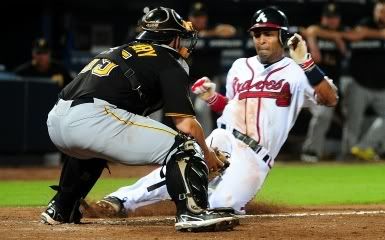
The throw home was perfect, alright. Pirates catcher Michael McHenry, a minor league scrub acquired from the Red Sox organization after a slew of Pittsburgh catchers started falling apart in succession, received the throw from Alvarez and met the oncoming Lugo a few feet in front of home plate. Lugo was out by a mile and he knew it. He didn't even try to bowl the catcher over or knock the ball out of his glove, he simply executed a feeble slide with a look on his face like he didn't want the catcher to be too rough with him. Perhaps McHenry sensed Lugo's hapnophobia because instead of firmly smacking him with the glove, he waved his arm in the vicinity of Lugo's leg.
Lugo stood up from his slide with his body slumped into disappointment when suddenly the umpire gave the signal "SAFE!" and Lugo quickly touched homeplate. The game was over. And "the umpire" was about to lose his relative anonymity. The world of baseball-watchers exploded in anger. I've never enjoyed following the stream of Twitter messages as much as I did that Tuesday night (after 1 AM, mind you). Everybody had been tuning into the game because of how unusually long it was lasting, it seemed like there was a shot at history being made. Well, it was historic alright. Many people called it the worst call they'd ever seen in a baseball game.
In retrospect, the umpire Jerry Meals apologized and admitted he messed up while some have argued that he may have actually made the correct call. Major League Baseball actually issued a statement saying that Meals screwed it up, but they can't take it back. They won't be bringing the two teams back together to re-do everything. It's in the books. Worst of all for the Pirates, who are contending for the first time in some 19 years, this could be the difference between them going to the postseason or not.
* * *
All of that stuff was going on around 2 AM eastern time and so the next day figured to be filled with all kinds of reactions once everyone got to gather their thoughts on the incident. Well, a huge wave of Wednesday baseball action suddenly splashed, overtaking and washing away all the Jerry Meals news that had begun to pile up.
With the trade deadline looming, the newswire had begun to buzz with big news: the St. Louis Cardinals were going to trade their young stud centerfielder, Colby Rasmus. The 24-year-old Rasmus, although a world class talent, had been squabbling with the team's manager last year and it spilled over into this season with Rasmus having a bad year to show for it. It certainly didn't help Rasmus' standing with the Cardinals that his father had the attitude of a big-mouthed little league dad constantly interfering with the team's handling of his son. Better yet, it was the Toronto Blue Jays' shrewd young general manager who was swooping in to grab Rasmus and bring him up to the nest in Toronto along with a bunch of other rejected fledglings.
Before that trade was completed, the news wire blew up again: the New York Mets had reached a deal to send Carlos Beltran, the most coveted trade bait in baseball, to the San Francisco Giants. The rumors about Beltran had been swirling around for a few weeks but suddenly the wind jutted violently like a cold day in the Bay Area and Beltran was gone. But the Mets managed to scoop up the Giants' best pitching prospect, Zack Wheeler, in return. (Personally, I'm sad to see Beltran go but glad he's headed to a contender defending their championship. I'll have more to say on Beltran and the Mets soon.)
While baseball peeps were still assimilating these two huge events, an afternoon baseball game in Cleveland between the Angels and Indians suddenly demanded everyone's attention. Angels righthander Ervin Santana was pitching a no-hitter. Once everybody (including me, via my iPhone) managed to tune in, Santana cruised through the last two innings and history was made. Suddenly, nobody gave a crap about Jerry Meals.
Monday, July 25, 2011
Some words for Winehouse
Saturday morning I had to get up very early, around 6 AM, to drive my girlfriend to work. Bursting out of sleep and into consciousness so early brought with it a still-spinning movie reel of vivid dream action. I don't often remember my dreams (although I have tried a few times, including recently, to record them in the morning immediately upon waking up in an effort to tap into that unconscious wellspring) but this time I was still seemingly half asleep. The whole story was fresh and I outlined it to my girlfriend during the short drive over to her job, including my own attempts at interpreting each facet of it.
My memory of the dream began with me checking into a hotel and my credit card being denied. The problem was quickly resolved (although there was intense worry upon my only form of payment being rejected) and I went over to the elevator to head up to my room. It was a crappy, rickety old elevator, probably representing the elevators at the hotel I stayed at recently in Pasadena, those were unusually old and slow as hell.
I went in and hit the button to head up to my floor but then two little children rushed in and started playing a game where they chased each other in and out of the elevator while their mother looked on, unable to control them. I realized the elevator wouldn't be going anywhere so I opted to take the stairs. Walking back into the lobby there was a big beautiful staircase in the middle that led up to a restaurant on the second floor. This lobby, in retrospect, was a dream distortion of the lobby in the hotel I was forced to stay in after I was stranded at LAX last month when the United Airlines computers crashed and passengers had to sit at the ticket lines for over 5 hours.
Walking up the hotel lobby steps I heard a news report blaring out from a television below: a young superstar NHL goaltender had suddenly died in a car accident. This goalie had a name in the dream but it wasn't anybody real, just an unconsciously garbled name but this news hit me hard and I felt terrible for this young man who'd died so suddenly. A very close friend of mine, a hockey goalie who I'd grown up with since the age of 8 or so, died in his sleep two years ago, just two weeks after his 26th birthday and, with the anniversary of his untimely death coming up soon it's likely that the thought of him was present here.
As I continued ascending the stairs onto the second floor, the news report's grim images and descriptions of the young man, normally a spirited and animated presence in hockey games, having his life evaporate from him on a stretcher bubbled up sadness from my heart into my throat and I nearly broke into tears. The stairs led into a restaurant and while walking through the restaurant I spotted a familiar face. It was a distinguished man with glasses and he was carrying on a monologue to a large table of people, I recognized him as an NHL general manager, in fact, the GM of the team who'd just lost their goalie to a sudden death. I went up to him and offered my condolences at this horrible tragedy and he was relieved to see me because he'd been trying to communicate to his dinner guests just how bad this news is. I helped elaborate it for him, noting how this young man was only 25 years old and was at the height of his athletic career, etc, etc.
Shortly after that I woke up. After returning home from dropping my girlfriend off at work it was still super early and I was super tired so I sunk right back into bed and went back to sleep for hours. When I woke up again I was spacey and slow, before I could even get out of bed I languidly checked for new e-mails on my phone and then resorted to Twitter. There I saw the news that Amy Winehouse had just been found dead at the age of 27. It felt like my dream had perhaps tapped into a splash in the collective unconscious.
I never paid that much attention to Amy Winehouse's music over the years but I was certainly blown away by "You Know I'm No Good." The woman clearly had an immense gift for singing, listen to her voice for a few seconds and it will rumble down into the deep recesses of your soul. As powerful as her talent was, her inner demons were just as strong. We all wrestle with our shadows. Nietzsche wrote: "One must have chaos within oneself if one is to be a dancing star." Reading about Ms. Winehouse's harrowing struggles with drug addiction it's clear that her torment ran deeper than we could possibly imagine. She certainly wasn't the first superstar musician to have a drug problem but reading the details of her preferred substances (crack, heroin, ecstasy, cocaine, ketamine, alcohol) makes Ol' Dirty Bastard seem like a choirboy. And her descent played out in plain sight for all to see and judge.
I've been listening to her music a lot these past few days and I'm simply in awe of her voice. Russell Brand wrote a beautiful and personal tribute to her and described this feeling perfectly:
I also hope that people can come to understand that she doesn't deserve to be tossed into the gutter because of her failure to cope with her problems. Artists are often lightning rods not just for controversy, glamor, and all the other paparazzi bullshit. They are antennas tuned into the aura of their epoch. We live in a chemically consumptive world and this brilliant young woman who couldn't stop gobbling up drugs is representative of our modern mass madness.
My memory of the dream began with me checking into a hotel and my credit card being denied. The problem was quickly resolved (although there was intense worry upon my only form of payment being rejected) and I went over to the elevator to head up to my room. It was a crappy, rickety old elevator, probably representing the elevators at the hotel I stayed at recently in Pasadena, those were unusually old and slow as hell.
I went in and hit the button to head up to my floor but then two little children rushed in and started playing a game where they chased each other in and out of the elevator while their mother looked on, unable to control them. I realized the elevator wouldn't be going anywhere so I opted to take the stairs. Walking back into the lobby there was a big beautiful staircase in the middle that led up to a restaurant on the second floor. This lobby, in retrospect, was a dream distortion of the lobby in the hotel I was forced to stay in after I was stranded at LAX last month when the United Airlines computers crashed and passengers had to sit at the ticket lines for over 5 hours.
Walking up the hotel lobby steps I heard a news report blaring out from a television below: a young superstar NHL goaltender had suddenly died in a car accident. This goalie had a name in the dream but it wasn't anybody real, just an unconsciously garbled name but this news hit me hard and I felt terrible for this young man who'd died so suddenly. A very close friend of mine, a hockey goalie who I'd grown up with since the age of 8 or so, died in his sleep two years ago, just two weeks after his 26th birthday and, with the anniversary of his untimely death coming up soon it's likely that the thought of him was present here.
As I continued ascending the stairs onto the second floor, the news report's grim images and descriptions of the young man, normally a spirited and animated presence in hockey games, having his life evaporate from him on a stretcher bubbled up sadness from my heart into my throat and I nearly broke into tears. The stairs led into a restaurant and while walking through the restaurant I spotted a familiar face. It was a distinguished man with glasses and he was carrying on a monologue to a large table of people, I recognized him as an NHL general manager, in fact, the GM of the team who'd just lost their goalie to a sudden death. I went up to him and offered my condolences at this horrible tragedy and he was relieved to see me because he'd been trying to communicate to his dinner guests just how bad this news is. I helped elaborate it for him, noting how this young man was only 25 years old and was at the height of his athletic career, etc, etc.
Shortly after that I woke up. After returning home from dropping my girlfriend off at work it was still super early and I was super tired so I sunk right back into bed and went back to sleep for hours. When I woke up again I was spacey and slow, before I could even get out of bed I languidly checked for new e-mails on my phone and then resorted to Twitter. There I saw the news that Amy Winehouse had just been found dead at the age of 27. It felt like my dream had perhaps tapped into a splash in the collective unconscious.
I never paid that much attention to Amy Winehouse's music over the years but I was certainly blown away by "You Know I'm No Good." The woman clearly had an immense gift for singing, listen to her voice for a few seconds and it will rumble down into the deep recesses of your soul. As powerful as her talent was, her inner demons were just as strong. We all wrestle with our shadows. Nietzsche wrote: "One must have chaos within oneself if one is to be a dancing star." Reading about Ms. Winehouse's harrowing struggles with drug addiction it's clear that her torment ran deeper than we could possibly imagine. She certainly wasn't the first superstar musician to have a drug problem but reading the details of her preferred substances (crack, heroin, ecstasy, cocaine, ketamine, alcohol) makes Ol' Dirty Bastard seem like a choirboy. And her descent played out in plain sight for all to see and judge.
I've been listening to her music a lot these past few days and I'm simply in awe of her voice. Russell Brand wrote a beautiful and personal tribute to her and described this feeling perfectly:
The awe that envelops when witnessing a genius. From her oddly dainty presence that voice, a voice that seemed not to come from her but from somewhere beyond even Billie and Ella, from the font of all greatness. A voice that was filled with such power and pain that it was at once entirely human yet laced with the divine.I hope her troubled soul can now finally rest in peace.
I also hope that people can come to understand that she doesn't deserve to be tossed into the gutter because of her failure to cope with her problems. Artists are often lightning rods not just for controversy, glamor, and all the other paparazzi bullshit. They are antennas tuned into the aura of their epoch. We live in a chemically consumptive world and this brilliant young woman who couldn't stop gobbling up drugs is representative of our modern mass madness.
Sunday, July 24, 2011
"Thought Through My Eyes": Epilogue, Part 3 (Expansive Bibliography)
To finally close out this treatise, I would like to share thoughts on some of the books used in the research process.

Published in 1942, this is really the definitive text to read for those interested in Dali. His writing style is superb though often flashy and exuberant as he tells the story of his life starting with intrauterine memories (seriously). The intrauterine stuff was actually very interesting, especially as compared to Stanislav Grof's research on the subject (which came decades later). As often seems to be the case, Dali's artistic intuition is so precise that it matches perfectly with later scientific findings.
Next to A Portrait of the Artist as a Young Man, this was one of the main texts for my paper and (as the point is belabored in the paper) its style of "autobiographical mythology" certainly makes for an interesting comparison with Joyce's autobiographical novel. One of the differences between them though is that Dali's book is filled with beautiful hand-drawn illustrations depicting symbols, scenes, characters, etc drawn from the story.
 Diary of a Genius by Salvador Dali
Although the opening pages, detailing his disputes with the Surrealists and André Breton, make for interesting reading, I didn't find this book to be all that good. Sure, Dali's writing style is always entertaining but this book is literally a diary, a daily account of a few years in Dali's life and we get to read how many times he crapped that day, what he ate, etc. It's not all boring, but I wouldn't read it again.
The Unspeakable Confessions of Salvador Dali (as told to André Parinaud)
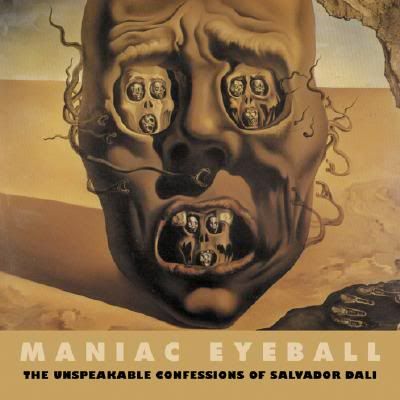
 This book is a written account of Dali dictating his life, his work, and his theories to Parinaud and it makes for a great read. It was composed in the 1970s when Dali had been a famous artist for about five decades so there's plenty to talk about and in the 300 pages there's tons of great material. There are illustrations (and photos) in here as well, hand-drawn in an interesting charcoal style. Plenty of great material on the paranoiac method in here, it's also got the only mention of Joyce by Dali that I've been able to track down. Very briefly, he shares Helena Rubinstein's account of the great writer: "nearsighted and smelling bad."
Salvador Dali by Robert Descharnes
Descharnes is Dali's main biographer and this big coffee table art book has an engaging account of the artist's life and career while also displaying big, beautiful color images of many of his paintings. This is the first Dali book I read and it remains a great one.
Dali: The Impresario of Surrealism by Jean‐Louis Gaillemin
When I visited London back on Thanksgiving 2008, there was an art museum right on the Thames River that had a big Dali exhibit. Of course I checked it out and it was great (they had some of his illustrations of The Divine Comedy which I loved). Afterwards I was in the gift shop trying to avoid getting anything (so as to conserve my meager funds), but this little book caught my attention and I couldn't resist picking it up. I devoured it on the return flight and still pick it up every now and then. It's another book about his life and career but it goes a little bit deeper into certain things like frequent motifs or his interactions with people like Jacques Lacan. In fact, it was reading this book that first put me on to the role Lacan plays in this whole thing. This is a great introductory primer to Dali and his work, I highly recommend it. It's also a very tiny book that could fit in your back pocket.
James Joyce: Portraits of the Artist in Exile edited by Willard Potts
When I was at the Joyce conference last month I often brought this book up in conversation and it seemed nobody had heard of it. I can't recommend this book highly enough. It's a collection of recollections of Joyce by a number of writers, artists, scholars, etc. that encountered him at various points in his life all throughout Europe. It's a highly entertaining book of anecdotes and there's tons of material in it that I've never read anyplace else. This might be meaningless to most people, but it reminds me of the great baseball book The Glory of Their Times.
James Joyce and the Politics of Egoism by Jean-Michele Rabaté
I've always thought this title sounds boring and overly academic but it's a great read. Rabaté is one of the best of the current Joyce scholars and he writes very well.
A Reader's Guide to James Joyce by William York Tindall
This book really came in handy when I first read A Portrait of the Artist as a Young Man. Tindall writes in a very clear and engaging style and he weaves through the mass of Joycean symbols and motifs very smoothly. My understanding of the symbols in Portrait really owes a lot to Tindall. (This is also a good book to have when reading Ulysses as he gives clear and brief breakdowns of each chapter.)
Coincidance by Robert Anton Wilson
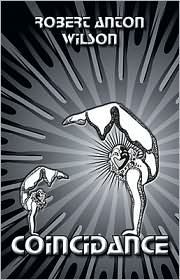
 I picked up this book very late in the research process and so I didn't include it in the actual bibliography but it certainly helped me put everything together. I've been admiring RAW for a while but this is the first book of his that I actually read and it was spectacular. It is a collection of essays dealing for the most part with instances of synchronicity all over the place in art, science, and history (there are also many essays about things that have nothing to do with synchronicity at all). He has three pieces on Finnegans Wake that are as interesting as anything I've come across yet on the Wake and which might convince you that Joyce was really working on some sort of unknown cosmic level. In one essay he details how the characters (and sigla) of the Wake coincide perfectly with the trigrams of the I-Ching and effectively ties both of those in with the composition of DNA. Really, really delicious food-for-thought. (There is also a footnote in which he claims certain parts of the Wake are influenced by Dali but I didn't find his argument convincing at all.)
Jacques Lacan by Elizabeth Roudinesco
For someone who lived such a wild, "rock-and-roll" lifestyle, I thought Roudinesco's account of Lacan was pretty boring. Her writing style was very dry and bland. Somebody at the conference asked me what's the best book on Lacan's life and, as far as I know, this is the only one and I wasn't too impressed with it.
How James Joyce Made His Name: A Reading of the Final Lacan by Roberto Harrari

Out of all the books I read for my study, this was the most difficult. The "final Lacan" is Lacan's 1975-76 seminar on le sinthome or "the symptom" and it's the one where he focuses entirely on Joyce who, he was convinced, was schizophrenic but was able to channel his madness through his art and thus remain on the safe side of sanity (although his daughter inherited the sickness and perished). That sounds easy enough to understand but Lacan illustrated his theories using the Borromean knot and twisted and tied everything in all different ways because he was at that time hanging out with a lot of mathematicians. In this book, Harrari tries to explain all of Lacan's darting thoughts but I found it impossible to follow. If you flip around the book using the index, though, it's easier to glean what info you need.
The Secret Life of Salvador Dali by Salvador Dali
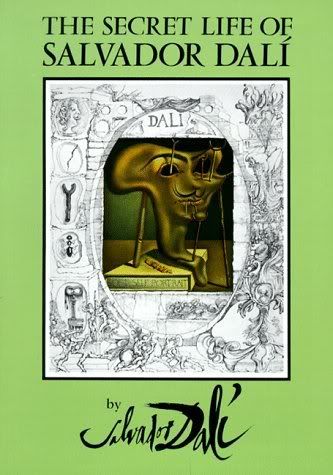
Published in 1942, this is really the definitive text to read for those interested in Dali. His writing style is superb though often flashy and exuberant as he tells the story of his life starting with intrauterine memories (seriously). The intrauterine stuff was actually very interesting, especially as compared to Stanislav Grof's research on the subject (which came decades later). As often seems to be the case, Dali's artistic intuition is so precise that it matches perfectly with later scientific findings.
Next to A Portrait of the Artist as a Young Man, this was one of the main texts for my paper and (as the point is belabored in the paper) its style of "autobiographical mythology" certainly makes for an interesting comparison with Joyce's autobiographical novel. One of the differences between them though is that Dali's book is filled with beautiful hand-drawn illustrations depicting symbols, scenes, characters, etc drawn from the story.

Although the opening pages, detailing his disputes with the Surrealists and André Breton, make for interesting reading, I didn't find this book to be all that good. Sure, Dali's writing style is always entertaining but this book is literally a diary, a daily account of a few years in Dali's life and we get to read how many times he crapped that day, what he ate, etc. It's not all boring, but I wouldn't read it again.
The Unspeakable Confessions of Salvador Dali (as told to André Parinaud)
Salvador Dali by Robert Descharnes
Descharnes is Dali's main biographer and this big coffee table art book has an engaging account of the artist's life and career while also displaying big, beautiful color images of many of his paintings. This is the first Dali book I read and it remains a great one.
Dali: The Impresario of Surrealism by Jean‐Louis Gaillemin
When I visited London back on Thanksgiving 2008, there was an art museum right on the Thames River that had a big Dali exhibit. Of course I checked it out and it was great (they had some of his illustrations of The Divine Comedy which I loved). Afterwards I was in the gift shop trying to avoid getting anything (so as to conserve my meager funds), but this little book caught my attention and I couldn't resist picking it up. I devoured it on the return flight and still pick it up every now and then. It's another book about his life and career but it goes a little bit deeper into certain things like frequent motifs or his interactions with people like Jacques Lacan. In fact, it was reading this book that first put me on to the role Lacan plays in this whole thing. This is a great introductory primer to Dali and his work, I highly recommend it. It's also a very tiny book that could fit in your back pocket.
James Joyce: Portraits of the Artist in Exile edited by Willard Potts
When I was at the Joyce conference last month I often brought this book up in conversation and it seemed nobody had heard of it. I can't recommend this book highly enough. It's a collection of recollections of Joyce by a number of writers, artists, scholars, etc. that encountered him at various points in his life all throughout Europe. It's a highly entertaining book of anecdotes and there's tons of material in it that I've never read anyplace else. This might be meaningless to most people, but it reminds me of the great baseball book The Glory of Their Times.
James Joyce and the Politics of Egoism by Jean-Michele Rabaté
I've always thought this title sounds boring and overly academic but it's a great read. Rabaté is one of the best of the current Joyce scholars and he writes very well.
A Reader's Guide to James Joyce by William York Tindall
This book really came in handy when I first read A Portrait of the Artist as a Young Man. Tindall writes in a very clear and engaging style and he weaves through the mass of Joycean symbols and motifs very smoothly. My understanding of the symbols in Portrait really owes a lot to Tindall. (This is also a good book to have when reading Ulysses as he gives clear and brief breakdowns of each chapter.)
Coincidance by Robert Anton Wilson
Jacques Lacan by Elizabeth Roudinesco
For someone who lived such a wild, "rock-and-roll" lifestyle, I thought Roudinesco's account of Lacan was pretty boring. Her writing style was very dry and bland. Somebody at the conference asked me what's the best book on Lacan's life and, as far as I know, this is the only one and I wasn't too impressed with it.
How James Joyce Made His Name: A Reading of the Final Lacan by Roberto Harrari

Out of all the books I read for my study, this was the most difficult. The "final Lacan" is Lacan's 1975-76 seminar on le sinthome or "the symptom" and it's the one where he focuses entirely on Joyce who, he was convinced, was schizophrenic but was able to channel his madness through his art and thus remain on the safe side of sanity (although his daughter inherited the sickness and perished). That sounds easy enough to understand but Lacan illustrated his theories using the Borromean knot and twisted and tied everything in all different ways because he was at that time hanging out with a lot of mathematicians. In this book, Harrari tries to explain all of Lacan's darting thoughts but I found it impossible to follow. If you flip around the book using the index, though, it's easier to glean what info you need.
Thursday, July 21, 2011
The McLuhan Centennial

Today is the 100th birthday of the great influential thinker Marshall McLuhan. McLuhan died back in 1980 but his influence has exploded over the last decade or so as most of what he used to talk about in the 1960s has come to fruition lately. I spoke about this in two recent posts reviewing Douglas Coupland's excellent new biography of McLuhan.
Ever since reading that book, I've been devouring all the McLuhan material I can find albeit without picking up any of his books yet (I'm already far behind on a bunch of other books). I can't quite pinpoint what it is exactly that so fascinates me about McLuhan but his intense erudition and his nonchalant, almost humorous way of presenting it certainly appeals to me. He was also a devout student of Joyce, especially Finnegans Wake and he often brings up the Wake in his writings, lectures, interviews, etc. He was also a sort of modern public mystic, one with the physical appearance of a 50-something-year-old English professor (which is exactly what he was). For someone who was technically a literary scholar writing books about the future of technology, he was also very much a poet, an artist.
There is an audio clip of an interview with Robert Anton Wilson that I often listen to where he discusses Finnegans Wake at length and in the opening he describes James Joyce as "one of the greatest archeologists who ever lived." The more I look into McLuhan, the more that quote resonates in my mind and I've been starting to see McLuhan as a sort of successor to Joyce in that respect, a perfect connecting link between Joyce (who flourished in the first three decades of the 20th century) and the current times.
I need not try to expand on all of that here as the 100th anniversary of his birth (his birthday is actually just three days after mine, I turned 26 on Monday) has brought about a whole slew of interesting pieces and profiles all over the interwebs.
A couple weeks back, this big article appeared in Toronto Life completed with photos and an engaging write-up of his rise to fame. Here's a quote from it:
McLuhan didn’t really care if he was right. Right or wrong and good or bad had nothing to do with it. He was, he often claimed, not a moralist but an observer. An explorer, not an explainer. He was too fond of the paradox and the pun, always more of an imagistic and satiric poet. He was not a sociologist, nor was he, strictly speaking, a futurist. “If you really are curious about the future,” he said on CBC’s Ideas, “just study the present.”That last part brings to mind a quote from Wyndham Lewis that I recently came across (no surprise since McLuhan was buddies with Lewis for a while): "The artist is always engaged in writing a detailed history of the future because he is the only person aware of the nature of the present."
The Toronto Star also has a couple of pieces about him.
Douglas Coupland, author of the aforementioned book You Know Nothing of My Work!, wrote a piece on MM in the Guardian.
The American Spectator has an interesting piece talking about McLuhan and Mark Zuckerberg.
And, of all the McLuhan pieces I've read today, the best one is this blog post by Nicholas Carr.
A few more McLuhan links I'd like to share:
Friend of this blog Bobby Campbell created an illustrated article on McLuhan a few years back called "The State of the Art." (Hat tip to the Maybe Logic blog.)
I think I've already linked to this before but here is a great article about McLuhan and Giordano Bruno.
And here is a really good interview McLuhan did back in 1971 (I actually burned this on CD and have listened to it during my daily commute---McLuhan starts off slow but then takes off). This is Part 1 of 6:
Thursday, July 14, 2011
"Thought Through My Eyes": Epilogue, Part 2
"If you like the epilogue look long on it"
- Ulysses, pg 213
One of the important facets of my paper that I really didn't get to delve into as much as I would've liked is Dali's paranoiac-critical method. This is also probably the most complex part of the whole paper and the part I found most difficult to write (and talk) about. Here I would like to expand on Dali's philosophies and percepts with regard to paranoia and also delve into how this relates to the title for my essay.
In Part 2 of my paper, the paranoiac-critical method is first described in what I think is the simplest and most understandable manner: looking at a cloud and clearly observing a rabbit. We do this kind of thing all the time. Recently, I was sitting outside having lunch with my lady at one of Austin's many great food trucks, and we were looking at an enormous conglomeration of what turned out to be thunderhead clouds. They were in motion, morphing into different shapes so that first we could clearly see a wolf, then a woman's face, and so on. One of us would perceive something and point out each little wrinkle to the other and they would see the same image too.
In 1929, when he was about my age (25), Dali started to realize something special about this phenomenon of perception. He became aware of an exceptional ability to look at an arrangement and perceive something altogether different. His mind could look at objects and create its own interpretation. He once looked down at a pile of envelopes and papers on a desk and saw a perfect reproduction of one of Picasso's faces. Turns out it was just a photograph angled a certain way. He later painted this same scene in The Paranoiac Visage. As he delved deeper into this process of perceptive organization, it became clear to him that this was a crack on the supposedly smooth surface of objective reality. If one can systematically and thoroughly outline one's own unique subjective obsessions or unconscious material onto the outside world, then the concept of an objective reality starts to melt down (this image of soft, melting, or amorphous objects is probably Dali's most well-known motif). During this time he published his first essay on the subject of paranoia entitled The Rotten Donkey and laid out the basics of this his theory (which, he would later admit, he still was only beginning to comprehend himself):
*As described by Stephen in the Proteus chapter, "veil of space with coloured emblems hatched on its field." (Ulysses pg 48)
Returning to the example of clouds, the cloud is a big puffy, soft, shapeless form as in a thought cloud, the image most often used in comic books to denote the workings of a character's mind. When staring at a cloud, this fluffy ambiguous form can be organized by our minds into a familiar shape, symbol, signifier. Dali explains: "Paranoiac systematization influences the real and orients it, predisposes it, and implies lines of force that coincide with the most exact of truths." We can see Dali's fascination with the anamorphic softness of clouds in many of his paintings including those which I posted in Part 1 of this epilogue. Morphing clouds are essentially the most eye-grabbing and important aspect of The Temptation of St. Anthony, the painting analyzed in the original essay.
We see the scene from the perspective of St. Anthony, the ascetic who's been fasting in the desert and now perceives the clouds morphing into enormous and nightmarish temptations (notice how closely the horse's chest resembles the clouds on the right). In Flaubert's novel The Temptation of St. Anthony, the scenes Anthony sees often involved people from his life. This image is thus an exemplary scene of paranoia because this is all emanating from the character's own mind. We will come back to this shortly.
If you take a look at most books of Dali's paintings (and there are tons of them), they usually bring up Dali's paranoiac theory in reference to some of his works that feature visual tricks or trompe l'oeil ("trick the eye" in French) techniques. During the decades of his deepest paranoiac explorations (1930s-40s) Dali produced about thirty sketches and paintings that invoke this technique, here is one of the most famous examples:
There are many more images like this from Dali including this one which is one of my favorites:
The culmination of this trick-of-the-eye technique is probably The Endless Enigma, in which the image can take on any number of forms depending on the observer.
This multiple-image effect, which Dali calls "anamorphic hysteria," is just one example of the paranoiac method. Dali's inquiry into paranoia certainly goes much deeper than this. As he discusses in the book The Unspeakable Confessions of Salvador Dali (pg. 140-144), the word "paranoia" is defined not in the way we commonly think of the word now---fear that the universe is plotting against you--- but in a much broader and more scientific sense as "the phenomenon of delirium manifested in a series of systematic interpretive associations." The "critical" part of paranoiac-critical is, as he says, for the artist to "play the part of a photographic developer" and Dali would self-induce a hallucinatory paranoid state (without drugs, "I don't take drugs, I am drugs" as Dali used to say) and spontaneously record the delirious associations, witnessing the "clash of systematization with the real" and the inevitable "evolution and production" that occurs in the exchange between subjective and objective. There is supposed to be a veil or a wall between these two (subjective and objective, psychological and physical, etc) but they are actually shaping each other. As Eugene de Klerk puts it in his excellent essay on this subject, "If one is able to remain critically aware while inducing paranoia, one can open up the play of representations which shape perceptual reality."
We start to see the importance of this tool for Dali; he's not simply trying to play visual tricks on you, he's going toe to toe with the accepted principles of our very existence. "It is time for us, in the history of thought, to see that the real as given to us by rational science is not all of the real," he states.
It occurred to me during my studies on this stuff that another image I have hanging on my wall is actually a perfect representation of this idea. If reality itself is a sort of fluid, morphing substance emanating and reflecting our own selves, then M.C. Escher's glass sphere can be seen as a proverbial droplet of this substance, reflecting and staring right back at us.
It is through all these considerations that I came to think about "Proteus," the third episode of Ulysses. It's the episode where readers usually gives up on the book because we get a firsthand look at Stephen's inner attempt to transcend the "limits of the diaphane," the veil of existence. This is perhaps my favorite episode in the book and one of my favorite pieces from Joyce. It is from the opening sentence that my title is derived:
Ineluctable modality of the visible: at least that if no more, thought through my eyes.
By the very act of perception we are stuck in this modality of visible space, inescapable or "ineluctable" as it is (the word "ineluctable" derives from Latin and literally means "not to struggle against"). The "ineluctable modality of the ineluctable visuality" he says later on. On page 48 he ruminates, "I throw this ended shadow from me, manshape ineluctable, call it back. Endless, would it be mine, form of my form?"
Reality or "space: what you damn well have to see" (Ulysses pg 186) is created by our looking at it through those bulbous organs of ours, eyes, which Dali eloquently considers:

- Ulysses, pg 213
One of the important facets of my paper that I really didn't get to delve into as much as I would've liked is Dali's paranoiac-critical method. This is also probably the most complex part of the whole paper and the part I found most difficult to write (and talk) about. Here I would like to expand on Dali's philosophies and percepts with regard to paranoia and also delve into how this relates to the title for my essay.
In Part 2 of my paper, the paranoiac-critical method is first described in what I think is the simplest and most understandable manner: looking at a cloud and clearly observing a rabbit. We do this kind of thing all the time. Recently, I was sitting outside having lunch with my lady at one of Austin's many great food trucks, and we were looking at an enormous conglomeration of what turned out to be thunderhead clouds. They were in motion, morphing into different shapes so that first we could clearly see a wolf, then a woman's face, and so on. One of us would perceive something and point out each little wrinkle to the other and they would see the same image too.
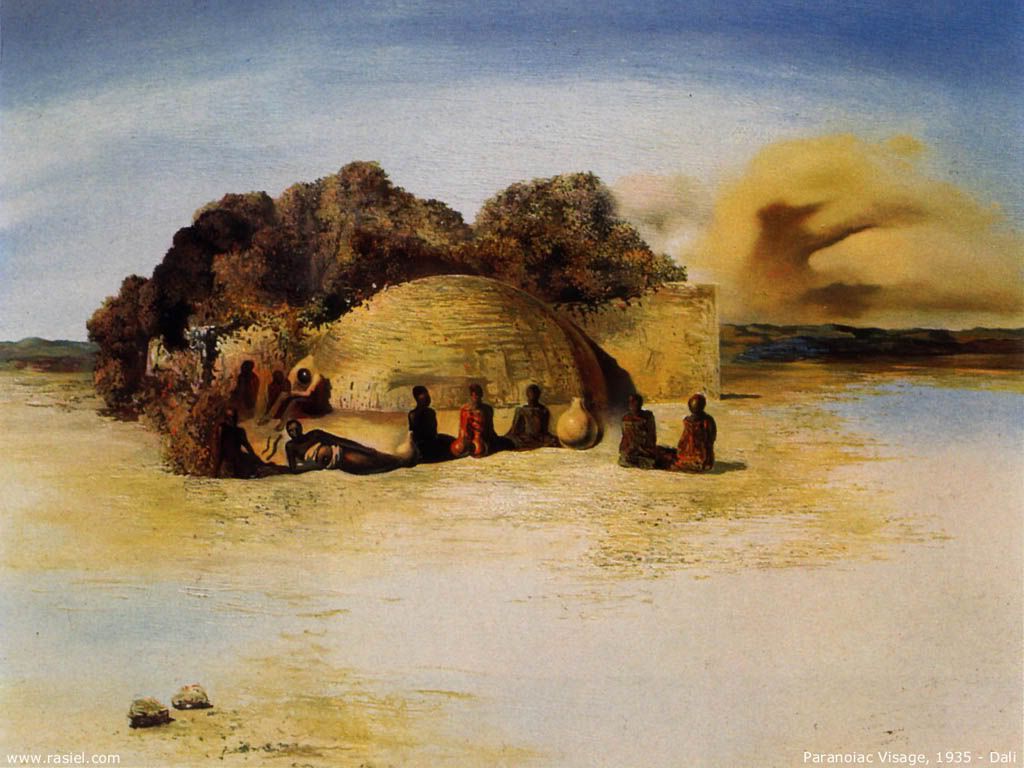 |
| The Paranoiac Visage (1935) |
As far removed as possible from the sensory phenomena that can be thought of as more or less connected to hallucination, paranoid activity always makes use of verifiable, recognizable materials. It is enough for someone in the grip of an interpretive delirium to link the meanings of heterogeneous paintings that happen to hang on the same wall for the real existence of such a link to become undeniable. Paranoia uses the external world to validate an obsessive idea, with the troubling result of validating its reality to others. The reality of the external world serves as illustration and proof of the paranoid idea and is subservient to the reality in our minds.(emphasis mine)Before quantum physics asserted to us that nothing really "exists" without an observer, here is Dali hinting at the fact that the external world is "subservient to the reality in our minds." What we are getting at here is a realization that what we see before us and perceive as reality is actually an ambiguous, amorphous flux upon which we project our own being, our own inner symbols and organizing principles.* Under normal conscious circumstances, this fact is suppressed and denied as irrational. But, in a state of delirium when irrational phenomena dominates one's view of everything, suddenly the whole outside world can be seen to mesh with one's own subjective thoughts (i.e., paranoia). What Dali was trying to show is that the irrational perspective presents a more accurate picture of reality and this became a conquest for him, "The Conquest of the Irrational," an attempt to discredit ordinary reality and free humanity from its collective madness, declared "in the service of Revolution" in The Rotten Donkey essay.
*As described by Stephen in the Proteus chapter, "veil of space with coloured emblems hatched on its field." (Ulysses pg 48)
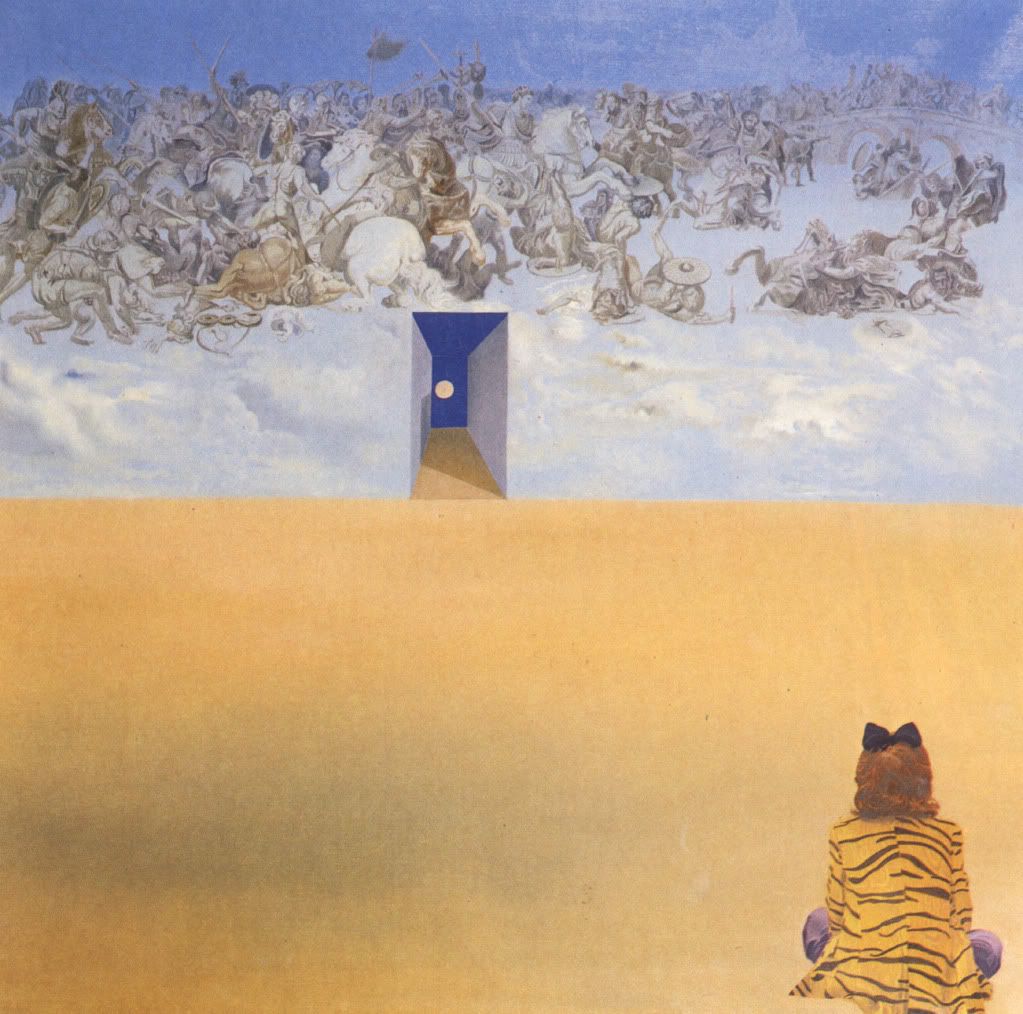 |
| Battle in the Clouds (1974) |
 |
| The Temptation of St. Anthony (1946) |
We see the scene from the perspective of St. Anthony, the ascetic who's been fasting in the desert and now perceives the clouds morphing into enormous and nightmarish temptations (notice how closely the horse's chest resembles the clouds on the right). In Flaubert's novel The Temptation of St. Anthony, the scenes Anthony sees often involved people from his life. This image is thus an exemplary scene of paranoia because this is all emanating from the character's own mind. We will come back to this shortly.
* * *
"He seeks fluid, wavelike forms that will express
immutable laws through infinite mutations,
the clarity of eternal forms through their
opaque but ineluctable modalities."
- J. Mitchell Morse discussing
the Proteus episode in
James Joyce's Ulysses: Critical Essays, pg. 31
"He seeks fluid, wavelike forms that will express
immutable laws through infinite mutations,
the clarity of eternal forms through their
opaque but ineluctable modalities."
- J. Mitchell Morse discussing
the Proteus episode in
James Joyce's Ulysses: Critical Essays, pg. 31
If you take a look at most books of Dali's paintings (and there are tons of them), they usually bring up Dali's paranoiac theory in reference to some of his works that feature visual tricks or trompe l'oeil ("trick the eye" in French) techniques. During the decades of his deepest paranoiac explorations (1930s-40s) Dali produced about thirty sketches and paintings that invoke this technique, here is one of the most famous examples:
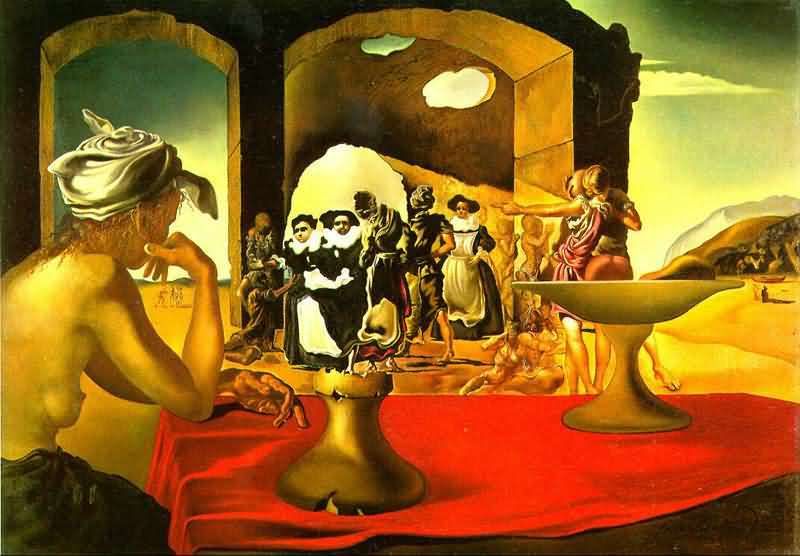 |
| Slave Market with the Disappearing Bust of Voltaire (1940) |
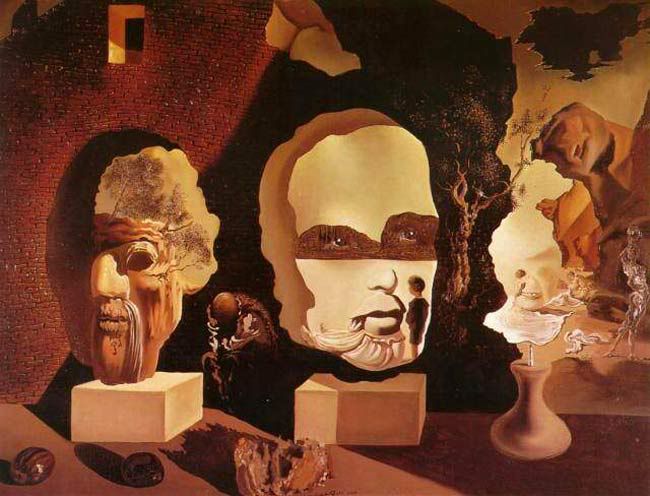 |
| The Three Ages (1940) |
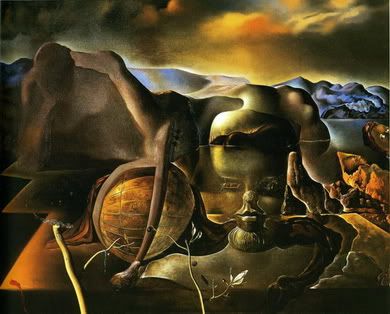 |
| The Endless Enigma (1938) |
We start to see the importance of this tool for Dali; he's not simply trying to play visual tricks on you, he's going toe to toe with the accepted principles of our very existence. "It is time for us, in the history of thought, to see that the real as given to us by rational science is not all of the real," he states.
The world of logical and allegedly experimental reason, as nineteenth-century science bequeathed it to us, is in immense disrepute. The very method of knowledge is suspect...In the end, it will finally be officially recognized that reality as we have baptized it is a greater illusion than the dream world. Following through on my thought, I would say that the dream we speak of exists as such only because our minds are in suspended animation; the real is an epiphenomenon of thought, a result of non-thought, a phenomenon of amnesia.Whoa!
The true real is within us and we project it when we systematically exploit our paranoia, which is a response and action due to the pressure---or depression---of cosmic void.The same paranoiac phenomenon that systematically organizes ambiguous images into meaningful associations through our eyes is also the way we create our subjective individual selves, seemingly separate from all that we see. The space that we see and occupy is also being unconsciously created in this same manner. As Joyce writes: "We walk through ourselves, meeting robbers, ghosts, giants, old men, young men, wives, widows, brothers-in-love. But always meeting ourselves." I was recently listening to an old interview with Marshall McLuhan who touched on this as well, he said that primitive non-literate man doesn't think of the eye as a receptor but as a creator; it is creating that which it sees. The same idea comes from the observations of modern physics, which state that a particle is in a state of unsure probabilistic flux until it is observed and then takes on a certain form.
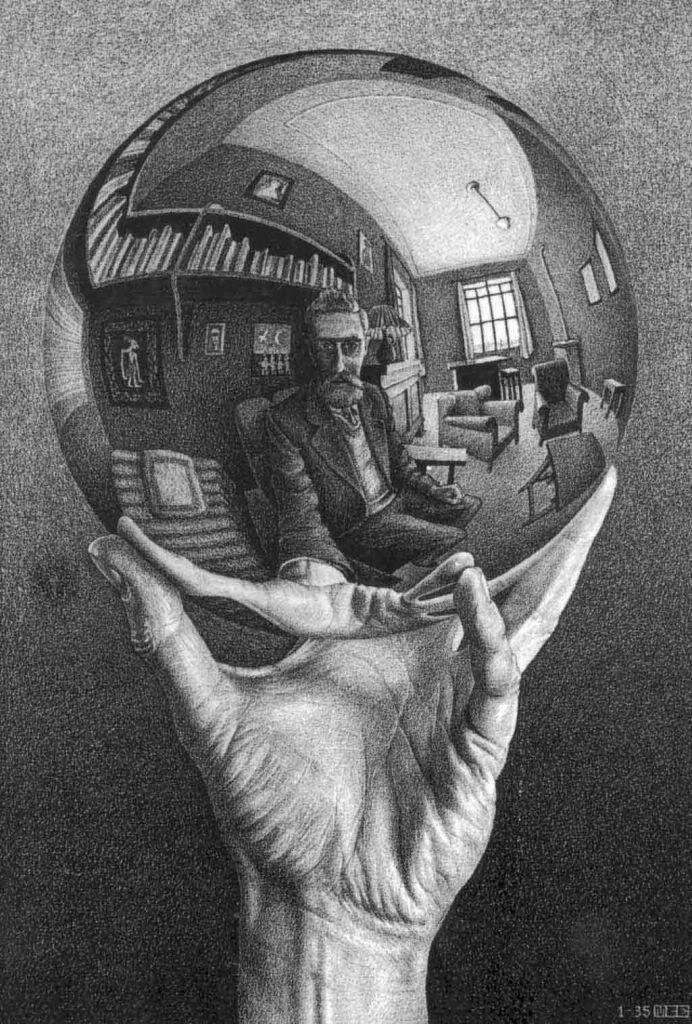 |
| Reflecting Glass Sphere (1935) by M.C. Escher |
It is through all these considerations that I came to think about "Proteus," the third episode of Ulysses. It's the episode where readers usually gives up on the book because we get a firsthand look at Stephen's inner attempt to transcend the "limits of the diaphane," the veil of existence. This is perhaps my favorite episode in the book and one of my favorite pieces from Joyce. It is from the opening sentence that my title is derived:
Ineluctable modality of the visible: at least that if no more, thought through my eyes.
By the very act of perception we are stuck in this modality of visible space, inescapable or "ineluctable" as it is (the word "ineluctable" derives from Latin and literally means "not to struggle against"). The "ineluctable modality of the ineluctable visuality" he says later on. On page 48 he ruminates, "I throw this ended shadow from me, manshape ineluctable, call it back. Endless, would it be mine, form of my form?"
Reality or "space: what you damn well have to see" (Ulysses pg 186) is created by our looking at it through those bulbous organs of ours, eyes, which Dali eloquently considers:
What is the eye? A glob of humors, a knot of muscles, a film of flesh and nerves irrigated by a flow of acid? Beneath that appearance lurk galaxies of microscopic electrons, agitated by an impalpable wave, itself the fluid of a quasi-immaterial energy. At what level then, the real? The truth to me, to Dali, is in the magnifying-glass I aim at the world, called my eye, through which there takes place an exchange that for that moment is known as real. (pg. 144 Unspeakable Confessions)This whole emphasis on the eye and visual perception is interesting also because Joyce actually suffered from terrible eye problems throughout his adult life. As his friend Louis Gillet gruesomely described it in an obituarial essay:
For twenty years, the great poet was half-blind; the left eye was lost and in the other remained only a flap of retina. Reading and writing was torture. The wretched man retained a gleam of light thanks only to twenty operations---each time a very cruel martyrdom. I still see him, in order to decipher a text, placing the paper sideways and bringing it into the narrow angle where a ray of his ruined sight still subsisted. (Portraits of the Artist in Exile, pg. 168)
* * *
"guide them through the labyrinth of
their samilikes and the alteregoases
of their pseudoselves...
from loss of bearings deliver them"
- Finnegans Wake, pg. 576
Going back to that first line of Proteus again, the "ineluctable modality" also feels to me like a good description of a labyrinth as well and, of course, Joyce bestowed the name Dedalus upon his hero so as to invoke the symbolism of the architect Daedalus who, himself, built the labyrinth on the island of Crete and was also trapped in it because of its complexity. In A Portrait of the Artist as a Young Man, the metaphor has to do with Stephen Dedalus trying to escape the oppressive atmosphere of Ireland to fly to mainland Europe just as Daedalus seeks to fly from the island of Crete to mainland Greece. Here in Proteus, this most metaphysical of chapters in the sequel to Portrait, Stephen is trying to escape the very labyrinth of space and existence.

This ties back to Dali again as he composed a number of essays on paranoia (including a piece alongside Jacques Lacan) in the surrealist art review called Minotaure, a title that conjures the beastly creature that was housed inside the labyrinth on Crete to keep people from escaping. He did clearly think of this paranoiac creation of existence in the sense of a labyrinth we've created and trapped ourselves in, indeed, he states in the aforementioned Unspeakable Confessions book: "We are at the heart of a labyrinth and can find our way while becoming labyrinths ourselves." Like many of Dali's profundities, that sounds like nonsense, but what he is referring to (intuitively, I assume) is that our souls are labyrinths. We exist in a labyrinth and we ourselves are also labyrinthine, this latter fact has been explored for centuries in the symbolic usage of mandalas to represent the soul and this symbol is still used in many modern psychotherapeutic practices to help people bring their psyches into balance. The labyrinth is essentially a mandala and vice-versa.
Now, to finally get us out of this labyrinth of an essay, let us conclude by once again considering the original point of the entire paper (if you haven't read it yet, contact me and I will send you a copy). What got this all started was a rather peculiar interpretation I made of Dali's painting The Temptation of St. Anthony in which I systematically compared it to the material in Joyce's Portrait of the Artist. The paper has elicited a positive reaction from those that have encountered it and on a few occasions folks have commented to me that it would really solidify the whole thing if I could identify a "smoking gun" that proves once and for all that Dali painted St. Anthony with Joyce on his mind. I would argue that such a thing isn't necessary. The piece-by-piece interpretation of connections/resonances with Portrait is interesting in its own right because it was initially a natural, organic, unwitting example of the paranoiac-critical method in action.
Not in the sense of a simple trick of the eye, no, I didn't stare at the painting and realize it formed a picture of Joyce's face or anything like that (though the Martello Tower does appear to be there in the background). Instead, under a spell of thoughts and speculations on the symbols and motifs of Joyce's work, I suddenly was able to look at the painting of a tempted desert monk and associate all of the characters and objects with the object of my obsession at that moment. The resonances and connections I made can, I believe, probably stand up on their own but even beyond that, the paranoiac analysis led to two new ideas on the painting: that it is largely autobiographical in scope, and that it exemplifies the artist's famous paranoiac-critical method.
Subscribe to:
Posts (Atom)